A checklist is a short, ordered list of the things that must not be forgotten. Pilots run them before every flight, surgical teams before every operation, and they work for the same reason in an office, a workshop, or a kitchen — memory is unreliable under pressure, and a list isn’t. The free templates below are editable MS Word and Excel files, and beneath them you’ll find what separates a checklist people actually use from one that gets ignored, plus how to add real clickable checkboxes.
Two Kinds of Checklist
Before writing one, decide which of these you’re making — because they’re used at different moments and written differently:
- Read-Do. You read each item, then do it. Suited to unfamiliar procedures, emergencies, and anything where the sequence matters and the person may not know it by heart — a shutdown procedure, a first-time setup, an incident response.
- Do-Confirm. You do the work from memory and expertise, then pause and run the checklist to confirm nothing was missed. Suited to routine work performed by people who know it well — opening a shop, closing a site, preparing a delivery.
Getting this wrong is a common reason checklists get abandoned. Hand an experienced person a Read-Do checklist for work they do daily and they’ll stop using it within a week, because it slows them down and implies they don’t know their job. Give a newcomer a Do-Confirm checklist for a procedure they’ve never performed and they’ll miss steps it never occurred to them to take.
What Makes a Checklist Work
1. Keep it short. Five to nine items per section is the working rule. A checklist is not a procedure manual — it holds the steps that are critical and commonly missed, not every step in the process. A thirty-item list gets skipped entirely, which is worse than a five-item list that gets run.
2. Make every item specific and verifiable. This single rule fixes most bad checklists. “Check equipment” isn’t an item — two people would tick it having done different things. “Confirm extinguisher gauge reads green” is. Ask of each line: could two people disagree about whether it’s done? If so, rewrite it.
3. Decide the pause point. A checklist needs a moment in the workflow where it’s run — before opening, after loading, before the vehicle moves. Without a defined point it becomes a document people mean to use rather than one they do.
4. Put the critical items where they can’t be skipped. If one item matters more than the rest, it doesn’t belong buried at position eleven.
5. Name who runs it. A checklist everyone is responsible for is one nobody completes. One named role per checklist, with a signature or initials line if it matters.
6. Date it and version it. Procedures change; checklists get photocopied and stuck on walls for years. A version and date in the footer tells you whether the copy in someone’s hand is current.
Checklist Example
An opening checklist for a small café — a Do-Confirm list, run once by a named person, short enough to complete in three minutes:
|
MORNING OPENING CHECKLIST | Harbour Street Café Run by: duty supervisor · Before unlocking the front door · v3, updated Aug 2026 |
|
| SAFETY | |
| ? | Fire exit clear and unlocked, both doors |
| ? | Fridge temperatures recorded — chiller below 5°C, freezer below ?18°C |
| ? | Floor dry, wet-floor sign stowed |
| EQUIPMENT | |
| ? | Coffee machine on, pressure gauge 9 bar, first shot pulled and discarded |
| ? | Card reader powered and test transaction completed |
| ? | Till float counted — £150 confirmed |
| FRONT OF HOUSE | |
| ? | Today’s specials board written and displayed |
| ? | Milk stock checked against the day’s forecast — order placed if under 12 litres |
|
Completed by: ____________________ Time: __________ Date: __________ Anything not ticked: note the reason and tell the manager before opening. |
|
Look at the wording. Not “check fridges” but “chiller below 5°C, freezer below ?18°C.” Not “count the till” but “£150 confirmed.” Every line is something two people would agree on, which is what makes ticking it mean anything. And the last line tells the user what to do when an item can’t be ticked — the situation most checklists ignore, and the one where they matter most.
Free Checklist Templates in MS Word and Excel
Each template below is editable — replace the placeholder items with your own, keep the sections short, and print or save a master copy.
Sectioned Checklist Template

Grouped headings with checkbox items beneath and a sign-off line at the foot — the layout shown above, suited to opening, closing, and inspection routines.

Simple Checklist Template

A plain single-column list with checkboxes — for straightforward tasks where grouping isn’t needed.
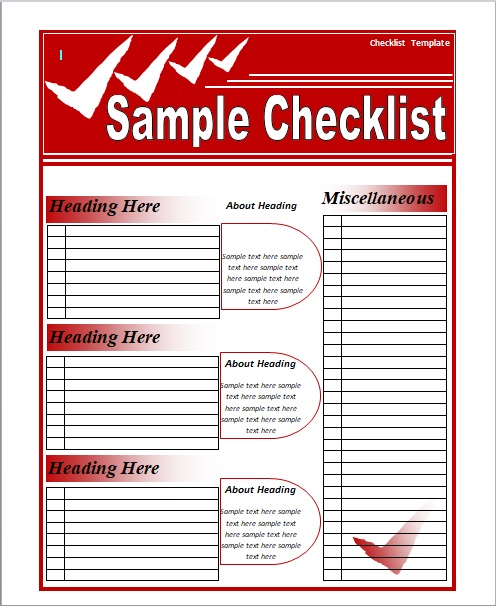
The download button for this Checklist Template 03 is given below.

The download button for this Checklist Template 04 is given below.

The download button for this Checklist Template 05 is given below.

The download button for this Checklist Template 06 is given below.

The download button for this Checklist Template 07 is given below.

The download button for this Checklist Template 08 is given below.

The download button for this Checklist Template 09 is given below.
Adding Checkboxes in Word and Excel
Two different needs here, and they need different methods.
Printable checkboxes in Word — a box you tick with a pen. Insert ? Symbol ? More Symbols, choose the Wingdings font, and pick the empty box character. Better still, make it a bullet: select your list, click the arrow beside the bullet button, choose Define New Bullet ? Symbol, and pick the same Wingdings box. Every item in the list then gets one automatically.
Clickable checkboxes in Word — a box you tick on screen. You need the Developer tab first: File ? Options ? Customize Ribbon, then tick Developer in the right-hand list. On that tab, click the Check Box Content Control to insert a box that toggles when clicked.
Clickable checkboxes in Excel — enable the Developer tab the same way, then Developer ? Insert ? Check Box (Form Control) and draw it in a cell. Right-click it, choose Format Control, and set a cell link to a cell (say, a hidden column) — that cell then shows TRUE or FALSE as the box is ticked. With that in place you can count completions:
=COUNTIF(D2:D20,TRUE) ? items completed
=COUNTIF(D2:D20,TRUE)/COUNTA(A2:A20) ? percentage complete
Format that second one as a percentage and you have a checklist that reports its own progress — useful for anything tracked across a team.
Types of Checklist
- Daily and routine — opening, closing, shift handover, end-of-day. Do-Confirm, short, same list every time.
- Task checklists — the steps within one piece of work. Often Read-Do the first few times and Do-Confirm afterwards.
- Process and procedure — multi-stage work with hand-offs between people. Group by stage, and name the role responsible for each group.
- Inspection and safety — equipment checks, site walks, vehicle inspections. These need verifiable readings rather than judgements, and usually a signature and date.
- Onboarding — everything a new starter needs in week one. The classic case where nobody remembers the full list, which is exactly what a checklist is for.
- Pre-launch and go-live — the checks before something goes public or into service. Write it while planning, not on the day.
- Packing and preparation — travel, events, deliveries. For food shopping specifically, our grocery list templates are organized by aisle; for gift and event shopping, see the shopping list templates.
For ongoing work rather than repeatable routines, a task list or a monthly to-do list is usually the better tool — a checklist is for the same sequence run repeatedly, not for a changing set of jobs.
Testing and Revising
Every first-draft checklist is too long, and the only way to find out which items earn their place is to use it.
Run it in real conditions a few times, with the people who’ll actually use it, and watch what happens. Items that get ticked without being checked should be cut or rewritten — they’re either obvious or unverifiable. Items that consistently cause a pause are the ones doing the work. And anything people find themselves doing that isn’t on the list should be added, if it’s critical.
Then keep revising it. A checklist that’s never changed since it was written is usually one nobody uses, or one describing a process that has since moved on. Put a version number and date in the footer, review it when the procedure changes, and make it easy for the people running it to suggest amendments — they’re the ones who know which lines are dead weight.
Frequently Asked Questions
What makes a good checklist?
Short sections of five to nine items, each one specific and verifiable, with a defined moment in the workflow where the list is run and a named person responsible. It should contain the critical and commonly missed steps, not every step in the process.
What is the difference between a Read-Do and a Do-Confirm checklist?
With Read-Do you read each item then perform it — right for unfamiliar procedures and emergencies. With Do-Confirm you complete the work from memory then run the list to check nothing was missed — right for routine work by experienced people.
How do I insert a checkbox in Word?
For a printable box, use Insert ? Symbol with the Wingdings font, or set it as a custom bullet so every list item gets one. For a clickable box, enable the Developer tab under File ? Options ? Customize Ribbon, then use the Check Box Content Control.
How do I make a checklist with checkboxes in Excel?
Enable the Developer tab, then Developer ? Insert ? Check Box (Form Control). Right-click the box, choose Format Control, and set a cell link so the linked cell shows TRUE or FALSE. COUNTIF on those cells then counts how many items are complete.
How long should a checklist be?
Short enough to run without anyone resenting it — five to nine items per section, and ideally a page or less overall. Long checklists get skipped entirely, and a skipped checklist catches nothing.
What’s the difference between a checklist and a to-do list?
A checklist is the same sequence run repeatedly — an opening routine, an inspection, an onboarding process. A to-do list is a changing set of one-off tasks. If you’d print the same list again next week, it’s a checklist.
Who should sign off a checklist?
Whoever ran it, by name or initials, with the date and time — particularly for safety and inspection checks where the record may be needed later. Add a line telling users what to do when an item can’t be ticked; that’s the situation checklists most often fail to address.

Pete Smith is a Business Management graduate and a passionate advocate for practical, accessible resources that empower professionals and entrepreneurs to succeed. With a strong foundation in organizational strategy and operational efficiency, Pete combines academic knowledge with real-world insights to simplify complex business processes. He is the creator behind a growing online platform dedicated to offering free, high-quality documents, templates, and actionable tips designed to save time and improve productivity.