A household budget is a budget with more than one person in it — which makes it a different problem from a personal one. The numbers are only half of it; the other half is agreeing how two incomes and two sets of habits meet in one set of bills. The free templates below are built for that: two income columns, shared and individual expenses kept apart, and space for the costs that come with children. For the month-by-month method itself, see our monthly budget templates; for annual planning, irregular income, and savings goals, see our personal budget templates.
How to Split Shared Expenses
This is the question most couples are actually asking when they look for a household budget. Three arrangements are common, and none of them is automatically right:
- Fully pooled. All income goes into one account, all expenses come out of it, and personal spending is agreed as a category rather than owned by anyone. Simplest to run, and the fairest when incomes are very unequal — but it needs enough trust that neither partner feels they have to justify small purchases.
- Fully separate, with contributions. Each partner keeps their own account and pays an agreed amount into shared costs. Preserves independence, works well for couples who came together later or keep separate finances by choice, and requires a clear rule about what counts as “shared.”
- Hybrid — the most common in practice. A joint account for shared expenses (housing, utilities, groceries, children, insurance), funded by both, plus individual accounts for personal spending that nobody has to explain. It gives you one place where the bills live and one place where autonomy lives.
The proportional split. If you’re contributing to shared costs rather than pooling everything, splitting 50/50 quietly penalizes the lower earner. Proportional contribution usually feels fairer: if one partner takes home 60,000 and the other 40,000, they contribute 60% and 40% of shared costs. On a shared total of 2,500 a month, that’s 1,500 and 1,000 — and both partners are left with the same proportion of their income for personal spending and saving, which is the outcome most people actually mean by “fair.”
A Household Budget with Two Incomes
Here’s the structure the templates below use — shared costs funded jointly, individual spending kept visible but separate:
| INCOME (take-home) | ||
| Partner A | 3,000 | 60% |
| Partner B | 2,000 | 40% |
| Total household income | 5,000 | |
| SHARED EXPENSES | ||
| Rent / mortgage | 1,300 | |
| Utilities, internet, phone | 300 | |
| Groceries & household | 600 | |
| Childcare & school | 450 | |
| Transport & insurance | 350 | |
| Total shared | 3,000 | A: 1,800 B: 1,200 |
| INDIVIDUAL & SAVINGS | ||
| Personal spending (each) | 600 | A: 360 B: 240 |
| Joint savings & emergency fund | 900 | |
| Irregular-expense set-aside | 500 | |
| Remaining | 0 | |
Two things make this a household budget rather than a personal one: the shared total is split proportionally to income (1,800 and 1,200), and each partner keeps a personal spending line that requires no explanation. That second row prevents more arguments than any spreadsheet formula.
Free Household Budget Templates
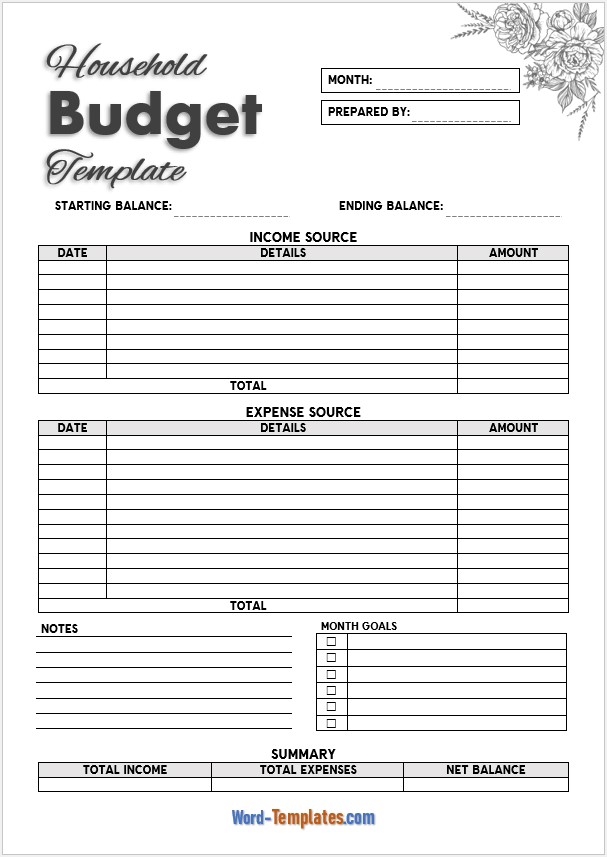
Each template below is editable — enter both incomes and your shared costs, and the totals do the rest. Formats are noted per file.
Household Budget Template with Two Income Columns

The layout shown above — both incomes, shared expenses with a proportional split, and individual spending lines.

Family Budget Template with Children’s Categories

Adds childcare, school fees, activities, and children’s clothing as their own lines, so family costs are visible rather than buried in “miscellaneous.”

Family Expense Categories Worth Separating
Households with children have costs that behave differently from everything else, and burying them in general categories hides what’s actually happening:
- Childcare and school — nursery fees, after-school care, tuition, uniforms, books, trips. Often the single largest household line after housing, and the one most likely to change at the start of a school year.
- Activities — sports clubs, music lessons, equipment. These arrive in termly or seasonal lumps rather than monthly, so they belong in the irregular-expense set-aside.
- Children’s clothing — a separate line from adult clothing, because children outgrow things on a schedule adults don’t. Budgeting it monthly stops the twice-yearly shock.
- Medical and dental — routine appointments plus a buffer. With children, the buffer gets used.
- Gifts and celebrations — birthday parties, other children’s parties, festivals. Small individually, substantial annually, and almost always forgotten in a first budget.
The Monthly Money Meeting
The habit that makes household budgets survive isn’t a better spreadsheet — it’s twenty minutes a month with both partners at the table. Pick a fixed date, just after payday. Go through three things: what actually happened last month against what you planned, anything unusual coming up in the next month, and one decision if there’s one to make. Keep it short and keep it scheduled, because the alternative is discussing money only when something has gone wrong — which is how a budgeting problem turns into an argument about something else.
Two rules that help: whoever didn’t overspend doesn’t get to run the meeting as a prosecution, and the personal spending lines are off-limits for review. They exist precisely so that not every purchase is a joint decision.
Frequently Asked Questions
How should couples split household expenses?
Three common arrangements: pool everything, keep finances separate and contribute an agreed amount to shared costs, or run a hybrid with a joint account for shared bills and individual accounts for personal spending. Where incomes differ significantly, contributing in proportion to income is generally fairer than splitting 50/50.
Should couples have joint or separate bank accounts?
Either works — the hybrid arrangement suits most households: a joint account that shared bills are paid from, plus individual accounts for personal spending. What matters more than the account structure is that both partners can see the shared budget and agree how much goes into it.
What should a household budget include?
Both incomes, shared expenses (housing, utilities, groceries, transport, insurance, children), individual spending allowances, savings and debt payments, and a set-aside for irregular annual costs. Keeping shared and individual expenses in separate blocks is what distinguishes a household budget from a personal one.
How much of household income should go on housing?
A commonly cited guideline is around 30% of take-home pay, but it’s a rough marker rather than a rule — in high-cost cities housing routinely runs higher, which simply means other categories have to give. What matters is that the total budget balances, not that any single line hits a target.
What if one partner earns much more than the other?
Proportional contribution to shared costs is the usual answer: each pays the share of joint expenses that matches their share of household income, so both are left with a similar proportion of their own income afterwards. Equal personal spending allowances are also common, and worth agreeing explicitly rather than assuming.
How do we budget when our spending habits are different?
Personal spending lines. Agree an amount each that requires no discussion, and hold the review to the shared categories. Most friction in household budgets comes from small individual purchases being treated as joint decisions — a personal allowance removes the issue rather than negotiating it every month.

Pete Smith is a Business Management graduate and a passionate advocate for practical, accessible resources that empower professionals and entrepreneurs to succeed. With a strong foundation in organizational strategy and operational efficiency, Pete combines academic knowledge with real-world insights to simplify complex business processes. He is the creator behind a growing online platform dedicated to offering free, high-quality documents, templates, and actionable tips designed to save time and improve productivity.