A memo is a short internal document that records something and tells people what to do about it. It differs from a letter in one obvious way and one important one: it has no greeting and no sign-off, and it’s written to be scanned rather than read. The free templates below are editable MS Word files, and beneath them you’ll find the standard memorandum format, the six types of memo, and the two habits that decide whether anyone acts on yours.
The Memorandum Format
The format is fixed, and following it is part of what makes a memo recognisable as a memo:
- Heading — the word MEMORANDUM or MEMO, and your organization’s name or logo.
- TO — the recipient or group. Be specific: “All warehouse staff” rather than “All staff” if only warehouse staff need it.
- FROM — your name and role.
- CC — anyone copied, where relevant.
- DATE — written in full. A memo is a record, and “12/10” means different months in different countries.
- SUBJECT — specific. See below; this line does more work than any other.
- A horizontal rule separating the header from the body.
- The body — purpose first, then detail.
- The action — what you want, from whom, by when.
No “Dear” and no “Kind regards”. This is the detail people writing their first memo almost always get wrong. A memo isn’t addressed to a person, it’s issued to recipients — the TO line has already done the addressing, and a sign-off adds nothing. Initialling beside your name in the FROM line is the traditional equivalent, though it’s largely disappeared now that memos travel by email.
Memo Example
HARBOUR LOGISTICS LTD.
MEMORANDUM
| TO: | All staff who submit expense claims |
| FROM: | Dana Ferreira, Finance Manager |
| CC: | Department heads |
| DATE: | 24 September 2026 |
| SUBJECT: | New expense claim deadline — 5th of each month, from 1 November |
From 1 November, expense claims must be submitted by the 5th of the month following the expense. Claims received after the 5th will be paid in the following month’s payroll run.
The change brings our claims process into line with the payroll cut-off. At present, late claims are processed manually each month, which delays reimbursement for everyone and takes around two days of finance time.
What this means for you
- Submit claims for October by 5 November.
- Receipts must be attached at submission — claims without receipts will be returned.
- Claims for expenses more than three months old will need your department head’s approval.
The updated claim form is on the intranet under Finance ? Forms. The old form will stop being accepted on 1 December.
If this creates a problem for your team, please speak to me before 15 October so we can look at it.
Note the structure. The subject line contains the whole message — someone scrolling an inbox already knows the deadline and the start date. The first sentence repeats it in bold for anyone who opened the memo but won’t read past the first line. The reasoning comes after the instruction, not before it. And the closing line offers a route to object, with a date, which is what stops a policy memo generating a month of corridor complaints.
Free Memo Templates in MS Word
Each template below is editable in Word. Set up your header block and logo once, then save it as a master file.
Classic Memorandum Template

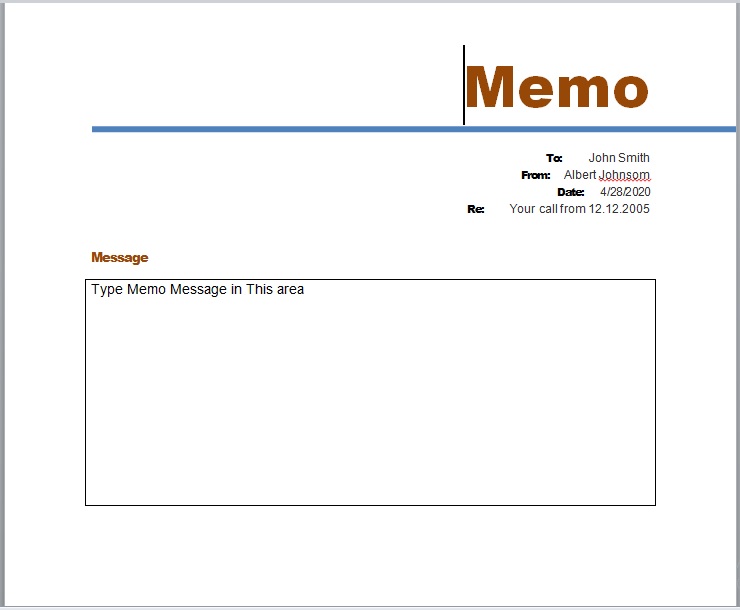
The standard format — TO, FROM, CC, DATE and SUBJECT block above a horizontal rule, with a clean body area beneath.

Memo Template with Logo Area
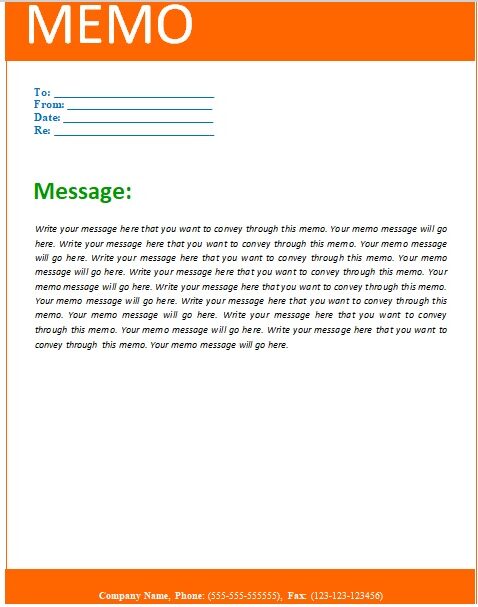
A version with space for a company logo and address at the head, suited to memos that may be seen outside the immediate team.

Click on this download button to grab this Memo Template for free.
Click on this download button to grab this Memo Template for free.

Click on this download button to grab this Memo Template for free.
Click on this download button to grab this Memo Template for free.
Click on this download button to grab this Memo Template for free.
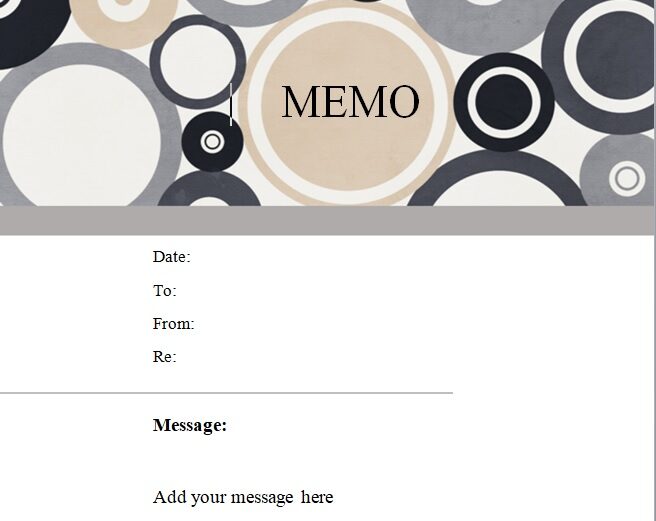
Click on this download button to grab this Memo Template for free.

Click on this download button to grab this Memo Template for free.
Types of Memo
Six kinds, each with a different opening move:
- Informational — announcing something people need to know: a change of premises, a new starter, a revised opening time. Lead with the fact.
- Directive or policy — instructing people to do something differently. Lead with the instruction and the date it takes effect, as in the example above.
- Request — asking for information, resources, or a decision. Lead with what you’re asking for and by when, not with the background that prompted it.
- Confirmation — putting a verbal agreement in writing. “This memo confirms our discussion on 18 September, at which we agreed…” These are short, and they matter more than their length suggests: a confirmation memo is what prevents two people remembering a conversation differently.
- Response — replying to a request or a query, usually quoting the original memo’s date and subject.
- Report memo — brief findings or an update, where a full report would be disproportionate. Conclusion first, supporting detail after.
For memos circulating between departments, our interoffice memo templates cover the distribution conventions. For anything running past two pages, a summary report is the better format, with a short memo as its cover.
The Subject Line
The most under-used line in business writing. Most memos arrive in an inbox, get scanned in a list, and are opened or ignored on the strength of the subject alone.
Compare:
| Weak | Better |
|---|---|
| Policy Update | New expense claim deadline — 5th of each month, from 1 November |
| Car Park | Rear car park closed 14–16 October — use Mill Lane during resurfacing |
| Staffing | Action needed: confirm December cover preferences by 10 November |
A subject line that carries the message means the memo has done its job even for the people who never open it — and the ones who do open it already know what they’re reading about.
Writing the Body
- Purpose in the first sentence. Not the background, not the history, not the committee that discussed it. What’s happening, and from when.
- Reasoning second. People accept a change more readily when they understand it, but they need to know what the change is first.
- One page. If it’s longer, the detail belongs in an attachment with the memo as a cover note.
- Use a short list for anything with more than two parts. Memos are scanned, and a list survives scanning better than a paragraph.
- Say who does what by when. A memo with no named action produces no action.
- Plain language. “We are implementing a revised submission framework” says less than “claims are due by the 5th,” and takes longer to read.
- Offer a route to respond — a name and a date. It costs a line and it converts grumbling into feedback you can actually act on.
Memo, Email, or Letter?
- A memo is internal, one-to-many, and written for the record. Use it when the same message goes to a group and you’ll want to point back to it later.
- An email is the usual delivery mechanism now, and for routine matters it’s the whole thing. Write a memo when the content is substantial enough to be referred to again — then paste it into the email or attach it.
- A letter goes outside the organization, and carries a salutation and a sign-off. A customer, a supplier, a regulator or a job applicant gets a letter, not a memo.
The practical middle ground most organizations use: routine notes go by email, and anything that changes a policy, confirms a decision, or may need to be produced months later is written as a memo and sent as an attachment — because an attachment survives being forwarded, and an email body frequently doesn’t.
Distribution and the Record
- Send it to the people it affects, not to everyone. All-staff memos that don’t apply to most staff are why all-staff memos stop being read.
- Number policy memos — a simple reference such as FIN-2026-04 — so they can be cited, superseded, and withdrawn cleanly.
- File them centrally, by date and reference. A memo that exists only in people’s inboxes isn’t a record.
- Say when a memo supersedes an earlier one, and name it: “This memo replaces FIN-2026-02 of 14 March.”
- Post it as well as sending it where the audience isn’t desk-based — a printed copy on a noticeboard reaches warehouse, kitchen and site staff that email doesn’t.
- Keep the master file with your header block already set up, so writing the next one takes two minutes.
Frequently Asked Questions
What is a memo?
A short internal document used to inform a group about something, instruct them, request something, or confirm a decision in writing. It’s written for the record and designed to be scanned rather than read closely.
What is the correct memorandum format?
A heading with the word MEMORANDUM, then TO, FROM, CC, DATE and SUBJECT lines, a horizontal rule, and the body beginning with the purpose. No greeting and no sign-off — those belong in a letter.
Do memos have a greeting and a sign-off?
No. The TO line has already addressed the recipients, so “Dear colleagues” and “Kind regards” are out of place. This is the most common mistake in a first memo.
What are the types of memo?
Informational, directive or policy, request, confirmation, response, and report memos. Each opens differently — a directive leads with the instruction, a request leads with the ask, a confirmation leads with what was agreed and when.
How long should a memo be?
One page. If the content runs longer, put the detail in an attachment and use the memo as a cover note stating what’s attached and what the reader needs to do.
What should a memo subject line say?
The message itself, not the topic. “New expense claim deadline — 5th of each month, from 1 November” works; “Policy Update” doesn’t. Most memos are opened or ignored on the strength of the subject line alone.
What is the difference between a memo and an email?
A memo is a document with a set format, written for the record; email is a delivery method. Routine notes are just emails. Anything that changes a policy, confirms a decision, or might need producing months later is better written as a memo and attached.
What is a confirmation memo?
A short memo putting a verbal agreement in writing — “this confirms our discussion of 18 September, at which we agreed…”. It takes five minutes and it’s what prevents two people remembering the same conversation differently.

Pete Smith is a Business Management graduate and a passionate advocate for practical, accessible resources that empower professionals and entrepreneurs to succeed. With a strong foundation in organizational strategy and operational efficiency, Pete combines academic knowledge with real-world insights to simplify complex business processes. He is the creator behind a growing online platform dedicated to offering free, high-quality documents, templates, and actionable tips designed to save time and improve productivity.