If you manage a car park — a business lot, an apartment complex, a church, a school, or a few reserved spaces behind a shop — you eventually need to leave a notice on a vehicle that shouldn’t be there. The free templates below are editable MS Word parking violation notices for private property, and beneath them you’ll find what to put on one, why your signage matters more than the notice does, and where the line sits between a private notice and an official citation.
A Private Notice Is Not a Citation
This distinction matters more than anything else on the page, so it’s worth being precise about it.
- An official citation is issued by a police force, parking authority, or municipal officer. It carries a legally enforceable fine, a statutory appeal process, and consequences backed by law. Only those bodies can issue one.
- A private parking notice is issued by a property owner or their agent on land they control. It tells a driver they’ve parked contrary to the posted terms, and asks them to move or to pay a charge set out on your signage. Its force comes from property rights and the terms you’ve displayed — not from public authority.
Both are legitimate. What isn’t is a private notice dressed up to look like an official one. Designing a notice to imitate police or municipal citations — their layout, colours, crests, or wording — is at best misleading and in many places unlawful. Keep your notice clearly yours: your property name at the top, your contact details, and language that describes what it actually is.
What Goes on a Parking Violation Notice
- Your property or organization name at the top, with a logo if you have one. The driver should know immediately who left this.
- Notice number — sequential, so you can find the record if someone calls.
- Date and time the notice was issued.
- Location — the lot, and the specific bay or space number.
- Vehicle details — registration or plate number, make, model, and colour. All four, because plates get misread and a partial record is no record.
- The violation — specific, not general. “Parked in space 14, reserved for resident permit holders” rather than “unauthorised parking.”
- What the driver should do now — move the vehicle, contact the office, pay a charge. Say it plainly.
- Any charge, and the sign that sets it out. A charge with no reference to displayed terms is hard to justify and easy to dispute.
- How to query it — a phone number or email, and a name if you can. Most disputes end quickly when there’s someone to talk to.
- Issued by — the name or reference of whoever placed the notice.
Parking Violation Notice Example
PARKING VIOLATION NOTICE
Private property · This is not a municipal citation
HARBOUR STREET BUSINESS PARK
Managed by Harbour Estates Ltd.
Notice No: PN-2026-0418 Date: 24 Sep 2026 Time: 09:42
Location: Rear car park, Bay 14
| Registration | AB12 CDE |
| Make / model | Vauxhall Astra |
| Colour | Silver |
Violation: Parked in Bay 14, reserved 24 hours for Unit 3 permit holders. No permit displayed.
What to do now: Please move your vehicle to a visitor bay (Bays 20–28) or contact the site office. Vehicles remaining in reserved bays may be removed at the owner’s expense, as stated on the signs at the car park entrance.
Terms of parking are displayed at the entrance and on signs throughout this car park. Parking here constitutes acceptance of those terms.
Queries: Site office, 01000 000204 · parking@harbourestates.example
Issued by: R. Silva, Site Supervisor
Three features do the work. The header says “this is not a municipal citation”, which removes any ambiguity about what the driver is holding. The violation names the specific bay and the specific rule. And every statement about consequences is tied back to the signage — which is what gives a private notice any standing at all.
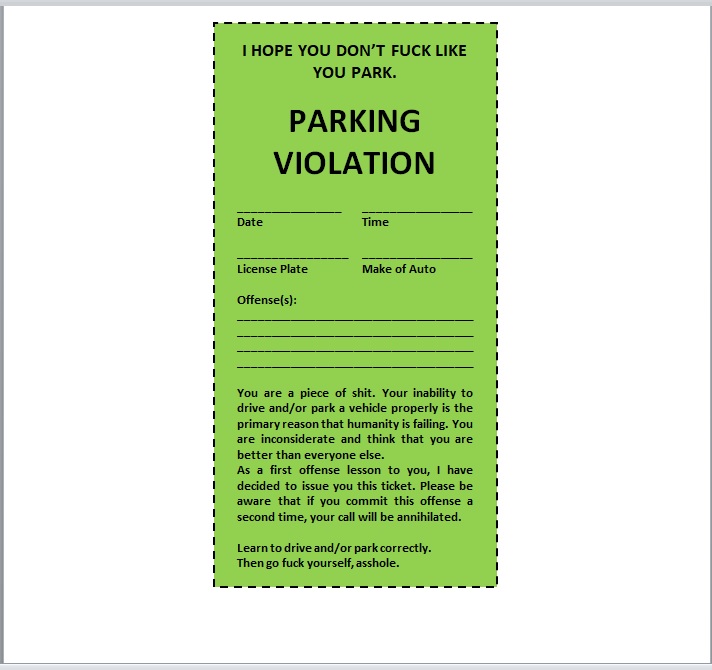
Free Parking Violation Notice Templates in MS Word
Each template below is editable in Word. Add your property name and contact details once, then print a batch to keep in the office.


Parking Violation Notice with Vehicle Details

The full format shown above — notice number, location, vehicle details table, violation, and what the driver should do next.
Parking Warning Notice (No Charge)

A first-notice format that asks the driver to move without levying a charge — the better opening step for customer car parks.

Your Signage Does the Real Work
A parking notice is only as good as the signs behind it. Whatever your notice says, the first question anyone disputing it will ask is what the car park told them when they drove in — and if the answer is “nothing,” the notice has very little standing.
Effective signage:
- At the entrance, positioned where a driver sees it before committing to a space.
- States the terms plainly — who may park, for how long, whether a permit is required, and the hours the restrictions apply.
- States the consequence — a charge, removal, or both — and the amount if there is one.
- Names the operator and gives a contact.
- Is legible from a car, in daylight and at night. A sign nobody can read is the same as no sign.
- Is repeated inside the lot, particularly next to reserved bays and disabled spaces.
Photograph your signage once it’s up, with a date. If a notice is ever challenged, that photograph is the evidence that the terms were displayed.
Issuing Notices Sensibly
- Photograph the vehicle in position before you place the notice — showing the plate, the bay, and ideally a sign in the frame. It takes ten seconds and settles almost every dispute.
- Start with a warning. For customer and visitor car parks, a first notice that asks someone to move usually gets the space back without turning a customer into a complainant. Save charges for repeat or blatant cases.
- Keep a copy or a log of every notice issued, with the number, date, vehicle, and reason. When someone phones a week later, you want the record.
- Place it under a wiper, in a weatherproof sleeve. Notices taped to glass or paint cause damage complaints, and a sodden notice proves nothing.
- Apply the rules consistently. Enforcement that’s selective is the kind that gets challenged successfully, and it’s also the kind that annoys the people you didn’t ticket.
- Be reachable. Most disputes end in a two-minute phone call. A notice with no contact details escalates by default.
What Not to Do
- Don’t imitate an official citation. No police or council colours, crests, seals, or badge-style logos, and no wording implying you act for a public authority.
- Avoid words that imply public power — “citation,” “fine,” and “penalty notice” carry legal meaning in many places. “Parking charge” or “violation notice” describes what it is.
- Don’t threaten what you can’t do. Naming consequences you have no authority to impose undermines every notice you issue afterwards.
- Don’t block the vehicle in, and don’t immobilize or tow without checking the rules — wheel clamping and towing are restricted or prohibited in many jurisdictions, and a wrongful tow costs far more than the parking ever did.
- Don’t chase the driver’s details yourself. Obtaining registered keeper information is regulated almost everywhere, and usually limited to operators who meet specific requirements.
A note on enforcement: private parking enforcement is regulated in many countries, with rules covering signage standards, the level of charges, accreditation of operators, and the process for obtaining keeper details. If you intend to issue charges rather than warnings — or to tow — check what applies where your property is before you start, or use an operator who already complies.
Frequently Asked Questions
What is a parking violation notice?
A notice left on a vehicle by a property owner or their agent, stating that the vehicle is parked contrary to the terms displayed on that property and setting out what the driver should do. It’s a private document, not an official citation.
Can I issue parking tickets on my own property?
You can issue a private parking notice. Whether you can enforce a charge depends on local law and, in most places, on having displayed clear terms on signage before the vehicle parked. Rules on charges, clamping, and towing vary considerably — check yours before going beyond a warning notice.
What’s the difference between a parking notice and an official citation?
An official citation is issued by police or a parking authority, carries a legally enforceable fine, and has a statutory appeal process. A private notice comes from a property owner and rests on the terms displayed at the site. A private notice should never be designed to resemble an official one.
What should a parking violation notice include?
Your property or organization name, a notice number, the date and time, the location and bay, the vehicle’s plate, make, model and colour, the specific violation, what the driver should do now, any charge and the sign it derives from, and contact details for queries.
Do I need signs to issue parking notices?
In practice, yes. The terms displayed at the entrance and around the lot are what a driver is deemed to have accepted by parking. Without visible signage stating who may park and what happens if they don’t comply, a notice has very little to stand on.
Should I charge or just issue a warning?
For customer and visitor car parks, a warning that asks the driver to move usually solves the problem without creating a complaint. Charges make more sense for residential permit schemes and repeat offenders — and only where local rules allow them and your signage supports them.
Can I have a vehicle towed from my property?
Sometimes, but towing and clamping are heavily restricted in many jurisdictions, with requirements on signage, notice periods, and who may carry it out. Check the rules that apply where you are, and use a licensed operator — a wrongful removal is an expensive mistake.

Pete Smith is a Business Management graduate and a passionate advocate for practical, accessible resources that empower professionals and entrepreneurs to succeed. With a strong foundation in organizational strategy and operational efficiency, Pete combines academic knowledge with real-world insights to simplify complex business processes. He is the creator behind a growing online platform dedicated to offering free, high-quality documents, templates, and actionable tips designed to save time and improve productivity.