A partnership agreement sets out how two or more people will run a business together: who put in what, how profits are shared, who can make which decisions, and — most importantly — what happens when someone wants to leave, stops pulling their weight, or dies. The free templates below are editable MS Word files, and beneath them you’ll find the clauses that matter, how to handle an equal 50/50 split, and the two facts about partnerships that most people starting one don’t know.
Two Things to Know Before You Start
1. You may already be in a partnership. In many jurisdictions, a general partnership comes into existence as soon as two or more people carry on a business together with a view to profit — no registration, no signature, no agreement required. If you and a friend have started selling something together and splitting the proceeds, you may legally be partners already.
And where there’s no written agreement, the law fills the gaps with default rules. Those commonly include splitting profits equally regardless of who contributed the money or the work, giving every partner an equal say, and allowing any partner to dissolve the partnership at will. Those defaults suit almost nobody’s actual arrangement, which is the strongest single reason to write an agreement.
2. General partners usually have unlimited personal liability. In a general partnership, each partner is typically liable for the partnership’s debts — including debts another partner took on in the partnership’s name. If your partner signs a lease or a supply contract on the business’s behalf, you may be personally responsible for it. That fact should shape every clause about who can commit the partnership and up to what amount.
Types of Partnership
- General partnership — all partners share management and, typically, unlimited liability. The default form, and the one most small business partnerships are.
- Limited partnership (LP) — one or more general partners manage the business and carry unlimited liability, while limited partners invest capital with liability capped at their contribution. Limited partners usually can’t take part in management without risking that protection. Common for investment and property ventures.
- Limited liability partnership (LLP) — partners share management while generally being protected from personal liability for the firm’s debts and other partners’ negligence. Availability and rules vary widely by jurisdiction, and in some places LLPs are restricted to professional practices.
Limited partnerships and LLPs usually require formal registration. Check what’s available and what’s required where you’ll be trading.
Partnership, Company, or Joint Venture?
- A partnership is the partners themselves carrying on business together. In a general partnership there’s often no separate legal entity, profits are usually taxed in the partners’ own hands, and liability sits with them.
- A company is a separate legal entity owned by shareholders and run by directors. Shareholders’ liability is typically limited to their investment, and the relationship between owners is governed by a shareholders’ agreement — a different document from this one.
- A joint venture is two or more businesses collaborating on a specific project or for a defined period, usually while remaining otherwise independent.
If you’re incorporating, you need a shareholders’ agreement rather than a partnership agreement. If you’re two businesses working on one project, look at a joint venture. If you’re people running an ongoing business together without incorporating, you’re in the right place.
What a Partnership Agreement Must Cover
- Name, purpose, and place of business — what the partnership does, and the scope within which partners act on its behalf.
- Capital contributions — what each partner puts in: cash, equipment, property, client relationships, intellectual property. Record the agreed value of anything non-cash, and whether contributions earn interest or are repayable on exit.
- Profit and loss sharing — the ratio in which profits and losses are divided. It doesn’t have to match capital; see the example below.
- Drawings — how and when partners take money out, and whether there’s a limit before accounts are settled.
- Time and duties — what each partner is expected to contribute in hours and roles, and whether they may work on other businesses.
- Authority — what each partner can do alone and what needs agreement. A spending limit per partner, above which a second signature is required, is one of the most protective clauses you can include.
- Decision-making — which decisions need unanimity (admitting partners, borrowing, selling the business) and which a majority can make.
- Banking and accounts — signatories, bookkeeping responsibility, and each partner’s right to inspect the books.
- New partners — how they’re admitted and on what terms.
- Withdrawal — how much notice a partner gives, and how their share is bought out.
- Death, incapacity, and divorce — what happens to a partner’s share, whether the others can or must buy it, and how that purchase is funded. Many partnerships use life insurance for exactly this.
- Valuation — how a departing partner’s share will be valued. Agreeing the method now, while nobody knows who’ll be leaving, is far easier than later.
- Restrictive covenants — non-solicitation of clients and staff, and any non-compete, drafted to a reasonable scope and duration. Enforceability varies considerably.
- Deadlock — see the 50/50 section below.
- Dispute resolution — mediation before arbitration or court.
- Dissolution — how the business is wound up, debts paid, and remaining assets divided.
Capital and Profit Don’t Have to Match
One of the most useful things to understand before drafting: the share of money each partner puts in and the share of profit each takes out are separate decisions.
| HARBOUR & PINE — CONTRIBUTIONS AND SHARES | |||
| Partner | Contributes | Capital | Profit share |
|---|---|---|---|
| Amara | 30,000 cash; one day a week on finance | 75% | 40% |
| Jonas | 10,000 cash; full-time running the business | 25% | 60% |
| Also agreed: Amara’s extra capital earns 5% annual interest before profits are split, and is repaid first on dissolution. Jonas draws 2,000 a month against his share. Profit split reviewed after two years. | |||
Neither partner is subsidizing the other. Amara provides most of the money and is compensated for it with interest and priority repayment; Jonas provides most of the work and is compensated with a larger profit share. A default equal split would have been unfair to both of them in different directions — which is exactly the situation where partnerships go wrong without an agreement.
Partnership Agreement Structure
PARTNERSHIP AGREEMENT
Made on [date] between [Partner A] and [Partner B], trading as [business name].
1. Name, Purpose & Place of Business
2. Commencement & Term
3. Capital Contributions — amounts, non-cash items valued, interest
4. Profits, Losses & Drawings
5. Duties & Time Commitment
6. Authority & Spending Limits
7. Decisions Requiring Unanimity
8. Banking, Books & Accounts
9. Admission of New Partners
10. Withdrawal & Buyout
11. Death, Incapacity & Valuation
12. Restrictive Covenants
13. Deadlock & Dispute Resolution
14. Dissolution
Signed: ____________________ Signed: ____________________
[Partner A] [Partner B]
Free Partnership Agreement Templates in MS Word
Each template below is editable in Word. Work through every clause with your partners rather than completing it alone — the discussion is most of the value.


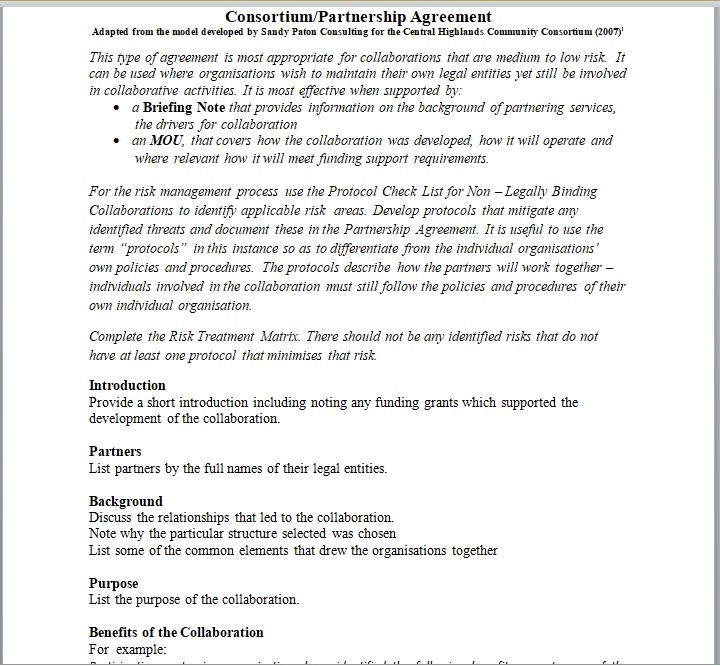
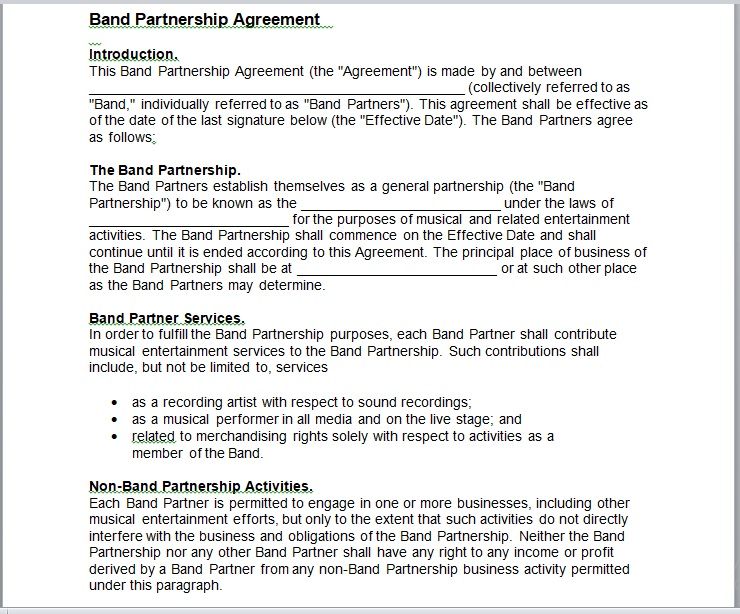
Simple Partnership Agreement Template
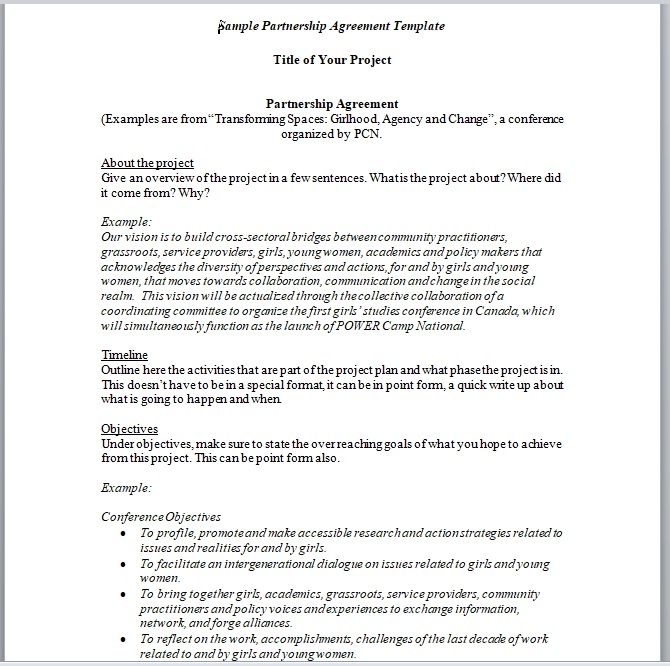
A concise general partnership agreement covering capital, profit sharing, authority, withdrawal, and dissolution.
Limited Partnership Agreement Template
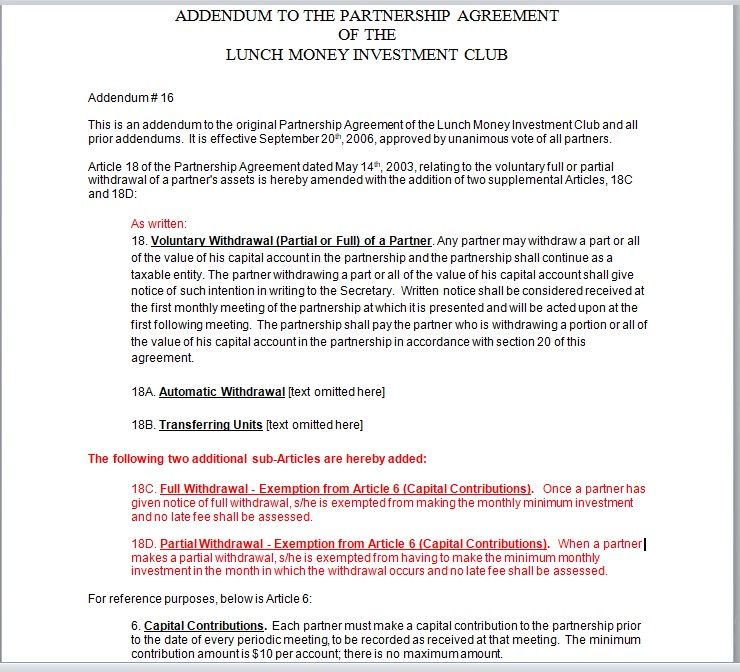
Distinguishes general partners, who manage the business, from limited partners, whose liability is capped at their investment.
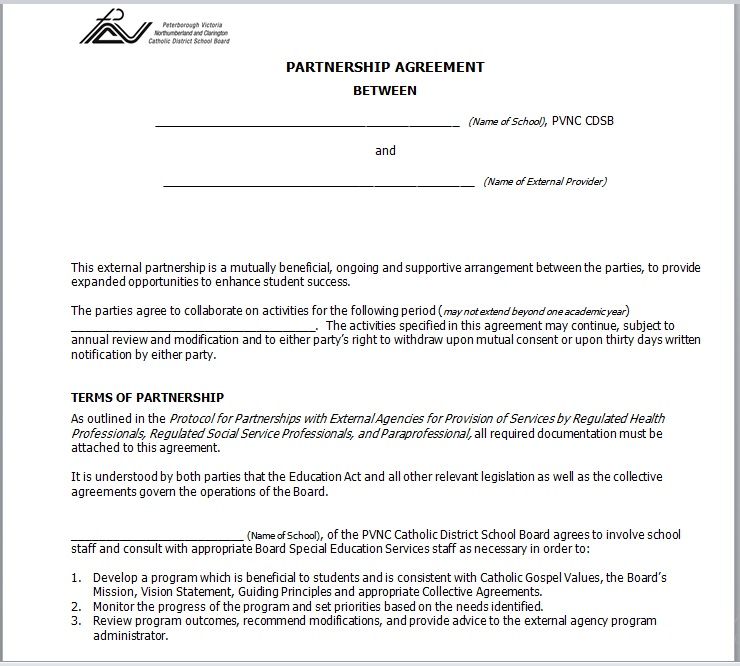
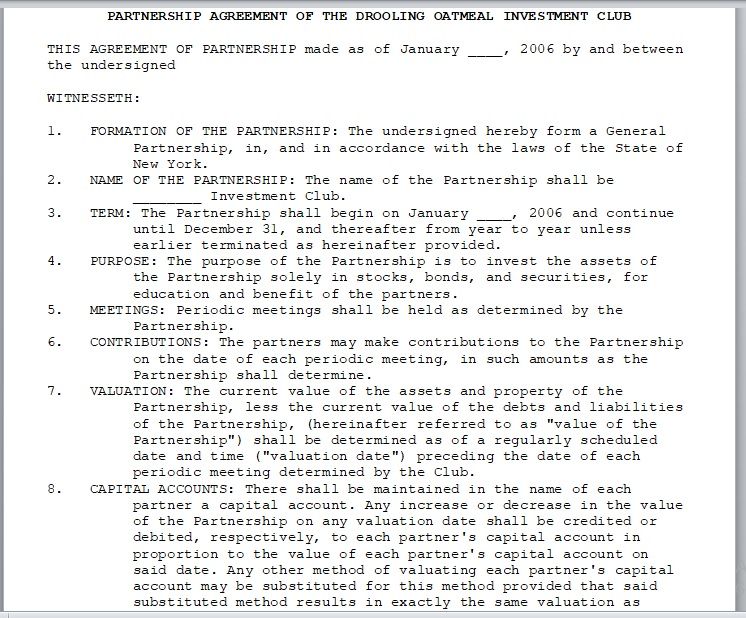

50/50 Partnerships and Deadlock
Equal partnerships are the most common kind and the most fragile, for one structural reason: when two partners with equal say disagree, there’s no majority. A business that can’t decide can’t operate, and deadlock is behind a large share of partnership breakdowns.
A 50/50 agreement needs a deadlock mechanism, written in advance while everyone is still getting along. Options, roughly from gentlest to most decisive:
- Divide the domains. Equal ownership doesn’t have to mean equal say on everything. One partner has final authority on operations, the other on finance and marketing. Most day-to-day deadlocks disappear.
- Mediation, then arbitration. A stated process for bringing in a neutral third party before anything reaches court.
- An independent tie-breaker — a named adviser, accountant, or mentor whose view settles a genuine deadlock.
- A rotating casting vote — each partner holds the deciding vote for alternate years.
- A shotgun clause. The decisive option: either partner can name a price for the business; the other must then either buy the first partner out at that price or sell their own share at it. Because whoever names the price doesn’t know which side they’ll end up on, they have every reason to name a fair one. It ends deadlock permanently, and its existence alone tends to make both partners more willing to compromise.
Whichever you choose, define what counts as deadlock — for example, a decision on a matter requiring agreement that remains unresolved after two meetings and thirty days — so the mechanism can’t be triggered by a single bad afternoon.
The Conversation to Have First
The clauses above are easy to write and hard to discuss, which is why partners tend to skip them. But the time to agree how a partnership ends is while nobody wants it to.
Before you sign, talk through: what happens if one of you wants out in two years? If one of you stops putting in the hours? If one of you is ill for six months, divorces, or dies? If an outsider offers to buy the business and only one of you wants to sell? If the business needs more money and only one of you can provide it?
If those conversations are uncomfortable now, they’re considerably worse when one of them is actually happening. Partners who’ve agreed the answers in advance usually find the answers are never needed. Partners who haven’t usually do.
Related documents: a non-disclosure agreement to protect ideas before a partnership is formed, a business plan to agree the direction, and service agreements for outside contractors the partnership engages.
Frequently Asked Questions
What is a partnership agreement?
A contract between the partners of a business setting out capital contributions, profit sharing, authority, decision-making, and what happens when a partner joins, leaves, or dies. Without one, default legal rules apply that rarely match what the partners actually intended.
Is a partnership agreement legally required?
Usually not for a general partnership — in many jurisdictions one forms automatically when people carry on business together for profit. But without a written agreement, statutory defaults govern profit sharing, decisions, and dissolution. Limited partnerships and LLPs typically require formal registration and documentation.
How do you write a partnership agreement?
Start with the conversation rather than the document: agree contributions, profit split, roles, authority limits, and what happens on exit, death, or deadlock. Then record those decisions clause by clause in a template, and have it reviewed before signing.
How should profits be split in a partnership?
However the partners agree. The split doesn’t have to follow capital contributions — a partner putting in more work can take a larger share while a partner putting in more money is compensated through interest on capital or priority repayment. Record the reasoning, and consider a review date.
What happens in a 50/50 partnership when partners disagree?
Without a deadlock clause, the business can become unable to act. Common solutions include dividing decision domains, mediation then arbitration, an independent tie-breaker, a rotating casting vote, or a shotgun clause requiring one partner to buy the other out at a named price.
What is a shotgun clause?
A deadlock provision letting either partner name a price for the business, after which the other must either buy at that price or sell their own share at it. Because the partner naming the price doesn’t know which side they’ll end up on, it encourages a fair valuation.
What is the difference between a partnership and an LLC or company?
In a general partnership, the partners typically carry unlimited personal liability and there may be no separate legal entity. A company or LLC is a separate entity whose owners’ liability is generally limited. The owners’ agreement for a company is a shareholders’ or operating agreement, not a partnership agreement.
Are non-compete clauses enforceable in partnership agreements?
It depends heavily on the jurisdiction. Some places don’t enforce them at all; many enforce them only if reasonable in scope, geography, and duration. Non-solicitation clauses covering clients and staff are often more enforceable than a broad non-compete. Take advice before relying on one.

Pete Smith is a Business Management graduate and a passionate advocate for practical, accessible resources that empower professionals and entrepreneurs to succeed. With a strong foundation in organizational strategy and operational efficiency, Pete combines academic knowledge with real-world insights to simplify complex business processes. He is the creator behind a growing online platform dedicated to offering free, high-quality documents, templates, and actionable tips designed to save time and improve productivity.