A payment reminder — also called a credit reminder or dunning letter — is the note a business sends a customer whose invoice has gone unpaid. Done well, it’s a sequence rather than a single letter: a polite nudge first, a firmer follow-up next, and a final notice only if those don’t work. The free templates below are editable MS Word files, and beneath them you’ll find sample wording for each stage, plus the things that actually make the difference between getting paid and getting ignored.
The Escalation Sequence
The most common mistake is sending the same letter three times, getting angrier each round. A working sequence changes tone deliberately, and each stage has a job:
| Stage | Timing | Tone | What it does |
|---|---|---|---|
| Courtesy reminder | 3–7 days before due | Helpful | Catches invoices sitting unapproved. Costs nothing and prevents a good share of late payments. |
| First reminder | 1–7 days overdue | Warm, assumes oversight | Re-sends the invoice and payment details. Most invoices are settled at this stage. |
| Second reminder | 14–21 days overdue | Business-like, direct | References the first, states the terms, asks for a specific payment date. Follow up by phone. |
| Final notice | 30–45 days overdue | Formal | States the consequence and a deadline. Sent by email and post for the record. |
Two rules govern the whole sequence. Never start at the top. You have one escalation to spend, and spending it in week one leaves you nowhere to go in week six. And don’t threaten what you won’t actually do — a final notice promising legal action you have no intention of taking teaches that customer to ignore your letters permanently.
Sample: First Reminder
Subject: Invoice INV-2026-0264 — payment reminder
Dear Ms Whitfield,
I hope you’re well. This is a quick reminder that invoice INV-2026-0264 for $3,480.00, issued on 12 August 2026, fell due on 11 September and is currently showing as unpaid on our account.
I’ve attached a copy in case it’s easier than digging it out. If it’s already been sent for payment, please ignore this note — and if you’re able to let me know the payment date, I’ll mark the account accordingly.
Payment details:
Springfield Bank | Account 0012 3456 7890 | Sort/Routing 04-22-19
Please quote INV-2026-0264 as the reference.
If there’s a query on the invoice, just reply and I’ll sort it out.
Kind regards,
D. Ferreira
Accounts, BrightTech Office Supplies · (555) 014-2200
Notice what this letter does: it attaches the invoice, gives the bank details in the message itself, offers the customer a graceful exit (“if it’s already been sent for payment”), invites a query, and — the important part — asks a question that needs answering. “Please make payment” can be ignored without awkwardness. “Can you let me know the payment date?” is harder to leave unanswered.
Sample: Final Notice
Subject: FINAL NOTICE — Invoice INV-2026-0264, 45 days overdue
Dear Ms Whitfield,
Despite reminders sent on 12 and 26 September, invoice INV-2026-0264 for $3,480.00, due on 11 September 2026, remains unpaid. The account is now 45 days overdue.
We ask that payment is received in full by Friday 31 October 2026.
If payment is not received by that date, we will suspend further supply to your account and refer the balance to our collections agent. We would prefer not to take either step, and if there is a difficulty with this invoice we are willing to discuss a payment arrangement — but we need to hear from you before the date above.
Payment details:
Springfield Bank | Account 0012 3456 7890 | Sort/Routing 04-22-19 | Ref: INV-2026-0264
Yours sincerely,
D. Ferreira
Accounts, BrightTech Office Supplies · (555) 014-2200
Sent by email and by post.
Still not aggressive — but every sentence is now doing something. It lists the previous reminders (building the record), names a specific deadline rather than “immediately,” states exactly what happens next, and leaves the door open to an arrangement. The line about sending by email and post matters too: if this ever goes further, you want to show the letter was properly served.
Free Payment Reminder Templates in MS Word
Each template below is editable in Word. Set up your company details and bank information once, save a master copy, and change only the customer, invoice, and amounts.
First Payment Reminder Letter
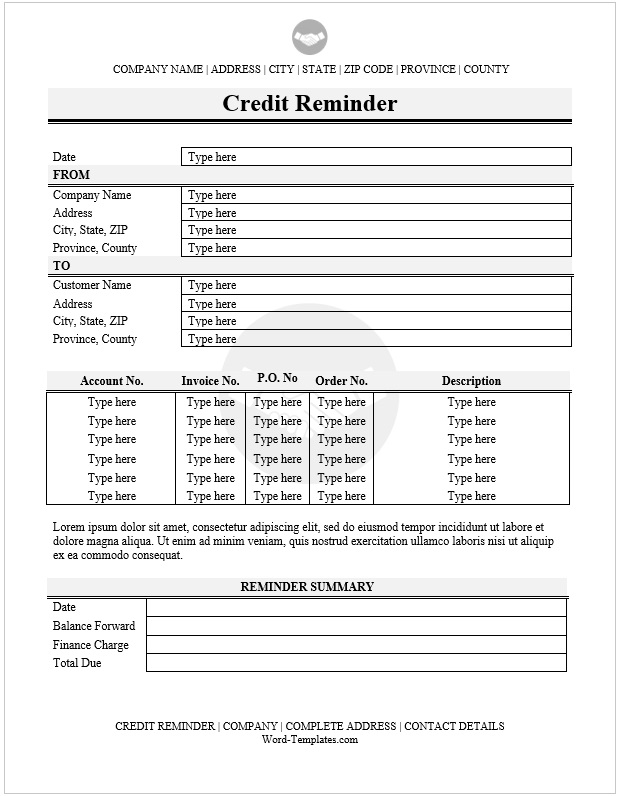
A polite early reminder that re-sends the invoice details and payment information, worded to assume an oversight rather than a refusal.

Final Notice / Letter Before Action
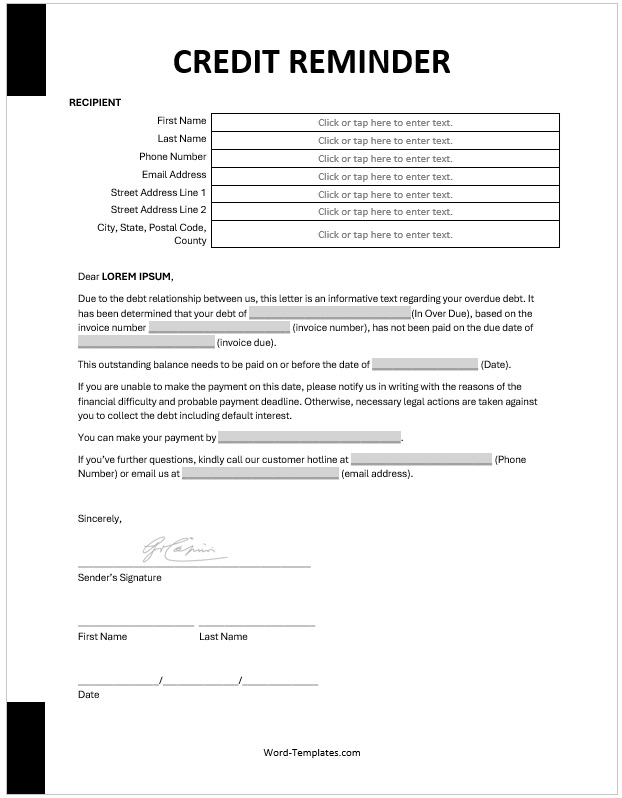
A formal notice listing previous reminders, stating a payment deadline and the consequence of missing it, while leaving room for a payment arrangement.
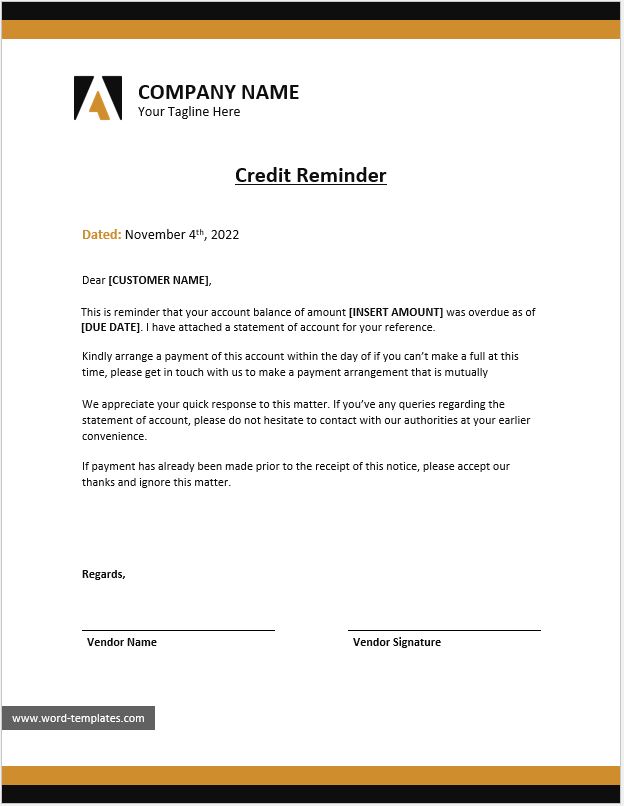
Click on the download button below and get this Credit Reminder Template as a freebie.
What Actually Gets You Paid
- Put the payment details in the reminder. A meaningful share of late payments are simply people who’d have to go hunting for your bank details. Remove the friction and some invoices pay themselves.
- Attach the invoice again. Don’t make the customer search their inbox — the version you attach is the version they’ll act on.
- Ask a question. A request for a payment date requires a reply; a request for payment doesn’t.
- Write to the right person. Your day-to-day contact often isn’t who releases money. By the second reminder, address it to accounts payable as well.
- Phone after the second reminder. A two-minute call resolves more thirty-day debt than any letter, because it surfaces the real reason — which is usually not what you assumed.
- Keep the record. Save every reminder sent, with dates. If the debt is eventually referred on, that trail is the first thing you’ll be asked for.
- Stay polite throughout. Not for sentiment — because a customer who feels ambushed disputes the invoice, and a disputed invoice takes months longer than a late one.
When It Isn’t Forgetfulness
Reminders solve exactly one problem: an invoice that slipped through. Past about thirty days, that’s usually not what’s happening, and sending a fourth letter won’t change anything. The common real causes:
- The invoice is stuck in an approval queue — often because it’s missing a purchase order number, or was sent to a person rather than the accounts inbox.
- There’s a dispute you don’t know about — a quantity short-delivered, a price different from the quotation, work considered incomplete. Customers frequently sit on an invoice rather than raising it.
- They believe they’ve paid. Ask for the remittance advice — either it exists and you have an allocation problem at your end, or it doesn’t and the payment was never made.
- They can’t pay right now. An agreed instalment arrangement recovers far more than a threat does, and it’s worth offering explicitly.
All four are found by asking, not by writing again. That’s why the phone call after the second reminder is the single highest-value step in the whole process.
Late Payment Interest and Fees
Many jurisdictions allow businesses to charge interest and recovery costs on overdue commercial debt, and some grant a statutory right to do so even where the contract is silent. Your own terms may also provide for a late fee.
Two practical points. First, the charge should have been stated on the invoice and in your terms before the debt arose, not introduced at the reminder stage. Second, plenty of suppliers state the right and choose not to apply it to customers they want to keep — the mention alone often works. Check what’s permitted where you operate before putting a figure in a letter.
Frequently Asked Questions
What is a payment reminder letter?
A letter or email from a business to a customer whose invoice is unpaid, asking for payment. It’s also called a credit reminder or dunning letter, and it usually forms part of a sequence that escalates from a polite nudge to a formal final notice.
When should I send the first payment reminder?
Within a week of the due date — many businesses send it the day after. Waiting a month signals that your payment terms aren’t taken seriously, and the longer a debt ages the harder it becomes to collect.
How many reminders should I send before escalating?
Typically three: a first reminder in the first week overdue, a second at around two to three weeks with a phone call alongside it, and a final notice at thirty to forty-five days. More than that and the reminders themselves stop carrying weight.
How do I write a strong letter for outstanding payment?
Strong doesn’t mean angry. State the invoice number, amount, and due date; list the reminders already sent; give a specific payment deadline rather than “immediately”; say precisely what happens if it passes; and offer to discuss an arrangement. Firm and specific beats emotional every time.
What is a letter before action?
A formal final notice warning that legal proceedings will follow if payment isn’t received by a stated date. In some jurisdictions sending one is expected before a court claim. If you send it, be prepared to follow through — and take advice before starting proceedings.
Can I charge interest on late payments?
Often yes for commercial debts, and some jurisdictions provide a statutory right to interest and recovery costs. Your terms should have stated it before the debt arose. Check the rules where you operate before applying a charge.
Should I send reminders by email or post?
Email for the early stages — faster, and it reaches the accounts inbox. For the final notice, send both: email for speed, post for the record. If the matter ever escalates, being able to show the notice was properly served matters.
What should I do if the customer says they’ve already paid?
Ask for the remittance advice and the payment reference. If they have one, check whether the payment arrived unallocated at your end — it happens more often than people expect. If they can’t produce one, the payment usually wasn’t released.

Pete Smith is a Business Management graduate and a passionate advocate for practical, accessible resources that empower professionals and entrepreneurs to succeed. With a strong foundation in organizational strategy and operational efficiency, Pete combines academic knowledge with real-world insights to simplify complex business processes. He is the creator behind a growing online platform dedicated to offering free, high-quality documents, templates, and actionable tips designed to save time and improve productivity.