A commission agreement sets out how someone earning commission gets paid: what rate, calculated on what, earned at what moment, and what happens if a customer returns the goods or never pays. Sales reps, agents, brokers, affiliates, and commission-based employees all work under one. The free templates below are editable MS Word files, and beneath them you’ll find every key clause explained — starting with the two that cause most commission disputes.
The Two Clauses That Cause Most Disputes
1. What the commission is a percentage of. “Ten percent commission” means nothing on its own. Ten percent of gross sales, of net sales after discounts and returns, of gross profit, or of cash actually collected? These produce very different payments on the same deal — see the example below. Name the basis explicitly, and define the deductions.
2. When commission is earned, as distinct from when it’s paid. Is it earned when the order is signed, when the invoice is issued, or when the customer’s money arrives? This decides what happens when a customer pays sixty days late, cancels after signing, or never pays at all — and, combined with the termination clause, whether a departing rep is owed anything on deals already closed. Agreements that state a payment date but never define the earning event are the ones that end up in argument.
Same Sale, Three Commission Bases
A 10% commission on one order of 10,000, with a 1,000 discount given, 500 of goods returned, and cost of goods of 6,000:
| Basis | Calculation | Commission |
|---|---|---|
| Gross sales | 10% of 10,000 | 1,000 |
| Net sales | 10% of (10,000 ? 1,000 discount ? 500 returns) | 850 |
| Gross profit | 10% of (8,500 ? 6,000 cost) | 250 |
| Collected revenue | 10% of amounts actually received (paid as they arrive) | 0 until paid |
Four times the difference between the highest and lowest, from one clause. Both sides should know which one they’ve agreed to before the first sale, not after it.
What a Commission Agreement Should Contain
- Parties and status — the company and the person or firm earning commission, and whether they’re an employee or an independent contractor. The distinction affects tax, benefits, and statutory protections.
- Scope — which products or services carry commission, which territory or customer accounts are covered, and whether the arrangement is exclusive.
- Commission rate and basis — the percentage (or fixed fee), what it’s calculated on, and every deduction that applies. Include the tier structure if rates step up with volume.
- When commission is earned — the triggering event: signed order, delivery, invoice issued, or payment collected.
- Payment schedule — how often commissions are calculated and paid, and the cut-off date for each period.
- Chargebacks and clawbacks — what happens if the customer returns goods, cancels, or never pays. State whether commission already paid is deducted from future commission, and over what period.
- Split commissions and house accounts — how credit is divided when two people work a deal, and which accounts carry no commission at all. Ambiguity here is a reliable source of internal conflict.
- Draws and advances — whether the earner receives a regular draw against future commission, and crucially whether it’s recoverable (repaid from later commission, or owed back if they leave) or non-recoverable. This should never be left implied.
- Post-termination commissions — whether deals closed before the agreement ended, but collected after, still carry commission, and for how long a tail. This is the most disputed clause in commission work, and in many places statute has something to say about it regardless of what the contract states.
- Expenses — who pays for travel, samples, and entertainment, and any approval limits.
- Records and audit rights — the earner’s right to see the sales data their commission is calculated from, and how to query a statement. A commission agreement without visibility of the numbers asks one party to trust arithmetic they can’t check.
- Confidentiality and non-solicitation — protection for customer lists and pricing. Often paired with a separate non-disclosure agreement.
- Term, termination, and governing law — duration, notice periods, and which jurisdiction’s law applies.
Commission Agreement Structure at a Glance
COMMISSION AGREEMENT
Made on [date] between [Company] and [Agent / Representative].
1. Parties & Status — employee or independent contractor
2. Scope — products, territory, accounts, exclusivity
3. Commission Rate & Basis — percentage, of what, tiers, deductions
4. When Commission Is Earned — order, invoice, or collection
5. Payment Schedule — frequency, cut-off, statement
6. Chargebacks — returns, cancellations, non-payment
7. Splits & House Accounts
8. Draws & Advances — recoverable or not
9. Post-Termination Commissions — tail period on closed deals
10. Expenses
11. Records & Audit Rights
12. Confidentiality & Non-Solicitation
13. Term, Termination & Governing Law
Signed: ____________________ Signed: ____________________
[Company] [Agent]
Free Commission Agreement Templates in MS Word
Each template below is editable in Word. Before signing: name the commission basis, define the earning event, and complete the chargeback and post-termination clauses — those three carry most of the risk.
Sales Commission Agreement Template
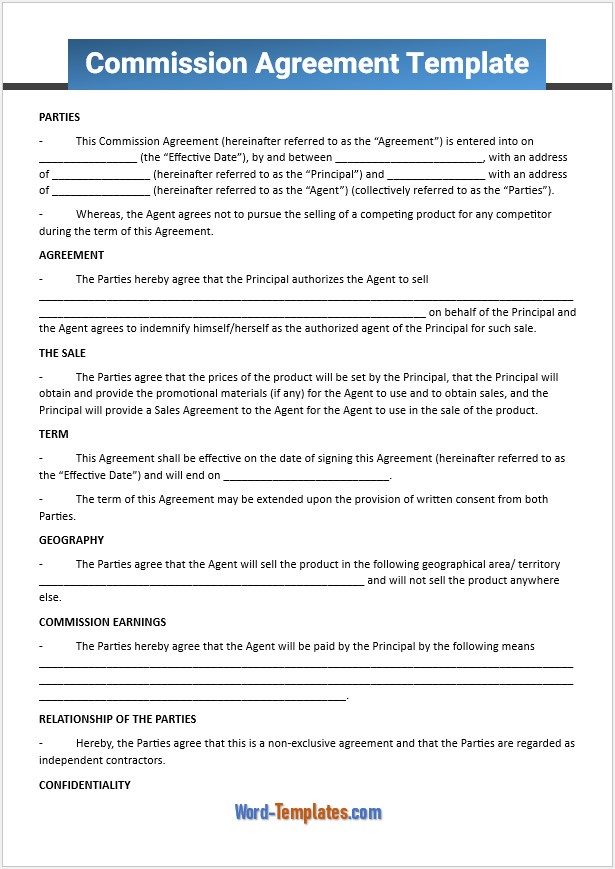
For sales representatives and agents — covers rate and basis, targets, payment schedule, chargebacks, and territory.

Referral / Finder’s Fee Agreement Template

A shorter format for one-off introductions — defines what counts as a qualifying referral, the fee, and when it becomes payable.


Types of Commission Agreement
- Sales commission agreement — for representatives and agents selling a company’s products. The most common type, and where targets, territories, and chargebacks matter most.
- Real estate commission agreement — sets the broker’s or agent’s commission on a property sale, how it splits between listing and selling sides, and when it becomes payable (usually on completion). Note that real estate commissions are regulated in many jurisdictions, and standard forms often apply.
- Affiliate commission agreement — for partners promoting products online. Adds tracking and attribution rules, cookie windows, approved promotional methods, and payment thresholds.
- Employee commission agreement — commission as part of employee compensation, alongside salary. Sits within the employment relationship, so employment law applies in addition to the contract terms.
- Referral or finder’s fee agreement — a one-off payment for an introduction that leads to business. Simpler, but still needs a clear definition of what counts as a qualifying referral and when the fee is earned.
Related documents: service agreements where the work is paid by fee rather than commission, partnership agreements where profits are shared rather than commissioned, and invoice templates for billing commission earned.
Frequently Asked Questions
What is a commission agreement?
A contract setting out how commission is earned and paid: the rate, what it’s calculated on, when it’s earned, the payment schedule, and what happens if a sale is returned or unpaid. It’s used with sales reps, agents, brokers, affiliates, and commission-based employees.
Should commission be based on gross or net sales?
Either can be fair — what matters is that the agreement says which, and defines the deductions. Gross is simpler and more generous; net (after discounts and returns) reflects what the business actually keeps; gross-profit-based commission aligns the earner with margin rather than volume. The example above shows how far apart the results can be.
When is a commission considered earned?
Whenever the agreement says — commonly on a signed order, on invoicing, or on payment being collected. Define the event explicitly, because it determines what happens with late payments, cancellations, and commissions after the agreement ends.
What is a commission chargeback?
Recovery of commission already paid when the underlying sale is reversed — a refund, a return, a cancellation, or a customer who never pays. The agreement should state whether chargebacks are deducted from future commission and over what window.
Do I still get commission on sales made before I left?
It depends on the agreement and on local law. Many agreements include a “tail” paying commission on deals closed before termination but collected afterwards, and some jurisdictions have statutes protecting earned commissions regardless of what a contract says. If you’re negotiating an agreement, this is the clause to read closely before signing.
What is a recoverable draw?
A regular advance against future commission that must be repaid from later earnings — and sometimes owed back if the earner leaves with a negative balance. A non-recoverable draw is kept regardless. The difference is significant, so the agreement should say which applies.

Pete Smith is a Business Management graduate and a passionate advocate for practical, accessible resources that empower professionals and entrepreneurs to succeed. With a strong foundation in organizational strategy and operational efficiency, Pete combines academic knowledge with real-world insights to simplify complex business processes. He is the creator behind a growing online platform dedicated to offering free, high-quality documents, templates, and actionable tips designed to save time and improve productivity.