A donation receipt is the written acknowledgment a charity, church, or nonprofit gives a donor to confirm a gift — and, where tax rules allow a deduction, it’s the document the donor relies on to claim it. That makes it a tax record rather than a thank-you note, and it has to carry specific wording to do its job. The free templates below are editable MS Word files for organizations issuing receipts, and this page covers exactly what a valid receipt must say, plus formats for in-kind gifts, church donations, and year-end giving summaries.
What a Donation Receipt Must Include
For US charities, a donor needs a written acknowledgment from the organization to substantiate a deduction for any single contribution of $250 or more, and they need it before they file their return. A valid acknowledgment contains:
- The organization’s name — the full legal name of the charity, plus your tax-exempt status and EIN. Donors and their accountants look for these first.
- The donor’s name and the date of the gift.
- The amount of cash contributed — the exact figure.
- For non-cash gifts, a description of the property — “twelve winter coats,” “a 2015 Honda Civic,” “office chairs, used.” Describe it; see the next bullet about value.
- One of two statements about goods and services, and this is the part that makes or breaks a receipt:
- If the donor received nothing in return: “No goods or services were provided in exchange for this contribution.”
- If they did receive something — a gala dinner, event tickets, merchandise: a description and good-faith estimate of its value, so the donor can deduct only the difference. This quid pro quo disclosure is required for payments over $75.
- An authorized signature and your organization’s contact details.
The rule nonprofits most often get wrong: for non-cash donations, the charity describes the property but does not assign it a value. Valuing donated goods is the donor’s responsibility (and, above certain amounts, requires a qualified appraisal). Writing “received: sofa, valued at $800” on your receipt oversteps your role and can create problems for both sides. Describe the sofa; leave the number to the donor.
Donation Receipt Example
RIVERSIDE COMMUNITY TRUST
74 Mill Lane, Springfield | (555) 014-9080
A registered 501(c)(3) organization | EIN: 00-0000000
DONATION RECEIPT
Receipt No: DR-2026-0184 Date of gift: 22 August 2026
Received from: Ms. Fatima Rahman, 9 Oakfield Avenue, Springfield
Amount: $500.00 (Five hundred dollars only), by cheque no. 114872
Designation: Winter shelter program
No goods or services were provided by Riverside Community Trust in exchange for this contribution.
____________________
A. Bello, Executive Director
Please retain this receipt for your tax records.
Free Donation Receipt Templates in MS Word
Each template below is editable in Word. Add your organization’s name, tax details, and logo once, save a master copy, and update only the donor, date, and amount for each gift.
Standard Donation Receipt Template

For cash, cheque, and card gifts — includes organization tax details, donor and amount fields, and the goods-and-services statement.

In-Kind Donation Receipt Template
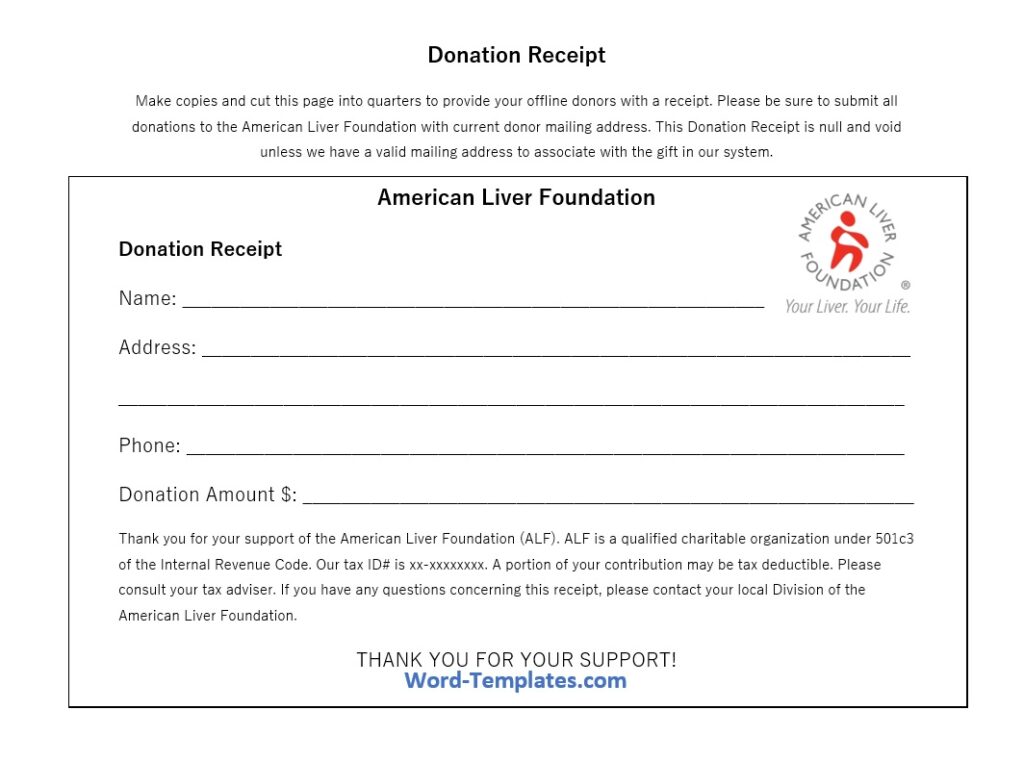
For donated goods and property — a description field with no value line, keeping valuation where it belongs, with the donor.

Here is download link for this donation receipt template 02,

Download link for this donation receipt template 01 is here,

Here is the download button to get this free Donation Receipt Template.
Donation Receipt Variants
In-kind (non-cash) donations. Describe what was received in plain terms and record the date. Don’t state a value, and don’t estimate one when a donor asks — point them to their tax adviser instead. If the gift is a vehicle, boat, or aircraft, or property above certain thresholds, additional forms and appraisal rules apply in the US, so check current guidance before issuing.
Church donation receipts. The requirements are the same as for any other qualifying charity — organization name, donor, amount, date, and the goods-and-services statement. Two practical notes: tithes and offerings are contributions like any other, and where a member has received something in return (a fundraising dinner, a retreat with meals included), the quid pro quo disclosure applies just as it would anywhere else.
Year-end giving summaries. Many organizations send an annual statement in January listing every gift a donor made during the previous year, with the same required statements applied to the total. It’s the most efficient way to acknowledge frequent small donors — and a genuinely appreciated touch. Send it early enough for donors to use while preparing their returns, and keep the individual receipts on file as well.
Receipt books and email receipts. If you receive gifts in person — collection boxes, events, counter donations — a duplicate receipt book with sequential numbering works the same way as any cash receipt: one copy to the donor, one retained. For online gifts, the same required wording belongs in the automated email; the format changes, the content doesn’t.
Outside the US: Canada, the UK, and Elsewhere
Donation receipting is governed by national tax law, and the rules genuinely differ. In Canada, official donation receipts issued by registered charities must carry prescribed elements — including the charity’s registration number and specific required wording — set out by the Canada Revenue Agency. In the UK, the main mechanism is Gift Aid, which works through a donor declaration allowing the charity to reclaim tax, rather than through a deduction receipt of the US kind. Other countries operate their own systems, and some require registration numbers or approved formats on the face of the receipt.
So treat the templates here as a starting layout, and confirm the required elements with your own tax authority before adopting a format for your organization. The structure — who gave, how much, when, what for, and what they received in return — is universal; the mandatory wording is not.
Frequently Asked Questions
What must a donation receipt include?
The charity’s name and tax details, the donor’s name, the date, the amount of cash (or a description of non-cash property), and a statement about goods and services — either that none were provided, or a description and good-faith estimate of what the donor received in return.
What is the “no goods or services” statement?
The sentence confirming the donor received nothing in exchange for their gift — for example, “No goods or services were provided in exchange for this contribution.” Without it, or without the alternative quid pro quo disclosure, an acknowledgment may not support the donor’s deduction.
Should the receipt state the value of donated goods?
No. For non-cash gifts the charity describes the property; valuing it is the donor’s responsibility, and larger items may require a qualified appraisal. Describe what you received and leave the number to the donor and their adviser.
At what amount is a written donation receipt required?
In the US, donors need written acknowledgment from the charity for any single contribution of $250 or more, and a quid pro quo disclosure is required where a payment over $75 was partly for goods or services. Many organizations issue receipts for every gift regardless — it costs little and donors appreciate it. Thresholds change, so verify current figures with the IRS.
Can I send donation receipts by email?
Yes. The required content is the same whether the receipt is printed, emailed, or generated by your donation platform. Keep copies of what was sent, and make sure the automated email carries the goods-and-services statement rather than just a thank-you.
When should year-end donation summaries be sent?
Early in the new year, before donors begin preparing their returns — January is standard practice. Summarize the year’s gifts with dates and amounts, and apply the same required statements to the total.

Pete Smith is a Business Management graduate and a passionate advocate for practical, accessible resources that empower professionals and entrepreneurs to succeed. With a strong foundation in organizational strategy and operational efficiency, Pete combines academic knowledge with real-world insights to simplify complex business processes. He is the creator behind a growing online platform dedicated to offering free, high-quality documents, templates, and actionable tips designed to save time and improve productivity.