An executive summary is a short, standalone version of a longer document — a business plan, project proposal, report, or research paper — written so a busy decision-maker can grasp the whole picture and act on it without reading the full document. It’s the page investors, executives, and funders read first, and often the only page they read closely. The free templates below are editable MS Word files, and below them you’ll find the structure that works, a complete worked example, and the mistakes that make summaries get skipped.
Two Rules That Decide Whether It Works
1. Write it last. An executive summary condenses a finished document. You can’t summarize an argument you haven’t made yet, which is why summaries drafted first read like vague promises (“this plan will explore several opportunities”) instead of conclusions. Finish the document, then distil it.
2. It has to stand alone. A reader who reads only the summary should have enough to make the decision — approve the project, take the meeting, release the funds. This is the line between a summary and an introduction. An introduction says what the document will cover; a summary says what the document found and what you want. If your first sentence begins “This report examines…”, you’ve written an introduction.
Length follows from both: roughly 5–10% of the source document, which for most business uses means one page, two at the absolute limit. If it runs longer, you’re summarizing everything instead of selecting what matters.
The Five-Beat Structure
- The situation or opportunity — what’s happening that makes this document necessary. One or two sentences, concrete.
- What you’re proposing — the plan, project, or recommendation, stated plainly.
- The key evidence — the two or three facts that make the case: market size, cost savings, test results, current numbers. Selected, not listed.
- The ask — what you want from the reader: funding, approval, a decision, a meeting. Name the amount and the deadline. Summaries that never state the ask are the most common kind that fail.
- The outcome — what success looks like, and by when.
Worked Example: Restaurant Business Plan
Here’s the structure applied to a business plan seeking expansion funding. Note that every number is specific, the ask appears explicitly, and the whole thing fits on part of a page:
Executive Summary — Saffron Kitchen, Second Location
Saffron Kitchen is a 40-seat South Asian restaurant that has operated in Springfield’s Mill District since 2022. Revenue has grown from $310,000 to $486,000 over three years, with the kitchen running at capacity on weekends and an average of 60 covers turned away each week.
We propose opening a second 70-seat location in the Harbour Quarter, two miles from the existing site, targeting the same customer base of local families and weekday office lunches. The premises at 14 Harbour Street are available on a five-year lease at $3,200 per month.
The Harbour Quarter has added 1,400 residential units since 2023 and has no comparable South Asian restaurant within a mile. Our existing site draws 22% of its customers from that postcode already, and the same menu and supplier arrangements will transfer, keeping food cost at the current 28% of revenue.
We are seeking $145,000 — $85,000 for fit-out and kitchen equipment, $40,000 for six months of working capital, and $20,000 for launch marketing — structured as a five-year term loan, with a decision needed by 30 November to secure the lease.
On our projections the second location reaches break-even in month nine and contributes $128,000 in annual operating profit by year three, taking group revenue above $1.1 million.
Read it back against the five beats: situation, proposal, evidence, ask, outcome. Nothing in it requires the reader to open the full plan — but everything in it is supported there.
Free Executive Summary Templates in MS Word
Each template below is editable in Word, with the structure laid out as prompts you replace with your own content.
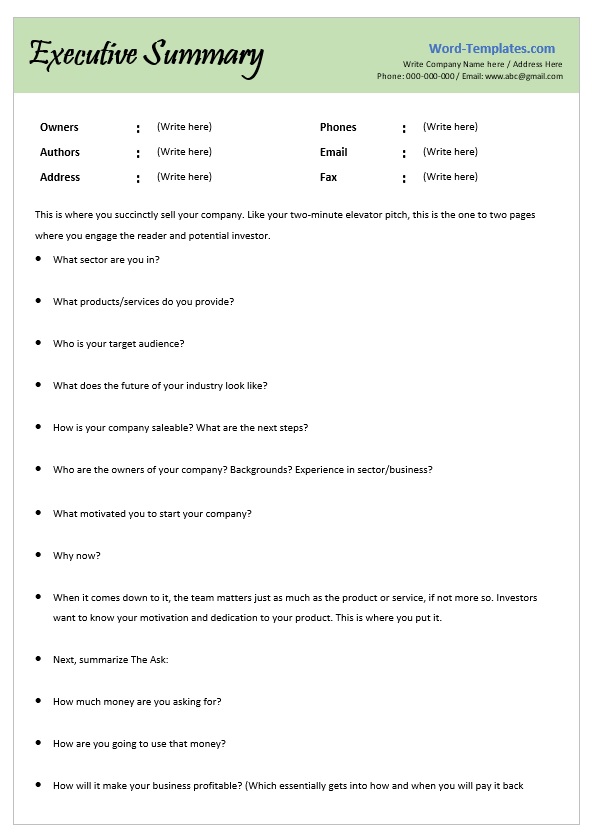
One-Page Executive Summary Template

A single-page narrative layout following the five-beat structure — the default choice for business plans and funding requests.

Sectioned Executive Summary Template

Short headed sections — situation, proposal, evidence, request, outcome — for readers who scan rather than read straight through.

Here is the download button for this Free Executive Summary Template.
Here is the download button for this Free Executive Summary Template.
Executive Summaries by Document Type
The skeleton stays the same; the emphasis shifts depending on what the reader has to decide.
- Business plan — lead with the opportunity and the traction you already have, then the funding ask and the return. Investors are deciding whether to keep reading, so the numbers belong on the first page, not held back for the appendix. See our business plan templates.
- Project proposal — lead with the problem and its cost, then the proposed solution, budget, and timeline. Approvers are deciding whether the problem justifies the spend.
- Report or study — lead with the findings and the recommendation, not the methodology. A report summary that describes how the research was conducted before saying what it concluded has buried the point.
- Business case — lead with the options considered and the recommended one, with the cost and benefit of each stated in a line. The reader wants to know you looked at alternatives.
Common Mistakes
- Writing it first. The summary written before the document promises; the one written after concludes.
- Writing an introduction instead. “This plan outlines our strategy for…” tells the reader nothing. State the strategy.
- Omitting the ask. Surprisingly common, and fatal. Name the amount, the decision, or the action you need — and the date you need it by.
- Including material that isn’t in the document. Everything in the summary must be supported in the body; new claims in a summary undermine both.
- Summarizing evenly. A summary isn’t a proportional shrink of every section. Two paragraphs of the body may deserve a sentence; one number may deserve its own line.
- Jargon and acronyms. The summary is read by people further from the detail than you are — often the furthest of anyone who touches the document.
Frequently Asked Questions
How long should an executive summary be?
About 5–10% of the source document — one page for most business plans, proposals, and reports, and two pages at the outside for long documents. If it’s running longer, you’re summarizing everything rather than selecting what the decision turns on.
What should an executive summary include?
The situation or opportunity, what you’re proposing, the two or three facts that make the case, the specific ask, and the expected outcome. The worked example above shows all five in sequence.
Is an executive summary the same as an introduction?
No. An introduction says what the document will cover; an executive summary says what it found and what you want. The test: could someone who reads only your summary make the decision? If not, it’s an introduction.
Should I write the executive summary first or last?
Last. You can only condense a document that exists, and summaries drafted first tend to describe intentions rather than conclusions. Write the full document, then distil it.
How do I write an executive summary for a restaurant business plan?
Same five beats, restaurant specifics: current trading and demand, the location or concept you’re proposing, the market evidence (footfall, local competition, existing customer data), the funding you need and what it buys, and your break-even point. The example above is written exactly this way.

Pete Smith is a Business Management graduate and a passionate advocate for practical, accessible resources that empower professionals and entrepreneurs to succeed. With a strong foundation in organizational strategy and operational efficiency, Pete combines academic knowledge with real-world insights to simplify complex business processes. He is the creator behind a growing online platform dedicated to offering free, high-quality documents, templates, and actionable tips designed to save time and improve productivity.