A recipe card holds one recipe on a single piece of card you can prop against the kettle and wipe clean afterwards. The free templates below are editable MS Word files in the standard sizes, and beneath them you’ll find what to put on one, how to write a method somebody else can actually follow, and how to capture a family recipe before the person who knows it isn’t there to ask.
Standard Recipe Card Sizes
Pick the size before the design, because it determines how much recipe fits and which boxes and sleeves it will sit in:
| Size | Metric | Suits |
|---|---|---|
| 3 × 5 in | 76 × 127 mm | The classic index card. Fits traditional recipe boxes. Room for a short recipe only. |
| 4 × 6 in | 102 × 152 mm | The most common choice now — enough space for most recipes without becoming a page. |
| 5 × 7 in | 127 × 178 mm | Longer recipes, larger type, or room for a photograph. |
| A6 | 105 × 148 mm | The European near-equivalent of 4 × 6. Four print to an A4 sheet. |
| A5 | 148 × 210 mm | Half an A4 sheet. Good for recipes with long ingredient lists or several components. |
Buy the box or sleeves first if you’re building a collection. Recipe boxes are made for 3×5 and 4×6; a beautifully printed 5×7 card that doesn’t fit the box you already own is a common and avoidable annoyance.
What Goes on a Recipe Card
- The recipe name, at the top and large enough to read while flicking through a box.
- Servings or yield — “serves 4” or “makes 12”. The first thing anyone needs to know.
- Prep time and cook time, separately. Twenty minutes of prep and two hours in the oven is a very different proposition from the reverse.
- Ingredients, with quantities, in the order they’re used.
- Method, numbered.
- Oven temperature and the tin or pan size, where they matter.
- Notes — substitutions, what to serve it with, how it freezes, what goes wrong.
- Source — “Grandma Nair’s”, “adapted from a 1978 magazine”, “Tuesday night invention”. This is the field people are most grateful for years later.
- Date added, which becomes part of the record.
Writing a Recipe Someone Else Can Follow
Four rules, and they’re the difference between a card that works in someone else’s kitchen and one that only makes sense to the person who wrote it:
1. List ingredients in the order they’re used. Not alphabetically, not grouped by type — in the sequence the method calls for them. It lets the cook set out everything in order and work down the list, and it makes a missed ingredient obvious.
2. Put the preparation in the ingredient line. “1 onion, finely diced” rather than “1 onion” followed by “dice the onion” in step three. It front-loads the chopping, which is how people actually cook, and it shortens the method considerably.
3. One action per numbered step. A step containing four instructions is a step someone loses their place in halfway through, usually with wet hands.
4. Say what it should look like, not just how long. “Until golden, about 8 minutes” beats “for 8 minutes.” Ovens run hot and cold, pans conduct differently, and onions vary — but “softened and translucent” means the same thing in every kitchen. This single habit is what separates a recipe that works for other people from one that only works for you.
Two smaller things. Use consistent units, and if the recipe came from elsewhere, convert rather than mixing cups with grams on one card. And write the notes — “don’t skip resting the dough”, “halves easily”, “freezes well before baking, not after”. Those lines are the accumulated experience that makes a family recipe better than the same recipe from a book.
Recipe Card Example
Grandma Nair’s Lemon Cake
Serves 8 · Prep 20 min · Bake 45 min · Oven 170°C / 340°F fan
INGREDIENTS
225g butter, softened
225g caster sugar
4 eggs, at room temperature
225g self-raising flour
2 lemons — zest of both, juice of one
For the drizzle: juice of the second lemon + 85g granulated sugar
METHOD
1. Line a 2lb loaf tin and heat the oven.
2. Beat the butter and sugar until pale and fluffy — about 4 minutes.
3. Add the eggs one at a time, beating after each. If it curdles, add a spoonful of the flour.
4. Fold in the flour, then the lemon zest and juice.
5. Bake 45 minutes, until a skewer comes out clean and the top springs back.
6. Mix the drizzle ingredients. Prick the warm cake all over and spoon it on slowly.
Notes: Better on day two. Freezes well undrizzled.
From: Priya Nair, written down 2019 · she never measured the drizzle — this is my version
Look at what the rules produce. Ingredients are in the order they’re used, with the prep in the line (“softened”, “at room temperature”). The method has one action per step, and step 5 says what to look for rather than trusting the clock. And the source line records both who it came from and the honest note that the drizzle was never measured — which is exactly the kind of detail a family recipe loses if nobody writes it down.
Free Recipe Card Templates in MS Word
Each template below is editable in Word. Set the size first, then fill in the recipe and print onto card.
Blank Recipe Card Template
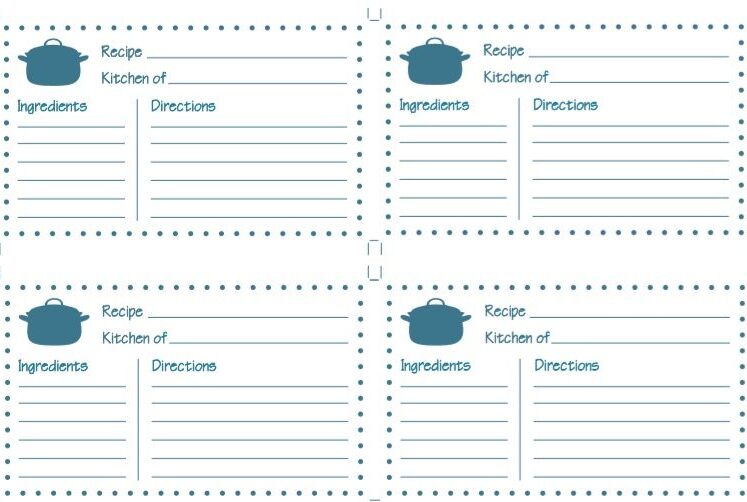
A clean 4 × 6 layout with fields for servings, times, ingredients and method — the one to print in quantity.

Family Recipe Card Template

Includes a “from” line and a notes area for the variations and warnings that get passed down with the recipe.
Blank Recipe Card Template
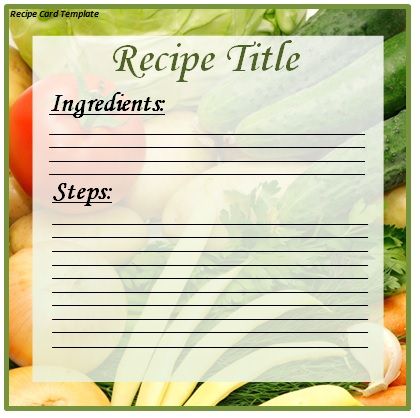
Click on this download button to get this Recipe Card Template as a freebie.
Customizable Recipe Card Design
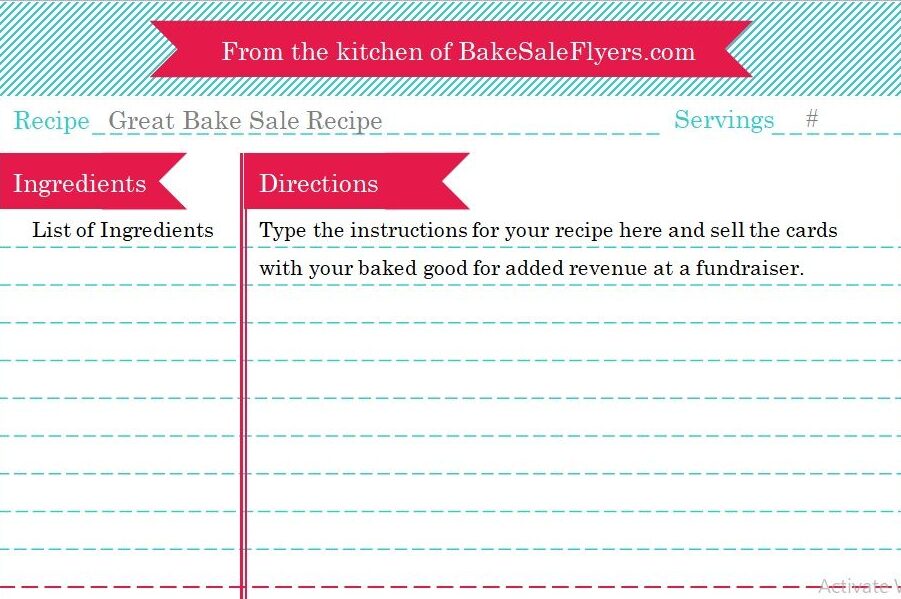
Click on this download button to get this Recipe Card Template as a freebie.
Digital Recipe Card Template
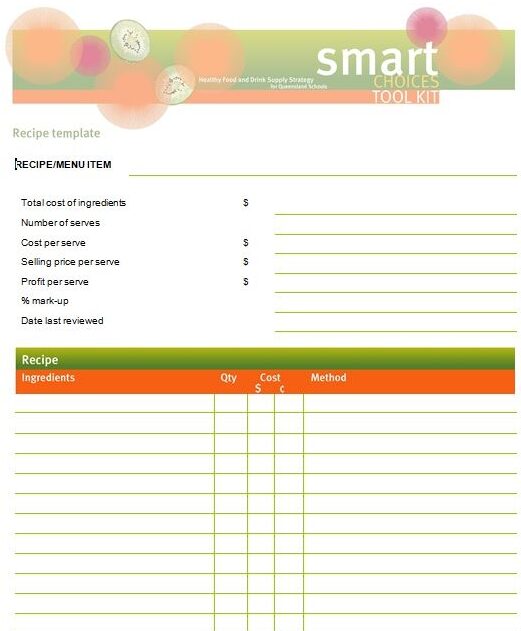
Click on this download button to get this Recipe Card Template as a freebie.
Kitchen Recipe Card Layout

Click on this download button to get this Recipe Card Template as a freebie.
Cute Recipe Card Printable
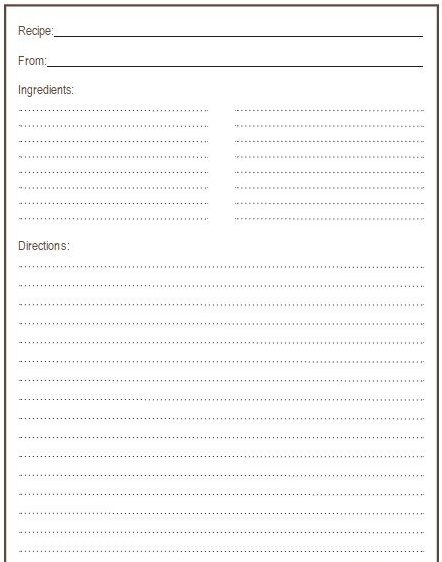
Click on this download button to get this Recipe Card Template as a freebie.
Minimalist Recipe Card Design

Click on this download button to get this Recipe Card Template as a freebie.
Family Recipe Card Template

Click on this download button to get this Recipe Card Template as a freebie.
Writing Down Family Recipes
The reason most people look for recipe cards, and the one worth doing sooner rather than later.
Family recipes usually exist in someone’s hands rather than on paper. They’re cooked by eye, adjusted by taste, and described in quantities like “a knob of butter”, “enough flour”, and “cook it until it looks right”. When that person isn’t there to ask, the recipe goes with them — and a card written afterwards from memory is never quite it.
How to capture one properly:
- Cook it with them and write as you go. Far better than asking them to dictate it. People who cook by instinct genuinely can’t recall what they do until their hands are doing it.
- Weigh the vague bits. When they reach for “a knob of butter”, put it on the scales. Record both — “a knob of butter (about 30g)” — because the phrase is part of the recipe and the number is what makes it repeatable.
- Ask what goes wrong. “What happens if you overmix it?” and “how do you know when it’s done?” produce the information that isn’t in any written version.
- Record the substitutions they make without thinking, and what they do differently at Christmas or when feeding more people.
- Write down who it came from and when — and where they got it, if they know. “My mother’s, from her time in Nairobi” is worth as much as the method.
- Photograph the original if one exists — the handwritten card, the splattered page, the back of an envelope. Keep the image with the typed version.
- Cook it yourself from your own card before you consider it finished. That’s when you discover the step you didn’t write down.
Printing and Keeping Them
- Print on card, 250 gsm or heavier. Recipe cards live in kitchens, and paper doesn’t survive one.
- Four A6 cards to an A4 sheet, or two 5 × 7. Trim with a guillotine.
- Print at 100%, never “fit to page,” or the card won’t be the size you chose and won’t fit the box.
- Laminate, or use plastic sleeves. A sleeve is better if you’ll add notes later; lamination is better for cards you’ll hand to other people.
- Leave a margin at the bottom for pencilled notes — “used half the sugar”, “needed 10 min longer”. That accumulated marginalia is what makes a card yours.
- Use dividers if you’re building a box: starters, mains, baking, preserves, whatever matches how you cook rather than how a cookbook is organised.
- Keep a digital copy. Photograph or scan each card as you complete it. Kitchens are hostile to paper, and a fire or a flood takes the collection with it.
Recipe Cards as a Gift
Three that work particularly well:
A boxed set of family recipes for a wedding, a house move, or someone leaving home — ten or fifteen cards of the things they grew up eating, in a box with dividers. It costs very little and it’s the sort of present people still have twenty years later.
Blank cards at a bridal or baby shower. Guests write a favourite recipe on a card during the afternoon, and the couple leaves with a collection in everyone’s handwriting. Put the cards and pens on the tables rather than announcing it as an activity.
A single card with a gift. A jar of something homemade with the recipe card tied to it, or a cake tin with the recipe for what to bake in it.
Planning what to cook rather than recording it? Our menu planner templates cover the week’s meals, and the grocery list templates are organised by aisle for the shop that follows.
Frequently Asked Questions
What size is a standard recipe card?
3 × 5 inches is the classic index card size and 4 × 6 is now the most common. 5 × 7 suits longer recipes, and A6 is the European near-equivalent of 4 × 6. Check what size box or sleeves you have before printing a set.
What should be on a recipe card?
The recipe name, servings, prep and cook times, oven temperature and tin size, the ingredients with quantities, a numbered method, notes, and where the recipe came from. The source line is the one people value most years later.
What order should ingredients be listed in?
The order they’re used in the method — not alphabetically or by category. It lets the cook work down the list in sequence and makes a missed ingredient obvious.
How do I write a recipe clearly?
Put the preparation in the ingredient line (“1 onion, finely diced”), keep to one action per numbered step, and describe what the food should look like rather than only giving a time — “until golden, about 8 minutes” works in every kitchen, while “8 minutes” doesn’t.
How do I write down a family recipe?
Cook it with the person and write as you go, weighing the vague measurements as they reach for them. Ask what goes wrong and how they know when it’s done, record who it came from, and photograph any original handwritten version.
What paper should recipe cards be printed on?
Card of 250 gsm or heavier, printed at 100% scale so the size is right. Laminate them or use plastic sleeves — sleeves are better if you want to add pencilled notes later.
How should I organise a recipe card box?
With dividers matching how you actually cook — weeknight dinners, baking, preserves, Christmas — rather than the categories a cookbook uses. Keep a photographed or scanned copy of each card as backup.

Pete Smith is a Business Management graduate and a passionate advocate for practical, accessible resources that empower professionals and entrepreneurs to succeed. With a strong foundation in organizational strategy and operational efficiency, Pete combines academic knowledge with real-world insights to simplify complex business processes. He is the creator behind a growing online platform dedicated to offering free, high-quality documents, templates, and actionable tips designed to save time and improve productivity.