A competitive analysis (or competitor analysis) is a structured comparison of your business against its rivals: what they sell, what they charge, who they target, and where they’re strong or weak. Done honestly, it shows you where you can win — the gap no competitor covers — and where you shouldn’t fight. The free templates below are editable MS Word documents built around the standard competitor comparison matrix. Beneath them you’ll find the steps for doing the analysis, a filled-in example matrix, and how this document relates to a SWOT and a market analysis.
How to Do a Competitive Analysis
1. Pick the right competitors — and not too many. Include your direct competitors (same product or service, same customers) and one or two indirect ones (a different product solving the same need — a meal-kit service competes with restaurants, not just other meal kits). Three to five companies analyzed in depth beats fifteen skimmed; the matrix below has columns, not a census.
2. Compare everyone on the same dimensions. The standard set: products and key features, pricing, target customer, sales and distribution channels, marketing message and positioning, and visible strengths and weaknesses. Using identical dimensions for every competitor is what turns scattered impressions into an analysis — it’s also exactly what the template’s rows enforce.
3. Gather information from sources you can actually access. Competitor websites and pricing pages, customer reviews (read the three-star ones — they state strengths and weaknesses in the same breath), their social media and advertising, their job postings (hiring reveals strategy: a rival recruiting delivery drivers is about to compete on delivery), and conversations with customers who considered them. All public, all legitimate.
4. Fill the matrix, then write the “so what.” The table organizes facts; the value is the paragraph you write under it: where you’re genuinely stronger, where you’re weaker, and the one gap in the market nobody’s covering. If the completed matrix doesn’t change anything you do, it was a filing exercise — push until it yields at least one decision.
Competitor Comparison Matrix: A Filled-In Example
Here’s the standard matrix completed for a fictional example — three competing tutoring centers in one city. The templates below contain blank versions of this table:
| Dimension | Your Business (BrightPath Tutoring) |
Competitor A (ScoreMax Center) |
Competitor B (TutorNow Online) |
|---|---|---|---|
| Offering | Small-group tutoring, grades 6–12, math & science | 1-on-1 test prep, all subjects | On-demand online sessions, any subject |
| Pricing | $25/hr (group of 4) | $70/hr | $18/hr |
| Target customer | Families wanting steady term-time support | Exam-year students, affluent families | Price-sensitive, urgent homework help |
| Channel | In-person center; school referrals | In-person; paid search ads | App/website; social media ads |
| Main strength | Affordable + consistent same-tutor groups | Strong exam results, premium brand | Instant availability, lowest price |
| Main weakness | No online option yet | Price excludes most families | Different tutor every session; no continuity |
The “so what” for this example: neither competitor offers affordable tutoring with tutor continuity — ScoreMax has continuity at triple the price, TutorNow has low prices with none. BrightPath’s gap to own is “the same trusted tutor, at a group price” — and its exposed flank is online delivery, which suggests piloting online group sessions before TutorNow adds continuity features. That paragraph — not the table — is the analysis.
Free Competitive Analysis Templates in MS Word
Each template below is editable in Word — add or remove competitor columns and dimension rows to fit your market, fill it in from the sources above, and finish with your own “so what” paragraph.

Here is the download link for this Market Competitive Analysis Template 01 in MS Word Format.


The download link for this Market Competitive Analysis Template 02 in MS Word Format is below.

Please click on the download button below to start downloading this Market Competitive Analysis Template 03.

To download this Market Competitive Analysis Template 04, click on the button below.
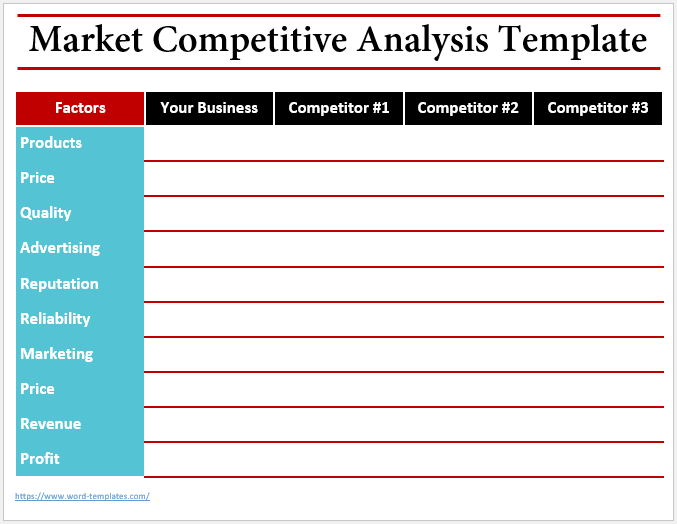
Please click on the button below to download this Market Competitive Analysis Template 05.
Competitive Analysis vs. SWOT vs. Market Analysis
These three tools overlap and are often confused, but they answer different questions:
- Competitive analysis looks outward at specific rivals: who they are, what they offer, and where they’re vulnerable. Its output is the comparison matrix above.
- SWOT analysis looks at your own business: internal strengths and weaknesses, external opportunities and threats. A completed competitor matrix feeds directly into it — rivals’ weaknesses become your opportunities, their strengths become threats. See our SWOT analysis templates for that next step.
- Market analysis looks at the whole market: its size, growth, customer segments, and trends — without focusing on any single rival. Business plans typically include a market analysis first, then a competitive analysis inside it.
In a typical planning sequence: market analysis establishes whether the opportunity is big enough, competitive analysis establishes whether you can win it, and SWOT condenses both into your strategy.
Frequently Asked Questions
What is included in a competitive analysis?
A defined set of competitors (direct and indirect) compared on consistent dimensions — offering, pricing, target customer, channels, positioning, strengths, and weaknesses — followed by conclusions: where you’re stronger, where you’re exposed, and what gap you can own.
What is the difference between a competitive analysis and a SWOT analysis?
A competitive analysis studies your rivals; a SWOT studies your own business. They connect: competitor weaknesses surface as your opportunities in the SWOT, and their strengths as threats. Doing the competitor matrix first makes the SWOT’s external half much sharper.
How many competitors should I analyze?
Three to five direct competitors plus one or two indirect ones. Beyond that, depth collapses into skimming — and the analysis exists to produce decisions, which requires depth. If your market has many players, analyze the leaders plus whoever most resembles you.
How often should a competitive analysis be updated?
Review it at least once a year, and immediately when something material changes — a competitor’s price move, a new entrant, or a major product launch. Keeping last year’s version alongside the update also shows you the direction each rival is moving, which a single snapshot can’t.
What is the difference between market analysis and competitor analysis?
Market analysis measures the arena — market size, growth, segments, and trends. Competitor analysis studies the other players in it. A business plan usually needs both: the market analysis proves the opportunity exists; the competitor analysis proves you can take a share of it.

Pete Smith is a Business Management graduate and a passionate advocate for practical, accessible resources that empower professionals and entrepreneurs to succeed. With a strong foundation in organizational strategy and operational efficiency, Pete combines academic knowledge with real-world insights to simplify complex business processes. He is the creator behind a growing online platform dedicated to offering free, high-quality documents, templates, and actionable tips designed to save time and improve productivity.