A SWOT analysis sets out the four things that decide whether a plan works: your Strengths and Weaknesses, which are internal and within your control, and the Opportunities and Threats in the world around you, which aren’t. It takes an hour, needs no software, and is the most widely used strategic tool there is. The free templates below are editable MS Word grids — and below them you’ll find a completed example, how to run the exercise properly, and how to turn a finished SWOT into decisions rather than a page nobody reads again.
The Four Quadrants
- Strengths — internal, helpful. What you do well, what you own, what you’re better at than the alternatives.
- Weaknesses — internal, harmful. What you lack, what you do badly, where you’re exposed.
- Opportunities — external, helpful. Changes in the market, customers, technology, or regulation you could benefit from.
- Threats — external, harmful. The same kinds of changes, pointed the other way.
The rule that keeps a SWOT honest is the internal/external split, and it’s where most people go wrong. Strengths and weaknesses are things you can act on directly. Opportunities and threats exist whether or not you do — they’d be true if your business closed tomorrow.
Two quick tests. “The market is growing” is not a strength; it’s an opportunity, because you didn’t create it and can’t control it. “A competitor cut their prices” is not a weakness; it’s a threat. If you can change it by deciding to, it belongs on the left side of the grid. If you can only respond to it, it belongs on the right.
SWOT Analysis Example
Here’s a completed SWOT for a newly opened restaurant — the templates below use this same grid:
| HELPFUL | HARMFUL | |
| INTERNAL |
STRENGTHS
|
WEAKNESSES
|
| EXTERNAL |
OPPORTUNITIES
|
THREATS
|
Note how specific the entries are. “Good food” and “strong competition” would fill the grid without telling anyone anything; “menu prices 15% below the two nearest competitors” and “national chain opening next year” can actually be acted on.
Free SWOT Analysis Templates in MS Word
Each template below is editable in Word — type into the four quadrants, add or remove rows, and print or share.
Classic SWOT Matrix Template (2×2 Grid)
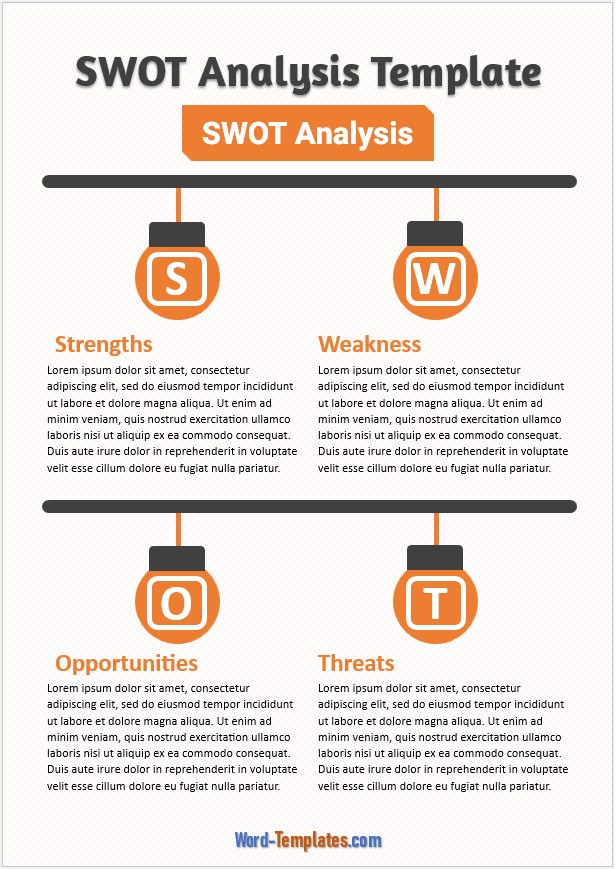
The standard four-quadrant grid with internal and external axes labelled — the layout shown above.

SWOT Analysis Template with Action Section
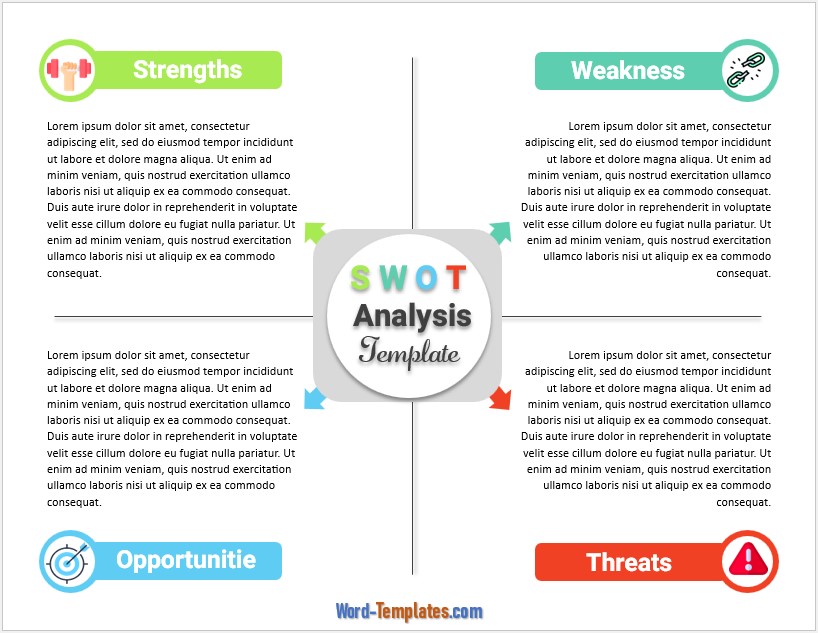
The four quadrants plus space underneath for the strategies each combination suggests — useful when the SWOT feeds a plan.
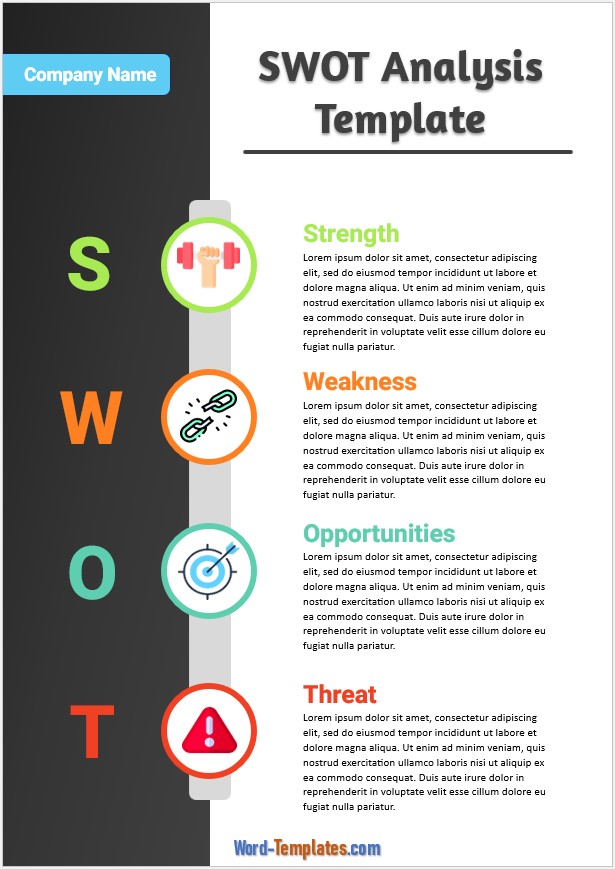

How to Run a SWOT Analysis
- Decide what the SWOT is for. “SWOT of our business” produces a vague grid. “SWOT for opening a second location” or “SWOT for bidding on this contract” produces a useful one, because every entry can be judged against a real decision.
- Gather evidence before filling anything in. Customer feedback, sales figures, staff observations, a look at what competitors are doing. A SWOT written from memory in a meeting room records opinions, not conditions.
- Involve more than one person. Weaknesses in particular are hard to see from inside your own job. Front-line staff usually name them faster than management.
- Write specifics, not adjectives. “Experienced team” is decoration; “three developers with ten years each in payments systems” is a strength you can build a bid around.
- Keep it to four to six entries per quadrant. Longer lists feel thorough and act as camouflage — the important item disappears among the obvious ones.
- Finish by converting it into actions. See TOWS below. A SWOT that ends as a completed grid has cost you an hour and changed nothing.
TOWS: Turning a SWOT Into Decisions
This is the step most SWOT exercises skip, and the reason so many completed grids get filed and forgotten. A TOWS matrix pairs the quadrants to produce four kinds of strategy:
- Strengths + Opportunities ? leverage. Which strengths let you capture which opportunities? Restaurant example: the chef’s local reputation and lower prices are exactly what a new office complex of 400 staff would respond to — build a lunch offer and market it to them before the chain arrives.
- Strengths + Threats ? defend. Which strengths protect you from which threats? Distinctive dishes the incoming chain can’t copy are the defence against it; price-matching a national chain isn’t.
- Weaknesses + Opportunities ? build. Which weaknesses block you from taking an opportunity, and what would fix them? No marketing activity is what stands between the restaurant and 400 new potential customers — and the council regeneration grant might fund it.
- Weaknesses + Threats ? avoid or mitigate. Where a weakness meets a threat, you have your real risk. Limited working capital plus a rent increase in 14 months is the combination that closes the business — so the reserve matters more than anything else on the grid.
Four pairings, four or five concrete actions, each with an owner and a date. That’s the output worth keeping — the grid is just how you got there. Where an action means closing a measurable gap, a gap analysis turns it into a plan; where it means managing a threat, a risk analysis is the next document.
Common Mistakes
- Putting external factors in the internal boxes. Market growth, competitor moves, and new regulation belong on the right-hand side, always.
- Listing wishes as opportunities. “Expand internationally” is a plan, not an opportunity. The opportunity is the external condition that would make it work.
- Vagueness. If an entry could appear on any company’s SWOT, it isn’t telling you anything.
- Treating every entry as equal. Mark the two or three items in each quadrant that actually matter; the rest is context.
- Doing it once. A SWOT describes a moment. Revisit it annually, and whenever something on the external side visibly changes.
- Stopping at the grid. The most common failure of all — see TOWS above.
Variations
- Business SWOT — the whole organization’s position, usually as part of a business plan or annual strategy review.
- Project SWOT — one initiative, before committing resources. Narrower, and usually more useful because the objective is already defined.
- Competitor SWOT — the same grid applied to a rival, to see where they’re exposed. Pairs directly with a competitive analysis, where the comparison matrix supplies the raw material.
- Personal SWOT — applied to your own career: skills and experience as strengths, gaps as weaknesses, industry shifts and openings as opportunities, and automation or market contraction as threats. A quick and honest way to plan a next move.
Frequently Asked Questions
What is a SWOT analysis?
A framework for assessing a business, project, or person across four quadrants: strengths and weaknesses (internal factors you control) and opportunities and threats (external factors you don’t). It’s used to decide where to focus effort and what to protect against.
What is the difference between a weakness and a threat?
A weakness is internal — something about you that you could change, like thin cash reserves or no marketing. A threat is external — something happening around you regardless, like a new competitor or rising costs. The test: could you fix it by deciding to? Then it’s a weakness.
What is a TOWS matrix?
The action step after a SWOT. It pairs quadrants to generate strategies: strengths with opportunities (leverage), strengths with threats (defend), weaknesses with opportunities (build), and weaknesses with threats (mitigate). It’s what turns a completed grid into decisions.
How many items should go in each quadrant?
Four to six. Longer lists look thorough but bury the entries that matter — and a SWOT exists to focus attention, not to catalogue everything true about your business.
How do I write a personal SWOT analysis?
Same grid, applied to you: skills, experience, and network as strengths; gaps and constraints as weaknesses; industry growth, openings, and training as opportunities; and automation, market contraction, or a narrowing skill set as threats. Then run the TOWS pairings to produce next steps.
When should a SWOT analysis be updated?
At least annually, and immediately when something on the external side changes materially — a competitor entering or leaving, a regulatory shift, a major cost movement. Keeping last year’s version alongside the new one also shows you which way things are moving.

Pete Smith is a Business Management graduate and a passionate advocate for practical, accessible resources that empower professionals and entrepreneurs to succeed. With a strong foundation in organizational strategy and operational efficiency, Pete combines academic knowledge with real-world insights to simplify complex business processes. He is the creator behind a growing online platform dedicated to offering free, high-quality documents, templates, and actionable tips designed to save time and improve productivity.