A donation flyer asks people for money, which means it has to do two things quickly: explain what the money is for, and make giving easy. The free templates below are editable MS Word designs for charity appeals, school fundraisers, community causes and church collections. Beneath them you’ll find the single change that lifts response more than any design decision, plus what has to appear on a fundraising appeal and how to handle the more sensitive kinds.
Suggested Amounts, With What They Buy
“Please give generously” leaves the reader with a question they didn’t want: how much is normal here? Many people resolve it by giving nothing, or by giving whatever coins are nearest.
Suggested amounts remove the question, and attaching an outcome to each one turns an abstract donation into something closer to a purchase:
| Amount | What it does |
|---|---|
| £10 | A hot meal and a bed for one night |
| £25 | A week of evening meals for one person |
| £50 | Emergency clothing and toiletries for a family |
| £100 | A month of one-to-one support for someone leaving the shelter |
Three or four options is the right number. Start at an amount almost anyone could give, and let the range run higher than you expect — people frequently give at the second or third level rather than the first, and a flyer whose top figure is £20 has quietly decided nobody would have given £50.
Work the figures out from real costs rather than inventing round numbers, and be ready to explain them if asked. “£25 buys a week of meals” should be traceable to something in your accounts.
What a Donation Flyer Must Say
- Who you are — the organization’s name, logo, and charity registration number. In many jurisdictions, registered charities must state their registered status on fundraising material.
- The need — specific and current. “Our winter shelter opens on 1 November and we are £8,000 short” beats a general description of your work.
- What donations do — the amounts table above.
- How to give — several routes. See below.
- A target or deadline, if you have one. Both create a reason to act now rather than later.
- A contact — a name, phone number, or email for questions.
- Gift Aid or tax relief information where it applies, without overstating it.
Donation Flyer Example
RIVERSIDE COMMUNITY TRUST
KEEP THE WINTER
SHELTER OPEN
Last winter our Mill Lane shelter provided 1,840 nights of safe accommodation. This year we open on 1 November — and we are £8,000 short of the cost of running it.
| £10 | A hot meal and a bed for one night |
| £25 | A week of evening meals |
| £50 | Emergency clothing for a family |
Give online: riverside.example/winter
Bank transfer: sort 00-00-00, acc. 00000000
In person: Mill Lane Hall, Mon–Fri, 9am–4pm
By post: cheques to Riverside Community Trust
Riverside Community Trust · Registered charity no. 0000000
UK taxpayers: Gift Aid adds 25p to every £1 at no cost to you — please ask for a form.
Questions? Call 01000 000204.
Three things worth copying. The need is quantified and dated — 1,840 nights, 1 November, £8,000 short — rather than described in general terms. There are four ways to give, so nobody is excluded by not having a smartphone or a chequebook. And the registration number and Gift Aid line sit at the foot, which is where they belong and where they’re most often left off entirely.
Free Donation Flyer Templates in MS Word
Each template below is editable in Word. Replace the text, drop in a photograph, and print at home or at a copy shop.
Charity Appeal Flyer Template

A single-page appeal with a photograph area, the need stated at the top, a suggested amounts table, and a block for ways to give.

School Fundraiser Flyer Template
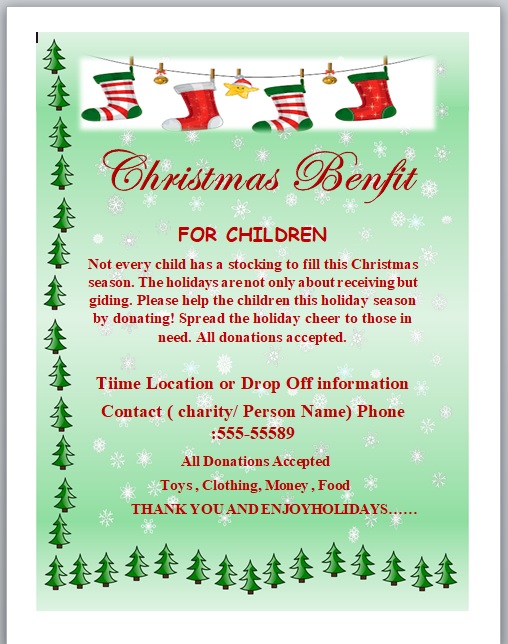
Brighter and shorter, for PTA appeals and sponsored events — what the money is for, how to give, and the date it’s needed by.

You can get this Donation Flyer Template from the below download button.
Ways to Give
Every route you leave off is a group of people who wanted to give and couldn’t. Offer at least three:
- A QR code to an online donation page. The highest-converting option, because it captures the moment someone is holding the flyer. Print it large enough to scan from a wall — at least 2 cm square — and test it with two different phones before printing.
- A short web address alongside the QR code, for anyone who won’t scan one.
- Bank details for a direct transfer. Include a reference so you can identify the gift.
- In person — an address and opening hours, or the collection point at an event.
- By post, with the exact name cheques should be made payable to.
- Text-to-give, if you have it set up.
Mention Gift Aid or your local tax relief scheme where it applies. In the UK, Gift Aid adds 25% to a donation from a taxpayer at no cost to them, and many donors don’t tick the box simply because nobody asked. Don’t overstate it, and don’t promise tax treatment you can’t deliver.
Record what comes in against the appeal so you can report back — our donation receipt templates cover the paperwork, and donation certificates suit thanking larger or corporate donors afterwards.
Photographs and Dignity
The image usually does more than the text, which makes it worth thinking about properly.
- Get written consent from anyone identifiable, and be explicit about where the image will appear. Consent for a newsletter is not consent for a flyer distributed across a town.
- Be especially careful with children — consent from a parent or guardian, and consider whether the image is necessary at all.
- Show people as capable, not pitiable. An image of someone doing something — cooking, working, teaching, rebuilding — raises more than an image of someone looking helpless, and it’s fairer to the person in the photograph.
- Don’t use stock photographs of people in a way that implies they’re your beneficiaries.
- A photograph of volunteers or your premises is a perfectly good alternative when you can’t photograph beneficiaries appropriately.
Fundraising for an Individual
Many people use donation flyers to raise money for one person or family — medical costs, a funeral, a house fire, an unexpected crisis. That’s a legitimate and common use, and it works differently from charity fundraising in ways worth being clear about.
- Say plainly that it isn’t a registered charity appeal. Don’t use charity language, a registration number that isn’t yours, or wording that implies tax relief. Donors are entitled to know what they’re giving to.
- Name where the money goes — which account, held by whom, and who decides how it’s spent.
- Say what happens to any surplus before you start collecting. It’s an awkward conversation afterwards and a simple line beforehand.
- Consider a crowdfunding platform rather than a bank account on a flyer. The fee buys donor protections, a public record of what was raised, and a page you can update — all of which make people more willing to give.
- Get the family’s agreement to everything you publish, including photographs and how you describe their circumstances.
- Report back. Publish the total raised and what it paid for. People who gave will look for it, and they’ll remember whether it appeared.
In-Memoriam Appeals
Asking for donations in memory of someone is one of the most common fundraising requests there is, and it needs a lighter hand than a general appeal.
With the family’s agreement, name the person and say briefly why the cause mattered to them — that connection is the whole reason people give. Keep the design restrained; a memorial appeal in bright fundraising colours reads badly. State the cause and how to give simply, without suggested-amount tables or urgency devices, and offer to tell donors the total afterwards, which families almost always want to know.
If the appeal is attached to a funeral, coordinate the wording and timing with the family and the funeral director rather than producing something separately.
Printing and Distribution
- A5 for handouts, A4 for noticeboards. Print on 130–170 gsm so it doesn’t feel disposable.
- Ask permission for shop windows, cafés, libraries, community centres and church porches — almost all will say yes to a local cause.
- Test the QR code on a printed copy rather than on screen, and on more than one phone.
- Put them where your supporters already are rather than where footfall is highest. Fifty flyers to the right group beats five hundred to passers-by.
- Date the appeal so old flyers can be identified and removed.
- Take them down when the appeal closes, and update the online page with the result.
- Report back to everyone. The total raised and what it funded — this is what makes the next appeal work, and most organizations skip it.
Other fundraising documents: sponsorship proposals for approaching businesses, raffle tickets for fundraising events, and annual reports for telling supporters what their money achieved over the year.
Frequently Asked Questions
What should a donation flyer include?
Your organization’s name and charity registration number, a specific and current statement of the need, suggested amounts with what each one funds, several ways to give, any deadline or target, and a contact for questions.
Why should I put suggested amounts on a donation flyer?
Because “give generously” leaves the reader guessing what’s normal, and many resolve that by giving nothing. Three or four amounts, each with what it buys, removes the question and gives the donation a known outcome.
Do I need to put my charity number on a fundraising flyer?
In many jurisdictions, yes — registered charities are required to state their registered status on fundraising material. Check the rules where you operate, and include it regardless: it tells donors you’re accountable to someone.
How should I handle photographs of the people we help?
Get written consent covering the specific use, take extra care with children, and choose images that show people as capable rather than helpless. A photograph of volunteers or your premises is a fine alternative when you can’t photograph beneficiaries appropriately.
Can I use a donation flyer to raise money for one person?
Yes, but say clearly that it isn’t a registered charity appeal, name where the money is held and who controls it, state what happens to any surplus, and consider a crowdfunding platform for the donor protections and the public record.
How do I write a donation appeal in memory of someone?
With the family’s agreement, name the person and say briefly why the cause mattered to them. Keep the design restrained, skip urgency devices and suggested-amount tables, and offer to share the total afterwards — families almost always want to know.
What is the best way for people to donate from a flyer?
A QR code to an online page converts best because it captures the moment the flyer is in someone’s hand. Print it at least 2 cm square, test it on a printed copy, and offer bank details, a collection point and a postal address alongside it.
