A petty cash log is the running record of a small cash fund kept on the premises for minor expenses — stamps, taxi fares, milk for the office, an urgent part from the hardware shop. It records every amount that leaves the box, what it was for, who took it, and what’s left. The free templates below are editable MS Word and Excel files, and beneath them you’ll find a filled-in example, the system that makes petty cash controllable, and the handful of rules that stop a cash box quietly emptying.
The Imprest System
Almost every petty cash fund is run on the imprest system, and understanding it explains every column on the log.
You set the fund at a fixed float — say 200. That amount goes into the box and stays as the fund’s official size. As money is spent, receipts and vouchers go back into the box in place of the cash. So at any moment:
Cash in the box + receipts and vouchers in the box = the float
When the cash runs low, you reimburse the fund back to exactly the float — not by a round number, but by whatever amount restores it to 200. The receipts are handed to accounts, coded to their expense categories, and the box starts again with a full float and no receipts in it.
That’s the whole mechanism, and its value is that the fund can be checked at any moment by one subtraction. If the cash and the receipts don’t add up to the float, something is wrong right now — not at month end.
What Goes in a Petty Cash Log
- Date of each transaction.
- Voucher number — sequential, matching the slip filed in the box.
- Description — what was bought, specifically. “Office supplies” tells nobody anything; “printer toner, Ryman, receipt attached” does.
- Received by — the name of the person who took the cash, ideally with their initials on the voucher.
- Expense category or account code, so the receipts can be coded when the fund is reimbursed.
- Amount out for each disbursement.
- Amount in for the opening float and each reimbursement.
- Running balance — the cash that should be in the box after each line. This is the column that makes the log useful; without it you only know the position at month end.
- Custodian and period at the top, plus signature lines for the reconciliation at the foot.
Petty Cash Log Example
|
PETTY CASH LOG | Period: September 2026 | Float: 200.00 Custodian: S. Malik, Office Manager |
||||||
| Date | Vch | Description | Received by | Out | In | Balance |
|---|---|---|---|---|---|---|
| 1 Sep | — | Opening float | — | — | 200.00 | 200.00 |
| 3 Sep | 041 | Postage — 12 recorded delivery items | D. Ferreira | 38.40 | — | 161.60 |
| 8 Sep | 042 | Taxi — client collection from station | K. Osei | 22.00 | — | 139.60 |
| 12 Sep | 043 | Printer toner, black — receipt attached | S. Malik | 54.95 | — | 84.65 |
| 19 Sep | 044 | Refreshments — board meeting | S. Malik | 31.20 | — | 53.45 |
| 24 Sep | 045 | Keys cut — storeroom, ×3 | R. Silva | 13.50 | — | 39.95 |
| 30 Sep | — | Reimbursement — restore to float | — | — | 160.05 | 200.00 |
|
Month-end reconciliation, 30 September Cash counted in box: 39.95 + Receipts and vouchers held: 160.05 = 200.00 — agrees to float. No overage or shortage. Counted by: ____________________ Verified by: ____________________ Date: __________ |
||||||
Note the reimbursement line: 160.05, not 150 or 200. The fund is topped back up by exactly the amount spent, which is what returns it to the float and is the whole point of the imprest system. Note too that the person counting and the person verifying are different — that separation is what makes the reconciliation worth signing.
Free Petty Cash Log Templates in MS Word and Excel
Each template below is editable. Pick the one matching how much detail your organization records — a simple log for a small office, or a version with voucher numbers, purpose, and receipt columns where the fund is larger or audited.

Download this editable petty cash log template in MS Word format from the link below.


Here is the download link for this petty cash log with Check Numbers in MS Word format inside a ZIP file.

Yet another petty cash log with Purpose in MS Word format.

You can download this petty cash log with Receipts from the link below.

Click on the button below to download this printable petty cash log.

Here is the download link for this Simple petty cash log template in MS Word format.
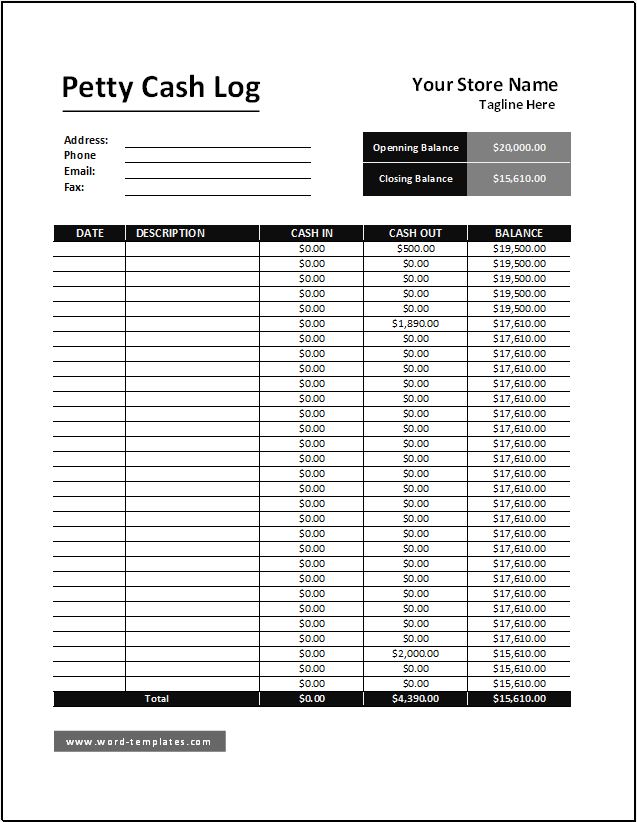
Click on the download button below to grab this Petty Cash Log in MS Excel format for free.
Vouchers and Receipts
The log is the running record; the petty cash voucher is the individual slip behind each line. A voucher records the date, amount, what it was for, the expense category, and — importantly — is signed by whoever took the cash. It goes into the box with the receipt stapled to it, and its number appears in the log.
The rule worth holding to is simple: no receipt, no reimbursement. Where a receipt genuinely can’t be obtained — a parking meter, a bus fare — the custodian completes a voucher noting why, and someone else countersigns it. That keeps the exception visible rather than turning into a habit.
Controls That Keep the Fund Honest
- One custodian. A single named person is responsible for the box, holds the only key, and is the only one who disburses from it. Shared responsibility for cash is no responsibility at all.
- A locked box, not a drawer. And not the same drawer the key lives in.
- Set a per-transaction limit — commonly a modest amount, above which the expense goes through a proper purchase order or a payment request instead. Petty cash exists for small, urgent items, not to bypass procurement.
- No IOUs. This is the classic way petty cash funds fail: someone borrows 40 from the box, leaves a note promising to repay on Friday, and the note is still there in March. A petty cash fund is not a staff loan scheme, and a scrap of paper is not a receipt.
- Never use it for payroll, wages, or advances on salary.
- Surprise counts by someone other than the custodian, at irregular intervals. Announced monthly counts catch far less.
- Separate the roles. The person who holds the cash shouldn’t be the only person who checks it — hence the two signature lines on the reconciliation.
- Keep the completed logs and vouchers with your other accounting records, for the same retention period.
Reconciling and Replenishing
Reconcile on a set schedule — monthly for most small offices, weekly where the fund turns over quickly — and always before requesting a reimbursement.
The process takes five minutes: count the cash, total the vouchers and receipts, and add the two together. The result should equal the float exactly. If it doesn’t, you have an overage or a shortage, and the right response is to record it on the log and investigate, not to quietly round the balance. Small discrepancies usually turn out to be a missing voucher or an arithmetic slip; recording them is what makes a genuine problem visible when one eventually appears.
Then request reimbursement for the total of the receipts, hand the receipts to accounts for coding, and start the next period with a full float and an empty voucher wallet. Where the fund keeps running out before the period ends, the float is too small — increase it deliberately rather than topping it up ad hoc, and record the change.
Frequently Asked Questions
What is petty cash?
A small fund of cash kept on site by a business to pay for minor, immediate expenses — postage, taxi fares, small supplies — where raising a purchase order or writing a cheque would be disproportionate. It’s held by a named custodian and recorded in a petty cash log.
What is the imprest system?
The standard method of running petty cash. The fund is set at a fixed float; cash spent is replaced by receipts and vouchers, so cash plus receipts always equals the float. When the fund runs low it’s reimbursed back to exactly that float amount.
How much should a petty cash float be?
Enough to cover roughly a month of genuine small expenses without needing an emergency top-up, and no more. Most small offices manage with a modest amount; the right figure is one that runs down over a month rather than sitting largely untouched, since idle cash on the premises is a risk without a benefit.
What should a petty cash log include?
Date, voucher number, description, who received the cash, expense category, amount out, amount in, and a running balance — with the float, custodian, and period at the top and a reconciliation block at the foot.
What is a petty cash voucher?
The individual slip completed for each disbursement, signed by the person taking the cash, with the receipt attached. Its number is recorded in the log so the two can be matched.
How do I reconcile petty cash?
Count the cash in the box, total the vouchers and receipts, and add them together. The total should equal the float. Any difference is an overage or shortage — record it on the log and investigate rather than adjusting the balance to fit.
What should petty cash not be used for?
Payroll or salary advances, personal loans or IOUs, and anything large enough to go through normal purchasing. If an expense has an invoice, it belongs in accounts payable, not in the cash box.
Who should hold the petty cash?
One named custodian, usually an office manager or administrator, with a locked box and sole access. Someone else should perform the periodic count, so that holding the cash and verifying it aren’t the same person’s job.

Pete Smith is a Business Management graduate and a passionate advocate for practical, accessible resources that empower professionals and entrepreneurs to succeed. With a strong foundation in organizational strategy and operational efficiency, Pete combines academic knowledge with real-world insights to simplify complex business processes. He is the creator behind a growing online platform dedicated to offering free, high-quality documents, templates, and actionable tips designed to save time and improve productivity.