An experience certificate is a formal document issued by an employer confirming that a person worked for the organization, stating their designation, period of employment, and key responsibilities. Employees typically request one when leaving a job, and use it as proof of work history for new job applications, visa processing, and background verification. On this page you’ll find ready-to-use sample wording you can copy, free editable templates in MS Word, and a checklist of what every experience certificate must include.
Imagine you’ve just finished a rigorous six-month training program, and your supervisor needs to acknowledge the new skill set you’ve mastered so you can move forward with confidence; a handwritten note simply won’t carry the weight of a formal document, and you’re left searching for a polished way to capture the achievement. This is where a well-crafted experience certificate template steps in, turning a potentially time-consuming task into a seamless process that guarantees consistency and credibility across the board. By choosing a professional experience certificate template, you gain access to a ready-made layout that aligns with HR experience certificate standards while still allowing enough flexibility to insert your own branding. Whether you need a free experience certificate template for immediate use, a customizable experience certificate that mirrors your company’s style, or a downloadable sample experience certificate that serves as a reference, the right experience certificate format ensures every certificate of experience you issue looks official, clear, and instantly recognizable.
Experience Certificate Sample (Standard Employment)
Here is a complete experience certificate you can copy and adapt. Replace the details in [brackets] with your own information, or download the Word templates further down this page.
[COMPANY NAME]
[Company Address] | [Phone] | [Email]
EXPERIENCE CERTIFICATE
Date: [DD Month YYYY]
Ref No: [HR/EXP/2026/____]TO WHOM IT MAY CONCERN
This is to certify that [Mr./Ms. Full Name] was employed with [Company Name] as [Designation] from [Start Date] to [End Date].
During this period, [he/she] was responsible for [two or three main duties — e.g., managing the accounts payable cycle, preparing monthly financial reports, and coordinating with external auditors]. [His/Her] performance was found to be [satisfactory / good / excellent], and [he/she] demonstrated professionalism and dedication throughout [his/her] tenure.
We wish [him/her] success in [his/her] future endeavors.
For [Company Name],
_________________________
[Name of Signatory]
[Designation — e.g., HR Manager]
(Company Seal / Stamp)
Internship Experience Certificate Sample
For interns, the wording shifts from job duties to learning and contribution. Here’s a version you can adapt:
[COMPANY NAME]
[Company Address] | [Phone] | [Email]
INTERNSHIP EXPERIENCE CERTIFICATE
Date: [DD Month YYYY]
TO WHOM IT MAY CONCERN
This is to certify that [Mr./Ms. Full Name], a student of [Institution Name], successfully completed an internship with [Company Name] in the [Department Name] department from [Start Date] to [End Date].
During the internship, [he/she] worked on [project or area — e.g., market research for the Q3 product launch] and gained practical exposure to [skills — e.g., data analysis, client communication, and report preparation]. [His/Her] conduct and performance during this period were [satisfactory / commendable].
We wish [him/her] the very best in [his/her] academic and professional future.
For [Company Name],
_________________________
[Name of Signatory]
[Designation — e.g., Internship Supervisor]
(Company Seal / Stamp)
Experience Certificate Essentials
Recipient Name
The name of the employee or candidate for whom the certificate is issued serves as the anchor of the document, instantly informing the reader whose professional journey is being validated and establishing a personal connection that underscores the relevance of the subsequent details.
Issuing Authority
Immediately following the recipient’s identity, the issuing authority—typically the organization’s name, department, and sometimes the specific manager—conveys the source of the endorsement, lending credibility because stakeholders can recognize and verify the legitimacy of the institution behind the claim.
Date of Issue
Embedding the precise date when the certificate is signed not only situates the experience in a temporal context but also helps future employers assess the recency of the information, thereby preventing doubts about outdated or fabricated records.
Title of the Certificate
A clear, prominently placed title such as “Experience Certificate” or “Letter of Service” functions as a headline that instantly clarifies the purpose of the document, guiding the reader’s expectations and reinforcing the professional tone of the content.
Description of Experience
In the body of the certificate, a concise yet comprehensive description outlines the employee’s role, key responsibilities, notable achievements, and the duration of service; this narrative transforms raw data into a meaningful story, demonstrating the individual’s contributions and providing tangible evidence of skill application.
Signatures
Including the authentic signatures of authorized signatories—often a direct supervisor and a senior HR representative—adds a personal endorsement that cannot be replicated through simple printing, thereby strengthening the document’s legal weight and assuring recipients that the information has been reviewed and approved at the appropriate managerial levels.
Official Seal or Stamp
The presence of an official seal, embossing, or corporate stamp further enhances authenticity, as it signals that the certificate has passed through formal verification processes and aligns with corporate branding standards, discouraging forgery.
Design Layout
Finally, a clean, visually appealing layout that balances whitespace, uses corporate colors, and adheres to consistent typography ensures the certificate looks professional, making it easy to read and reinforcing the organization’s attention to detail; a well-designed certificate not only impresses the recipient but also conveys the organization’s commitment to accuracy and quality in its documentation. Together, these interconnected elements form a cohesive whole that verifies an individual’s work history while projecting credibility, authority, and professionalism.
Experience Certificate Templates – Free Download
Download our free experience certificate templates and enjoy the convenience of ready-made, professionally designed layouts that you can edit in minutes. With intuitive formatting and fully customizable fields, you’ll create polished certificates quickly, leaving more time for what matters and present them confidently to employers or clients.
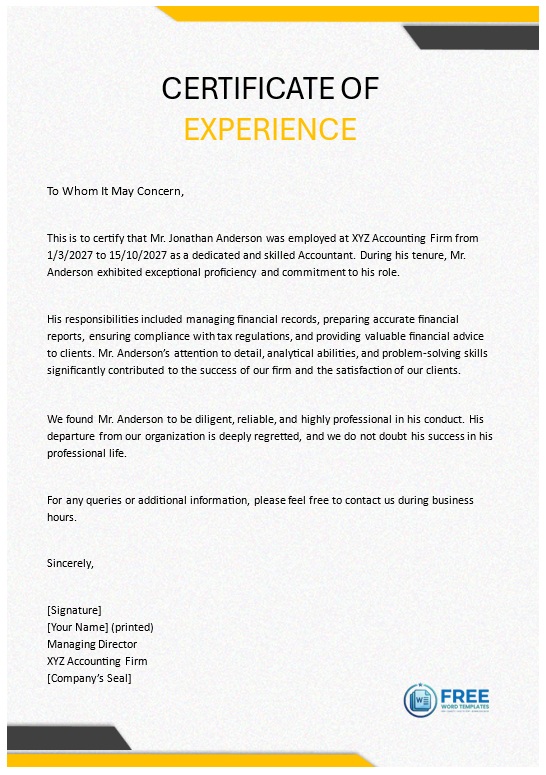
Employee experience certificate template
File Size: 2.8 MB
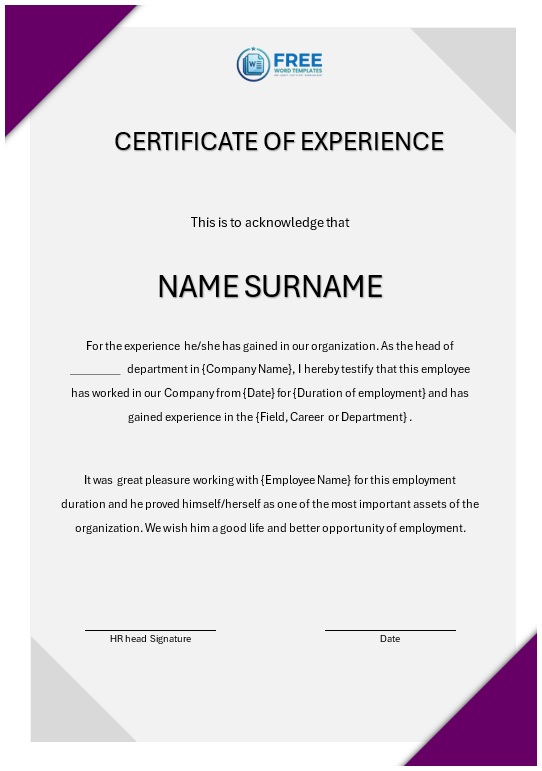
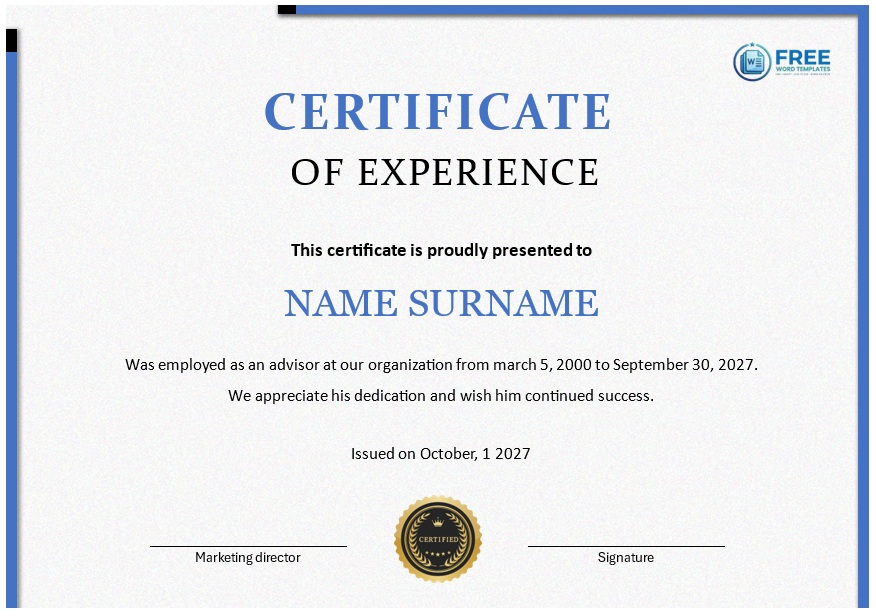
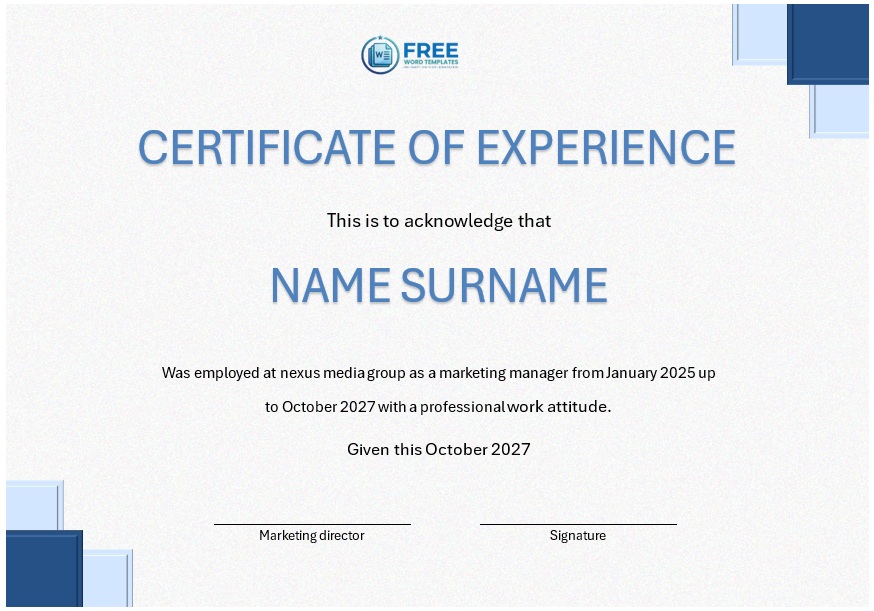
Printable Experience Certificate Template
File Size: 2.8 MB
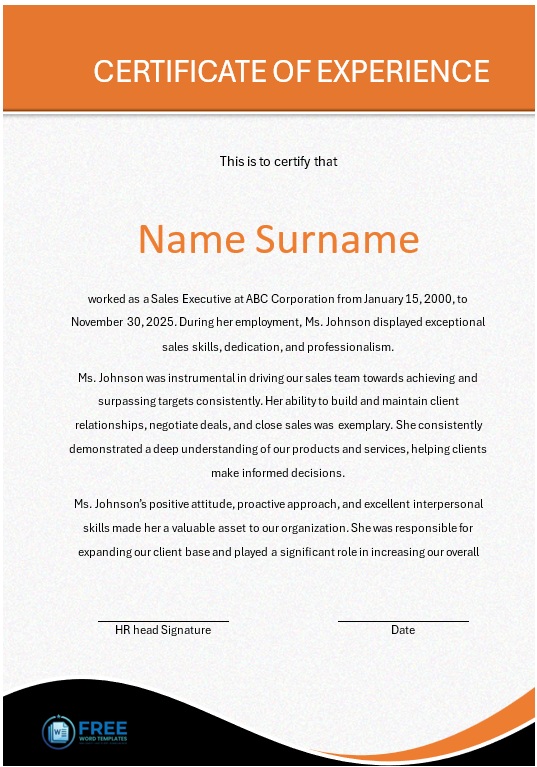
Professional Experience Letter Template
File Size: 3.0 MB

Types of Experience Certificates
The templates on this page cover the common variations. The differences are mostly in the body wording:
- Standard employment certificate — confirms designation, tenure, and responsibilities for a regular job. Used for new job applications and background checks.
- Internship certificate — emphasizes the learning purpose, the department or project, and skills gained. Often names the intern’s academic institution.
- Training or workshop certificate — confirms completion of a specific program, with dates, topics covered, and any CE/PD hours earned. See our training certificate templates for dedicated formats.
- Volunteer certificate — documents unpaid service, focusing on the nature of the work and its impact rather than job duties.
- Freelance or project certificate — issued by a client rather than an employer; states the project, deliverables, timeline, and the client’s satisfaction with the work.
Experience Certificate vs. Certificate of Employment vs. Relieving Letter
These three documents overlap, and employers are often asked for the wrong one:
- An experience certificate is issued when an employee leaves, and describes their role, tenure, and responsibilities in detail — it’s a summary of what they did.
- A certificate of employment can be issued at any time, including during employment, and simply confirms current or past employment status — banks and embassies usually ask for this one.
- A relieving letter only confirms that the employee has been released from duties as of a specific date and has no pending obligations — it says nothing about performance.
Departing employees commonly need both an experience certificate and a relieving letter; someone applying for a loan while still employed needs a certificate of employment instead.
Why Knowing the Common Pitfalls of Experience Certificate Templates Matters
When a professional presents an experience certificate, the document becomes more than a simple record of tenure; it serves as a tangible endorsement of competence, reliability, and the trustworthiness of both the employee and the organization that issues it. Because employers, educational institutions, and immigration officials often base crucial decisions on the credibility of such certificates, any misstep in their creation or use can undermine the very purpose they are meant to fulfill. Understanding the typical errors that arise when drafting or implementing experience certificate templates, therefore, is essential not only to safeguard the reputation of the issuing company but also to protect the career trajectory of the employee who relies on the document. By recognizing where things commonly go wrong, writers can proactively avoid compromising the professionalism, legal soundness, and persuasive power of the certificate, ensuring that it stands up to scrutiny and serves its intended role without raising doubts.
Unclear or Inconsistent Formatting
One of the most frequent issues stems from the lack of a standardized layout, often caused by copying fragments from disparate sources or by allowing multiple individuals to edit the same template without clear guidelines. When fonts, margins, and spacing shift from one section to another, the result is a visually chaotic document that subtly signals carelessness. Recruiters who skim dozens of certificates daily can instantly sense an inconsistency, interpreting it as a lack of attention to detail on the part of the employer. This perception can diminish the weight of the employee’s experience, as the certificate appears more like a hastily assembled private note than a formal corporate endorsement. To maintain a polished appearance, it is crucial to adopt a uniform style guide that specifies everything from header hierarchy to line spacing, thereby projecting the organization’s commitment to professionalism.
Vague or Overly Generic Language
Another prevalent mistake is the tendency to employ vague descriptors such as “worked diligently” or “performed duties satisfactorily” without anchoring those statements in concrete achievements or measurable outcomes. This habit often originates from a desire to avoid exaggeration or from an assumption that a general endorsement will suffice. However, such nebulous phrasing fails to convey the employee’s true value and makes it difficult for a prospective employer to gauge the relevance of the experience. When a certificate merely states that an individual “was employed as a manager,” without clarifying the scope of responsibility, team size, or key projects overseen, the document loses its persuasive edge. Admissions committees or immigration officers may then question the authenticity of the claim, suspecting that the issuer is masking a lack of substantive contribution. Adding specific responsibilities, notable accomplishments, and quantifiable metrics—while still adhering to factual accuracy—bolsters the certificate’s credibility and helps the recipient stand out among peers.
Missing or Inaccurate Dates
Dates, though seemingly straightforward, are a frequent source of error, whether through typographical slips, omission of day and month, or inconsistent date formats that clash with regional norms. These mistakes commonly arise when the template is reused without a thorough review of the new employee’s tenure details. A mismatched start or end date can lead to confusion over the length of service, and in worst-case scenarios, it can raise red flags about potential falsification. For example, an end date that predates the start date instantly undermines the document’s integrity, prompting the reader to doubt every other element. Moreover, using a format that differs from what the receiving party expects—such as “MM/DD/YYYY” in a country that prefers “DD/MM/YYYY”—can cause misinterpretation and delay verification processes. Ensuring that dates are meticulously double-checked and presented in a clear, universally understandable format eliminates ambiguity and reinforces the certificate’s reliability.
Improper Authentication and Signatory Authority
A certificate that lacks a proper signature, official seal, or the clearly identified authority of the signatory quickly loses its legal standing. This oversight often occurs when a template includes a placeholder for a signature but the final version is circulated without the required physical or digital authentication. The absence of a legitimate signatory—someone who holds a recognized position such as HR Manager, Department Head, or Company Director—creates a perception that the document is merely a template printed for convenience rather than an officially sanctioned record. Consequently, the employee’s claim may be dismissed or subjected to additional verification, eroding trust in both the individual and the organization. Applying a consistent practice of having the appropriate authority sign the certificate, incorporating a corporate stamp or watermark, and, where feasible, using secure digital signature technology, strengthens authenticity and shields the document from skepticism.
Neglecting Legal and Compliance Considerations
Finally, overlooking the legal nuances tied to employment verification can expose both the issuer and the employee to unintended consequences. In many jurisdictions, including specific wording about confidentiality, data protection, or the employee’s consent to share their information is mandated. Templates that omit these clauses may inadvertently breach labor regulations or privacy laws, leading to legal challenges that diminish the institution’s credibility. This lapse typically arises when the template is crafted without consulting legal counsel or when updates to legislation are not reflected in the latest version. By integrating a brief compliance statement that confirms the employee’s consent and adheres to relevant labor statutes, the certificate not only remains within legal boundaries but also signals the organization’s diligence and respect for regulatory standards.
Frequently Asked Questions
Can I request an experience certificate after resigning?
Yes. Employers normally issue it during the exit process, but you can request one later — even years after leaving. Most companies will issue it as long as your records exist, and in some countries labor law requires them to provide it on request.
Is an experience letter the same as an experience certificate?
In practice, yes — the two terms are used interchangeably. Some organizations use “letter” for a version written in letter form on letterhead and “certificate” for a more formal, decorated layout, but the content and purpose are identical.
Who should sign an experience certificate?
Someone with recognized authority — usually the HR manager, department head, or a company director. The signatory’s name and designation should be typed under the signature, and the document should carry the company seal or stamp.
Can an employer refuse to issue an experience certificate?
Rules vary by country. In many jurisdictions employers are legally required to issue proof of employment on request; in others it’s customary but not mandated. If an employer refuses, a relieving letter, appointment letter, and salary slips together can often serve as alternative proof of experience.

Pete Smith is a Business Management graduate and a passionate advocate for practical, accessible resources that empower professionals and entrepreneurs to succeed. With a strong foundation in organizational strategy and operational efficiency, Pete combines academic knowledge with real-world insights to simplify complex business processes. He is the creator behind a growing online platform dedicated to offering free, high-quality documents, templates, and actionable tips designed to save time and improve productivity.