A training certificate is the record a provider issues when someone completes a course. It’s kept for a CV, filed by an employer against a compliance requirement, or submitted to a professional body as evidence of continuing development, and whether it can do any of those things depends on a handful of fields. The free templates below are editable MS Word designs, and beneath them you’ll find wording, what to include for CPD claims, and the date that matters most on any safety or compliance certificate.
What the Certificate Is Evidence Of
Worth being precise, because it determines the wording.
A training certificate records that someone attended and completed a course. Unless there was an assessment, it doesn’t certify competence, and it shouldn’t be worded as though it does. “Has completed the Level 2 Food Safety course” is a factual record; “is qualified in food safety” is a claim most providers aren’t entitled to make.
Where an assessment formed part of the course, say so “completed the course and passed the end-of-course assessment” is stronger and still accurate. Where you’re an accredited body issuing a recognised qualification, the accreditation and qualification reference belong on the certificate too.
Related: our certificate of completion templates cover finishing any programme, placements, OJT, inductions — while this page is for courses delivered by a training provider.
Required Fields
- Provider name and logo, plus any accreditation or registration reference.
- Certificate title, “Certificate of Training” or the course’s own title.
- Recipient’s full name, spelled as it appears on their official documents.
- The exact course title, not a category. “Manual Handling in Care Settings”, not “Health and Safety”.
- Date of completion, and the date range where the course ran over time.
- Contact hours, see below.
- Assessment, if there was one, and whether it was passed.
- Expiry or renewal date, for anything with a refresher interval.
- Certificate number, from a sequence you keep.
- Trainer’s name and signature, with their qualification or role.
CPD Hours
The field most often left off, and the one your learners will come back and ask for.
Most professional bodies express continuing development requirements in hours, a set number per year, recorded and sometimes audited. When a member submits your certificate as evidence, the first thing their scheme looks for is how many hours it represents. If the certificate doesn’t say, they have to contact you, and you have to reconstruct it from a course outline eight months later.
Two things to get right:
State contact hours, not elapsed time. A course running from 9am to 4pm with an hour for lunch and two breaks is not seven hours of instruction. Count the taught time honestly, “6 contact hours” because an inflated figure is a problem for the learner if their submission is audited, not for you.
Distinguish the type where it matters. Some schemes separate structured or verifiable CPD from self-directed learning. Naming the format, “6 contact hours, tutor-led classroom” or “3 hours, structured online learning with assessment”, lets the learner categorise it correctly without guessing.
If you run courses regularly for a regulated profession, ask one of your learners’ professional bodies once what their certificates must show. The answer takes ten minutes to obtain and saves years of queries.
Training Certificate Example
NORTHGATE TRAINING ACADEMY
Accredited provider no. 000000
CERTIFICATE OF TRAINING
THIS IS TO CERTIFY THAT
Rosa Silva
has successfully completed
Manual Handling in Care Settings
comprising 6 contact hours of tutor-led instruction,
and has passed the practical assessment.
|
Completed 18 September 2026 |
Renewal due 18 September 2027 |
Certificate no. NTA-2026-0912 |
| S. Malik · Lead Trainer | Northgate Training Academy |
The three-cell band is what makes this certificate useful rather than decorative. Completion date, renewal date, and certificate number in one row, which is exactly what an employer copies into a training matrix, and exactly what most certificates omit. Note also that the course title is specific and the claim is bounded: completed the course and passed the assessment, not “is qualified”.
Free Training Certificate Templates in MS Word
Each template below is editable in Word. Set up your provider details, accreditation reference and signature block once, then change only the name, course and dates.
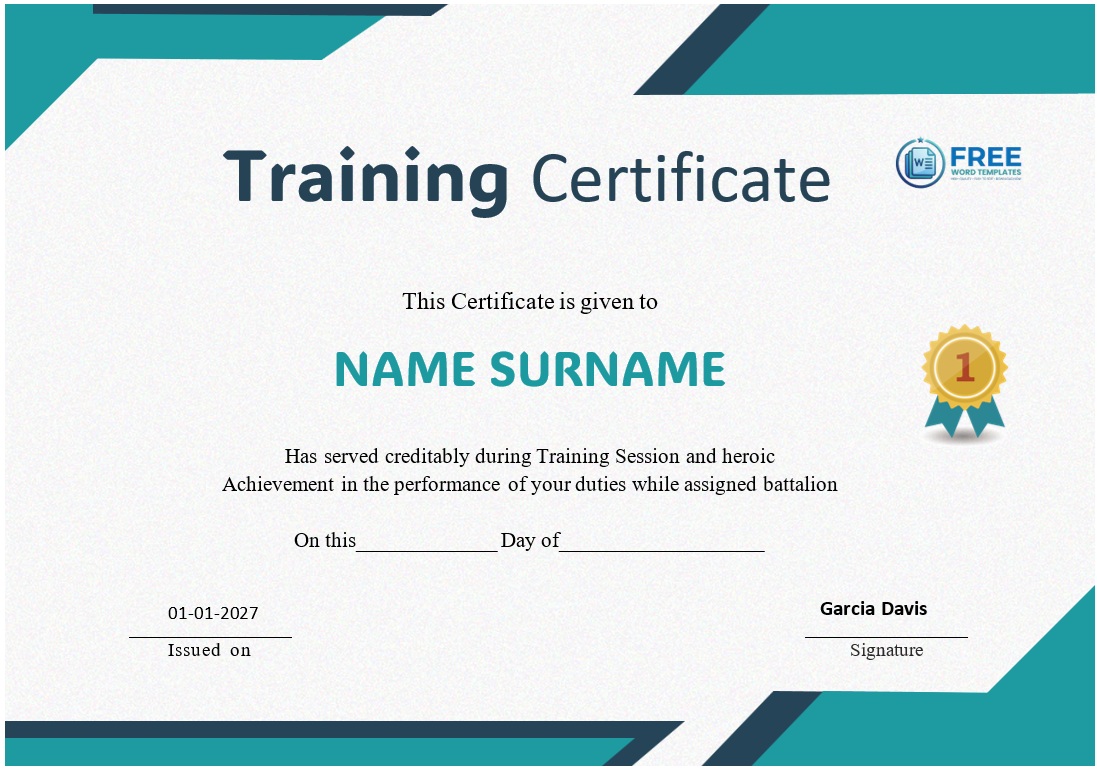
Professional Training Certificate Designs
File Size: 3.1 MB


Employee Training Certificate Templates
File Size: 3.0 MB
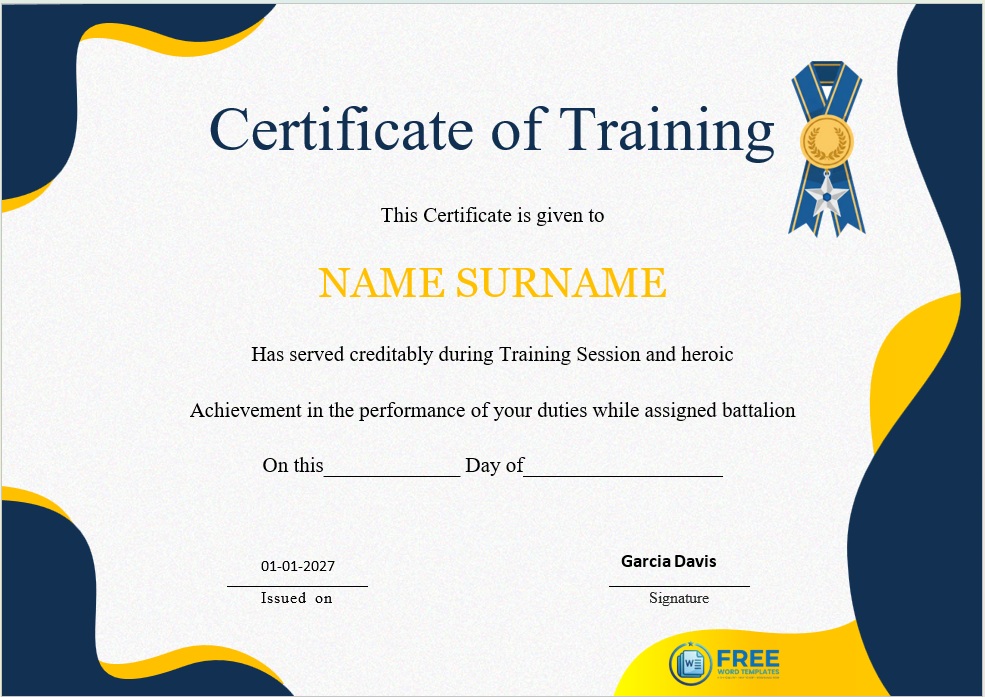

Training Completion Certificate Templates
File Size: 3.1 MB



Training Certificate Design Template 15
File Size: 1638 KB

Training Certificate Design Template 15
File Size: 138 KB
Mandatory Training and Expiry Dates
The section that separates a certificate an employer can file from one they have to chase.
A great deal of workplace training has a refresher interval. First aid, fire marshal, food hygiene, manual handling, safeguarding, infection control, working at height, each is typically valid for a set period, after which it must be redone. Intervals vary by country, sector, regulator and employer policy, so check the requirement for the training you deliver rather than assuming.
What matters for the certificate is this: put the renewal date on it.
An employer maintaining a training matrix needs to know when each person’s certification lapses. If your certificate shows only a completion date, someone has to work out the expiry from the course type, and in practice they either guess or chase you. A renewal date printed alongside the completion date means the certificate can be filed and the diary entry made in one action.
Three related points:
- Be clear whether the date is an expiry or a recommendation. “Renewal due” and “valid until” mean different things to a compliance officer.
- Don’t state a validity period you can’t stand behind. If the interval is set by a regulator, cite it; if it’s your own recommendation, say so.
- Send a reminder a month or two before renewal is due. It’s a service to the employer and the most reliable repeat business a training provider has.
Wording
Standard completion
…has successfully completed the [course title], comprising [X] contact hours of instruction.
…has completed the [course title] delivered on [date] at [venue].
…has completed all modules of the [programme] to the required standard.
With assessment
…has completed the [course] and passed the end-of-course assessment.
…has completed the [course] and demonstrated practical competence in [skill] under supervision.
…has achieved a pass in the [course] written and practical assessments.
Attendance only
…attended the [workshop / seminar] on [date], a session of [X] hours.
…participated in the [event], covering [brief scope].
Compliance and mandatory training
…has completed [course] in accordance with [standard or regulation], valid until [date].
…has completed the annual [subject] refresher training required under [policy].
…has completed [X] hours of [subject] training. Renewal due [date].
CPD-focused
…has completed [X] hours of structured continuing professional development in [subject].
…attended [course], representing [X] verifiable CPD hours.
Two rules across all of them. Name the exact course, because “Health and Safety Training” tells a future employer nothing about what was covered. And don’t overstate, completed is a fact, qualified is a claim.
Numbering and Verification
- Number every certificate and keep a register: number, name, course, date, hours, expiry, trainer. It takes seconds and it’s what lets you confirm a certificate when an employer calls.
- Print the number on the certificate. A credential nobody can check is worth considerably less than one that can be.
- Keep the register as long as the certificate might be relied on. For regulated training that may be years after the course.
- Publish how to verify — a phone number or email on the certificate, so an employer with a question knows where to direct it.
- Sign by hand where you can. A printed signature on a credential suggests nobody checked it.
- Keep a copy of each issued certificate, or at least the register entry.
Issuing Them Well
- Check the spelling of names against the enrolment record, not the sign-in sheet. A misspelled name on a credential is a reissue request.
- Issue within a week. Certificates arriving a month later have usually stopped being useful, and the learner has already had to tell their employer it’s coming.
- Send a PDF as well as any printed copy. Most recipients need to attach it to a CPD record or forward it to HR, and a scan of a posted certificate is always worse than the original file.
- Send the employer a summary where you’ve trained a group — a list of names, the course, the date, the hours and the renewal date saves them building it themselves and makes you easy to work with.
- Print on card, 200 gsm or heavier, for anything handed over in person.
- Keep one house format across all your courses. Inconsistent certificates from the same provider look improvised and are harder to verify.
Related documents: certificates of completion for programmes and placements, achievement certificates where something measurable was accomplished, and personal development plans for the learner recording their CPD across a year.
Frequently Asked Questions
What should a training certificate include?
The provider’s name and any accreditation reference, the recipient’s full name, the exact course title, the completion date, contact hours, whether an assessment was passed, a renewal or expiry date where applicable, a certificate number, and a signature.
Why do CPD hours need to be on the certificate?
Because professional bodies express development requirements in hours, and that’s the figure they look for when a member submits evidence. A certificate without it sends the learner back to the provider to ask.
How do I calculate contact hours?
Count taught time, not elapsed time. A course running 9am to 4pm with lunch and two breaks is around six contact hours, not seven. An inflated figure becomes the learner’s problem if their CPD submission is audited.
Should a training certificate have an expiry date?
For anything with a refresher interval, first aid, fire marshal, food hygiene, manual handling, safeguarding — yes. Employers track these in a training matrix, and a certificate showing only a completion date means someone has to work the expiry out or chase you for it.
Does a training certificate mean someone is qualified?
Not by itself. It records that they completed the course. Unless there was an assessment, in which case say so, the wording should describe what was completed rather than claiming competence.
What is the difference between a training certificate and a certificate of completion?
A training certificate is issued by a provider for a specific course, usually with hours and often an expiry date. A certificate of completion is broader, covering any programme finished — including placements, internships and inductions.
Why number training certificates?
So they can be verified. An employer checking a credential needs to contact the issuer and confirm it, and a numbered certificate matched to a register turns that into a two-minute task rather than an impossible one.
How soon should certificates be issued after a course?
Within a week. Learners frequently need them for an employer’s records or a CPD deadline, and a certificate that arrives a month later has usually already caused someone a problem.

Pete Smith is a Business Management graduate and a passionate advocate for practical, accessible resources that empower professionals and entrepreneurs to succeed. With a strong foundation in organizational strategy and operational efficiency, Pete combines academic knowledge with real-world insights to simplify complex business processes. He is the creator behind a growing online platform dedicated to offering free, high-quality documents, templates, and actionable tips designed to save time and improve productivity.