A certificate of employment is one of the most frequently requested HR documents — employees need it when applying for jobs, visas, bank loans, or rental agreements, and employers are often required to issue it on short notice. Rather than drafting each certificate from scratch, HR teams can use a ready-made template to fill in the employee’s details and issue a professional, consistent document in minutes. Below you’ll find free certificate of employment templates in MS Word format, covering general verification, salary details, work experience, and industry-specific formats — all editable and ready to print.
What is an Employment Certificate?
An employment certificate is a formal document issued by an employer to confirm that an individual is or was employed by their organization. It usually includes the employee’s name, job title, duration of service, and other relevant employment details.
The Purpose Decides the Content
The commonest HR mistake with these is issuing one standard document for every request. A certificate going to an embassy, a bank, and a prospective landlord needs different information in each case — and including everything by default discloses more about the employee than any single recipient asked for.
| Requested for | What the recipient needs |
|---|---|
| Visa application | Position, start date, confirmation that employment is ongoing, and often that leave has been approved for the travel dates. Salary where the embassy asks for it. |
| Bank loan or mortgage | Position, start date, employment type (permanent, fixed-term, probationary), and gross salary with frequency. Lenders usually want this stated annually. |
| Rental or tenancy | Position, start date, employment status and often income. Rarely anything more. |
| A new employer | Dates of employment and job title. Many organizations have a policy of confirming only these two things. |
| Professional body | Dates, role, and often a description of duties or supervised hours to evidence experience toward a qualification. |
| Leaving the company | Dates, position, and duties. In several countries employers are required to issue this on request when employment ends. |
Ask the employee what the certificate is for before writing it. It takes one question and it prevents both the under-detailed certificate that gets rejected and the over-detailed one that discloses too much.
What to Include
- Company letterhead — name, registered address, telephone, and company registration number where you have one.
- Date of issue.
- Addressee — named where you know it, otherwise “To Whom It May Concern”.
- Employee’s full name, as it appears on their official identification, and their employee number.
- Job title, and department.
- Start date, and end date for a former employee.
- Employment status — permanent, fixed-term, part-time, probationary — where it’s relevant to the request.
- Salary, gross, with the frequency stated, only where it was asked for.
- Brief duties, where the certificate supports an experience or professional claim.
- Signature of an authorised person, with their printed name, job title and direct contact details.
- Company stamp, where your organization uses one — many embassies and banks expect it.
What to Leave Out
The part no template explains, and the part that creates problems.
Don’t volunteer salary. If the request didn’t ask for it, leave it out. A tenancy application that only needed confirmation of employment doesn’t need the employee’s income disclosed to a letting agent.
Don’t state a reason for leaving unless the employee has specifically asked you to. “Left to pursue other opportunities” is harmless; anything more specific can follow someone for years, and it’s rarely information the recipient requested.
Don’t editorialise on performance. A certificate of employment confirms facts. Praise belongs in a reference, which is a separate document the employee can choose whether to use. A line meant kindly — or a coded one meant otherwise — can cost someone a tenancy or a visa, and in several jurisdictions a negative or ambiguous remark in a required certificate creates real legal exposure for the employer.
Don’t include anything the employee hasn’t agreed to. Confirm with them what’s being disclosed before the certificate leaves the building. This is good practice everywhere and a data protection requirement in many places.
The working rule: issue what was asked for, accurately, and nothing more.
Certificate of Employment Example
HARBOUR LOGISTICS LTD.
118 Harbor Street, Port Caldera · Tel 01000 000200 · Reg. no. 00000000
CERTIFICATE OF EMPLOYMENT
14 October 2026
To Whom It May Concern
This is to certify that Ms. Rosa Silva (Employee No. HL-0142) has been employed
by Harbour Logistics Ltd. since 3 March 2022 and remains in our employment
as at the date of this letter.
She currently holds the position of Customer Support Agent in the Customer
Support department, on a permanent, full-time contract. Her current gross annual
salary is £32,400, paid monthly.
This certificate is issued at the employee’s request for the purpose of a mortgage application.
Should you require verification, please contact the undersigned directly.
|
Yours faithfully, D. FERREIRA Human Resources Manager |
[ COMPANY STAMP ] |
Four features. The purpose is stated, which tells the reader why salary appears and signals that the employee consented to it. The employment is confirmed as current “as at the date of this letter”, which is what a lender needs. The salary is gross and annual with frequency given, which is the format financial institutions ask for. And there’s a named contact with a direct line, so verification takes a phone call rather than a letter to a general address.
Free Certificate of Employment Templates in MS Word
Here is our collection of Free Certificate Templates for your Employment Verification needs.

Employment Work Experience Certificate Template
File Size: 11 KB


Types of Employment Certificates
Employment certificate templates don’t fulfill all those purposes. For example, a certificate should always be work verification, financial, or an immigration issuance procedure; the shapes and content of that document can vary drastically with this context. If only organizations knew, they’d just find or create the types of employment certificate templates that suit the applicant and, at the same time, provide accuracy and professionalism attached to it.
General Employment Certificates
The general employment certificate is most probably the most common format. It is meant for establishing the basic facts on which employment is based on employee name, job title, and period of service. This kind of certificate would have the least expected utility in situations such as background checks, rentals, or simple verification. Compared to other types of certificates, it is the most brief, formal, and most of the time has been kept free of personal aspects like salary or performance remarks to cater for general administrative or HR occurrences.
Certificates with Salary Details
There are some employment certificate formats that are exclusively meant for financial institutions and visa authorities and would include salary details. This includes the month-wise or yearly earnings of the employee, bonus payments and at times deductions as well. Employees are often asked to submit this kind of certificate at the time of applying for a loan, a credit card, or sponsorship for immigration purposes. Salary details requires careful formatting and company approval, as financial figures always have to be accurate and updated, as errors or disagreements can lead to serious problems.
Experience Certificates
While verifying employment, an experience certificate examines more closely the employee’s roles, responsibilities, and professional contributions during his or her term with the organization. More often than not, this certificate becomes a requirement during job change and is an informal recommendation alongside the résumé. Most templates for experience certificates maintain a narrative tone incorporating the work ethic, skills, and behavior placed under those invaluable descriptors in regard to the employee’s career advancement.
Industry-Specific Certificates
Some industries would require certificates that follow a certain format or have certain additional data. For example, teachers, doctors, and IT professionals may need certificate templates that also mention license numbers, subject areas, or specialized roles. A well-structured industry-specific certificate makes sure that the professional details have also been brought in line with the requirements of the profession, or the codes have been formed out according to regulatory or sector-based expectations. Most of these templates happen to be preapproved by industry bodies, which also include terminologies or formatting specific to that particular profession.

Certificate Of Employment for Temporary Employees
File Size: 91 KB

Certificate of Employment for Security Personnel
File Size: 250 KB
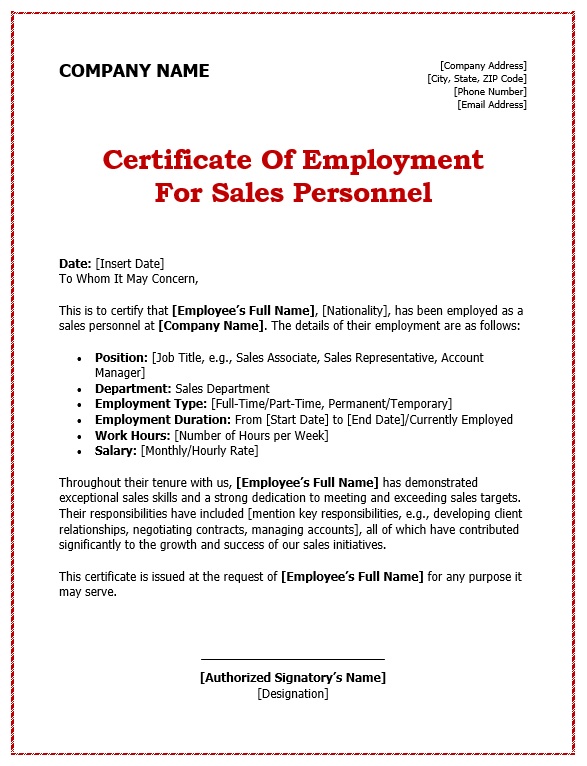
Certificate of Employment for Sales Personnel
File Size: 13 KB

Sample Wording
Current employee, general
This is to certify that [Name] has been employed by [Company] since [date] and remains in our employment as at the date of this letter, currently holding the position of [job title].
Former employee
This is to certify that [Name] was employed by [Company] from [date] to [date] in the position of [job title].
…[Name] served as [job title] with this organization from [date] to [date], a period of [X] years and [X] months.
With salary, for a loan or mortgage
…currently holds the position of [job title] on a permanent, full-time contract. [His/Her] current gross annual salary is [amount], paid [monthly/fortnightly].
…[His/Her] gross monthly salary is [amount], exclusive of any bonus or overtime.
For a visa application
…has been employed with us since [date] in the position of [job title]. [He/She] has been granted approved leave from [date] to [date] and is expected to resume duties on [date].
…remains in our employment and [his/her] position will be held open for the duration of the stated travel.
For a tenancy
…is currently employed by [Company] as [job title] on a permanent contract, having joined on [date].
For a professional body or experience claim
…was employed as [job title] from [date] to [date]. [His/Her] responsibilities included [brief duties], working under the supervision of [name, title].
…completed [X] hours of supervised practice in [area] during this period.
Closing lines
This certificate is issued at the employee’s request for [stated purpose].
This certificate is issued upon request for whatever lawful purpose it may serve.
Should you require any further information or verification, please contact the undersigned.
Verification
A certificate nobody can check is worth considerably less than one they can, and some institutions reject certificates outright when verification isn’t possible.
- Name a real contact with a direct phone number and email, not a general enquiries address. Banks and embassies verify by calling.
- Use company letterhead with a registered address and company number.
- Sign by hand and apply the company stamp where you use one — several jurisdictions and most embassies expect it.
- Number your certificates and keep a register: number, employee, date issued, purpose, who signed. It lets you confirm a certificate months later and tells you immediately if something is presented in your name that you didn’t issue.
- Keep a copy on the personnel file.
- Brief whoever answers the phone. A verification call that reaches someone who doesn’t know what to do with it fails just as completely as no contact at all.
Issuing Them Well
- Set a turnaround and publish it — two or three working days. Employees asking for these usually have a deadline attached, and a certificate that arrives after a visa appointment is useless.
- Ask the purpose at the point of request, so the right details go in.
- Check the name spelling against official records, not the staff directory. An embassy comparing the certificate with a passport will reject a mismatch.
- Check the dates against the personnel file. A start date off by a month causes problems that take weeks to unwind.
- Have one authorised signatory, or a named deputy, so certificates from your organization are consistent.
- Keep one house template rather than letting each department build its own.
- Issue on paper and as a PDF. Most employees need to upload it somewhere.
- Know your local obligations. In several countries employers are legally required to issue a certificate of employment to a departing employee on request, sometimes within a stated period. Check what applies where you operate.
Related documents: salary certificates where income is the main purpose, experience certificates for a fuller account of duties and performance, salary slips as supporting evidence of income, and reference lists for job applicants.
Frequently Asked Questions
What is a certificate of employment?
A formal document issued by an employer confirming that someone is or was employed by the organization, stating their job title and dates of service — and, where requested, their salary and duties.
What should a certificate of employment include?
Company letterhead and registration details, the date, the employee’s full name and number, job title, start date (and end date if applicable), employment status, salary only where it was requested, and a signature with a named contact for verification.
Should salary be included?
Only if the request asked for it. A loan or mortgage application needs it; a tenancy reference or a general verification usually doesn’t. Including it by default discloses more than the recipient needed.
What is the difference between a certificate of employment and an experience certificate?
A certificate of employment confirms the facts — who, what role, what dates. An experience certificate describes duties, responsibilities and often performance, and functions closer to a reference.
Should a reason for leaving be stated?
Not unless the employee has asked for it. A certificate confirms employment; the reason for departure is rarely what the recipient requested and can follow someone for years.
How quickly should HR issue one?
Within two or three working days, and publish that turnaround. Requests usually have a deadline attached — a visa appointment, a mortgage application — and a late certificate is often no use at all.
Is an employer required to issue a certificate of employment?
In several countries, yes — employers must provide one to a departing employee on request, sometimes within a defined period. Requirements vary, so check what applies in your jurisdiction.
How can a bank or embassy verify the certificate?
By contacting the named signatory. Include a direct phone number and email rather than a general enquiries address, use company letterhead, apply your company stamp, and keep a register so the certificate can be confirmed months later.

Pete Smith is a Business Management graduate and a passionate advocate for practical, accessible resources that empower professionals and entrepreneurs to succeed. With a strong foundation in organizational strategy and operational efficiency, Pete combines academic knowledge with real-world insights to simplify complex business processes. He is the creator behind a growing online platform dedicated to offering free, high-quality documents, templates, and actionable tips designed to save time and improve productivity.