A meeting agenda is the plan circulated before a meeting: what will be covered, in what order, for how long, and who is leading each item. Written well it makes a meeting finish on time with decisions made; written as a list of subject headings it does almost nothing. The free templates below are editable MS Word files, and beneath them you’ll find the one change that improves any agenda, a filled-in example, and what to do afterwards — which is where our meeting minutes templates come in.
Write Outcomes, Not Topics
Most agendas are a list of nouns: Budget. Recruitment. Website. Each one tells attendees that a subject will come up, and nothing else — not what has to happen, not how long they have, not whether they need to prepare.
Compare:
| Topic agenda | Outcome agenda |
|---|---|
| Budget | Approve Q4 marketing budget — decision — 15 min — K. Osei |
| Recruitment | Agree whether to backfill the support role or use contractors — decision — 10 min — D. Ferreira |
| Website | Website relaunch date confirmed for 3 Nov — inform — 5 min — M. Chen |
The right-hand column takes thirty seconds longer to write and changes how the meeting runs. People arrive knowing what’s expected of them, an information item can’t quietly consume twenty minutes, and at the end you can tell whether the meeting achieved anything by reading the agenda back.
Tag Every Item: Decide, Discuss, or Inform
Three words, one against each item, and they do more work than any other formatting choice:
- Decide — a choice has to be made in the room. Attendees need the background beforehand, and the item isn’t finished until the decision is recorded.
- Discuss — input is wanted but no decision is due. Useful for shaping something before it’s proposed, provided everyone knows that’s what’s happening.
- Inform — an update, no input needed. The most valuable tag of the three, because it gives the chair permission to cut discussion short: it’s on the agenda as information, and if it needs debate it becomes a Decide item at the next meeting.
A useful test when building the agenda: if every item is tagged Inform, you’ve scheduled a meeting where nothing needs to happen, and an email would serve everyone better.
Meeting Agenda Example
|
MONTHLY OPERATIONS MEETING — AGENDA Date: Tuesday 7 October 2026 | Time: 10:00–11:00 | Room 2 / Teams Chair: K. Osei | Minutes: D. Ferreira Attending: K. Osei, D. Ferreira, M. Chen, S. Malik, R. Silva, L. Brennan Pre-reading attached: supplier trial summary (2 pages), September support figures. |
||||
| Time | Item | Type | Lead | Min |
|---|---|---|---|---|
| 10:00 | Welcome, apologies, and AOB items collected | — | Chair | 3 |
| 10:03 | Minutes of 9 September and matters arising | Inform | Chair | 5 |
| 10:08 | Weekend support cover — agree premium pay or reduce Saturday to email only | Decide | D. Ferreira | 20 |
| 10:28 | Supplier B trial — review first month and agree whether to extend | Decide | S. Malik | 15 |
| 10:43 | Warehouse system go-live — readiness update | Inform | M. Chen | 7 |
| 10:50 | Christmas rota — early views before a proposal in November | Discuss | R. Silva | 7 |
| 10:57 | Any other business and confirm actions | — | Chair | 3 |
| Total Next meeting: Tuesday 4 November, 10:00 | 60 | |||
Three things worth copying. The minutes add up to the meeting length — sixty allocated for a sixty-minute slot, not ninety. The two decisions sit early, while everyone is present and alert. And AOB is collected at the start rather than opened at the end, so the chair knows what’s coming and can allocate the last three minutes rather than discovering a new problem at 10:58.
Free Meeting Agenda Templates in MS Word
Each template below is editable in Word. Set up your recurring items once, then change only the date, the items, and the timings for each meeting.
Meeting Agenda with Timings and Owners
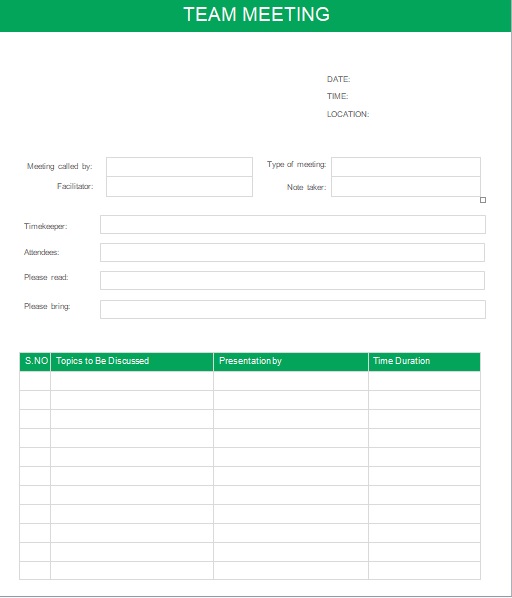
A table format with time, item, type, lead, and duration columns — the layout shown above, suited to regular team and operations meetings.

Simple Meeting Agenda Template
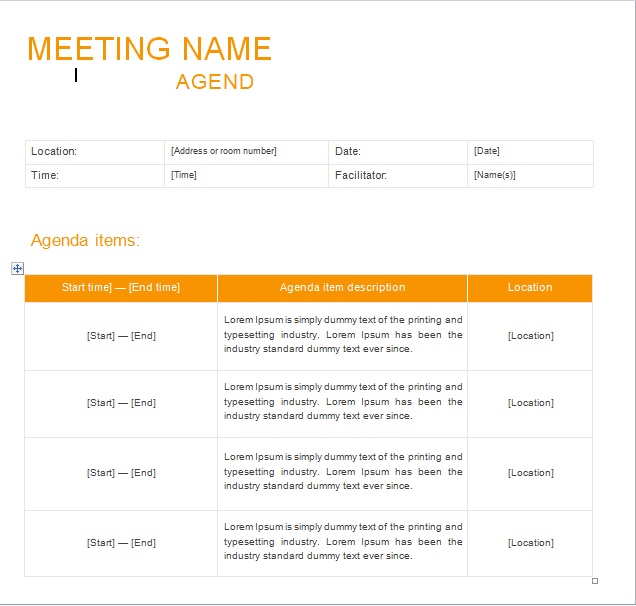
A clean numbered list with space for the date, attendees, and items — for short or informal meetings that don’t need per-item timing.

You can grab this Meeting Agenda Template 03 from the download button below.
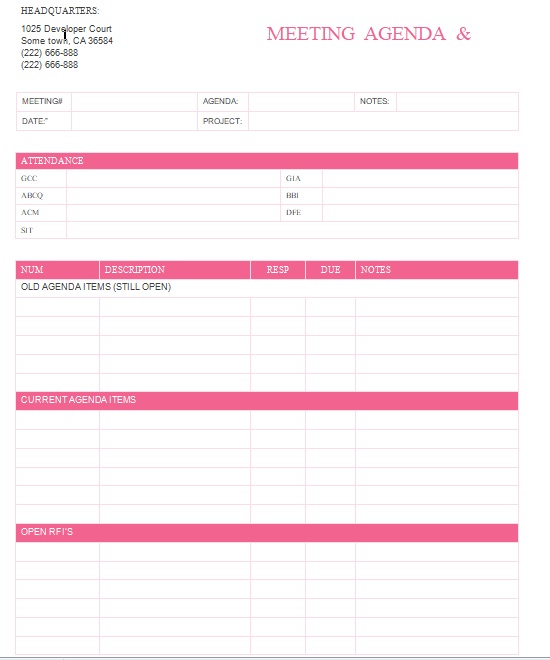
You can grab this Meeting Agenda Template 04 from the download button below.

You can grab this Meeting Agenda – Word Template 05 from the download button below.
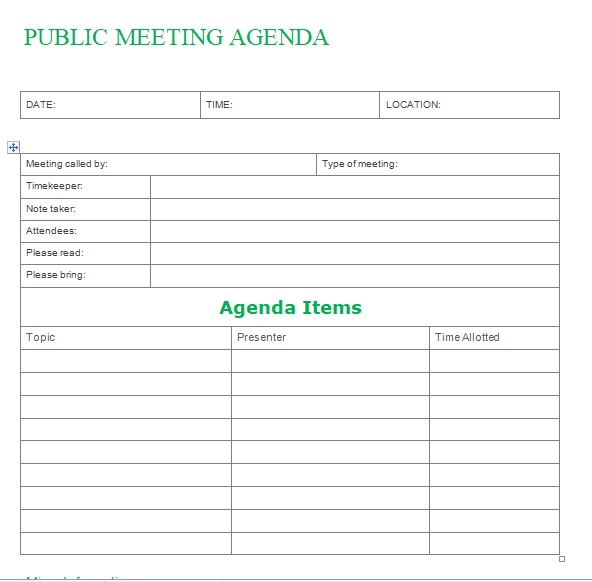
You can grab this Meeting Agenda Template 06 from the download button below.
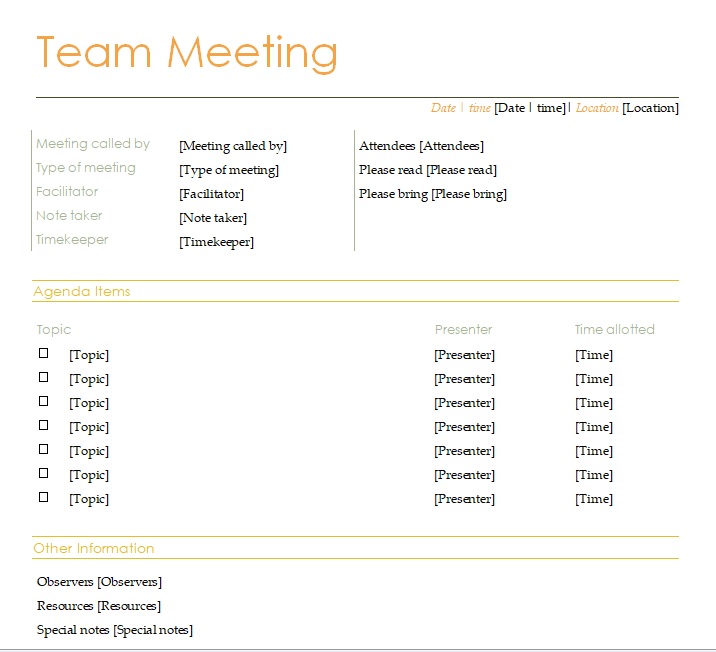
You can grab this Meeting Agenda Template 07 from the download button below.
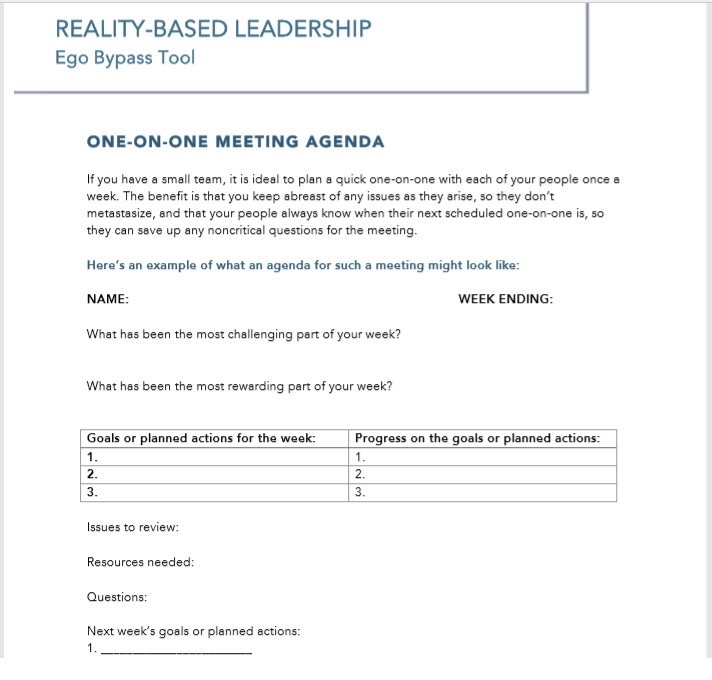
You can grab this Meeting Agenda Template 08 from the download button below.
Timing and Order
- Make the minutes add up. If the items total more than the meeting, you’ve already decided to overrun or to rush the last item — usually the one nobody prepared for.
- Most important first. Attention and attendance are highest at the start. Warm-up items at the top and the big decision at the bottom is the most common way an agenda wastes a meeting.
- Build in slack. Leave five minutes unallocated in an hour. Something always runs over, and a schedule with no give turns one long discussion into a cascade of rushed items.
- Be realistic about decisions. A contested decision rarely takes five minutes. If you’ve allocated five, you’ve planned for the version where everyone already agrees.
- Park rather than rush. When an item overruns, the chair’s job is to park it with a named owner and a date, not to hurry it to a poor conclusion.
Sending It Out
Circulate the agenda 24 to 48 hours ahead, with any pre-reading attached. An agenda sent five minutes before the meeting is a formality — nobody has read the supplier report, so the first ten minutes get spent reading it aloud.
Ask for agenda items in advance rather than assembling the list alone. It surfaces things you didn’t know about and it gives people ownership of the meeting. Set a cut-off — end of the previous day works — so the agenda you send is the agenda you run.
And if something arrives after the cut-off, put it on the next meeting unless it genuinely can’t wait. An agenda that changes in the room is one nobody prepared for.
Types of Meeting Agenda
- Team or staff meeting — recurring, with standing items (updates, actions from last time) plus whatever needs deciding. Keep the standing items short; they’re the part that expands to fill the hour.
- Board or formal meeting — more structured: apologies, declarations of interest, minutes of the previous meeting, matters arising, numbered substantive items, AOB, date of next meeting. Where motions are voted on, the agenda should say so in advance.
- Project kickoff — scope, roles, timeline, risks, communication plan, and next steps. Longer than a normal meeting and worth over-preparing.
- Client meeting — progress, decisions needed from them, and next steps. Send it in advance; clients who know what’s being asked of them arrive able to answer.
- One-to-one — shared between manager and report, with both able to add items. The best ones are mostly the report’s agenda, not the manager’s.
- AGM — often governed by a constitution or statute that prescribes what must appear on the agenda and how much notice is required. Check your own rules before drafting.
When Not to Have the Meeting
Writing the agenda is the cheapest test of whether a meeting should happen at all. Two signals worth acting on.
If you can’t articulate what each item is for — if the list stays a set of nouns however hard you try — the meeting probably has no purpose beyond the slot in the calendar. And if every item is tagged Inform, you’ve scheduled a broadcast: nothing requires the group to be in a room, and a written update would reach more people in less time.
Cancelling a meeting because the agenda didn’t justify it is not a failure. It’s the agenda doing its job before the meeting rather than after it.
Frequently Asked Questions
What should a meeting agenda include?
The date, time, location, chair, and attendees; any pre-reading; then each item with what it’s for, who’s leading it, how long it has, and whether it’s a decision, a discussion, or information. Close with AOB and the date of the next meeting.
What is the difference between an agenda and minutes?
The agenda is written before the meeting and sets out what will be covered. The minutes are written after and record what was decided. In practice the agenda usually becomes the structure of the minutes.
How far in advance should an agenda be sent?
24 to 48 hours, with any documents attached. Earlier for board and formal meetings, where notice periods may be set by your constitution or by law. An agenda sent minutes before the meeting means nobody has prepared.
How do I write good agenda items?
Write outcomes rather than topics. “Budget” becomes “Approve Q4 marketing budget — decision — 15 min — K. Osei.” The reader then knows what has to happen, how long it has, and who’s leading it.
How long should a meeting agenda be?
Short enough that the allocated minutes add up to the meeting length. For a one-hour meeting that’s usually four to six substantive items, plus opening and closing. More than that and something gets rushed.
Where should “any other business” go?
At the end, but collect the items at the start. That way the chair knows what’s coming and can allocate time for it, rather than discovering a significant issue with two minutes left.
Should every meeting have an agenda?
Any meeting with more than two people or more than one topic, yes. Beyond keeping the meeting on track, writing one tests whether the meeting is needed at all — and if every item turns out to be information, an email will do the job better.

Pete Smith is a Business Management graduate and a passionate advocate for practical, accessible resources that empower professionals and entrepreneurs to succeed. With a strong foundation in organizational strategy and operational efficiency, Pete combines academic knowledge with real-world insights to simplify complex business processes. He is the creator behind a growing online platform dedicated to offering free, high-quality documents, templates, and actionable tips designed to save time and improve productivity.