Training Certificate Templates help you create a standard document, which you can then use to train staff in various disciplines. The training certificate template will not only be useful for staff but may also be useful to students who are looking to gain qualifications. These can provide great results, providing that the right methodology is used throughout the program.
Imagine you’ve just finished a week-long leadership workshop, the instructor thanks the group and says, “We’ll hand out a certificate of completion tomorrow so everyone can showcase what they’ve learned on their LinkedIn profile.” In that moment the HR coordinator reaches for a stack of blank paper, worries about alignment, branding, and whether the document will look as polished as the training itself. That’s where a professionally designed training certificate template becomes a lifesaver; with an editable certificate template you can instantly insert names, dates, and signatures while the sleek layout guarantees a consistent, credible look across every batch. Whether you download a free, downloadable training certificate template, choose a printable certificate template for on-site printing, or use an online certificate maker that offers customizable training certificate options, the result is a polished certificate of completion that reinforces your organization’s commitment to development and adds real value to every learner’s résumé.
Why Training Certificate Templates Matter
In today’s fast-paced work and learning environments, a well-designed training certificate serves as more than just a decorative piece of paper; it embodies formal recognition of effort, provides clear documentation of completed competencies, and reinforces both personal motivation and organizational professionalism. When an employee finishes a safety course, a sales associate masters a new software, or a student completes an online workshop, a polished certificate instantly validates that achievement, giving all stakeholders a tangible record that can be filed, referenced, or displayed on professional profiles. This documentation not only helps individuals build a credible portfolio that signals reliability to prospective employers or clients, but also supports companies in meeting regulatory requirements, tracking skill development, and showcasing a culture of continuous improvement. The visual consistency and structured layout of a template lend credibility, because a familiar design communicates that the issuing body adheres to standards and takes the credential seriously. Moreover, receiving a certificate triggers a psychological sense of accomplishment, encouraging further learning and fostering loyalty to the organization that acknowledged the effort. In sum, a thoughtfully crafted certificate template meets real-world needs for verification, credibility, and morale, making it an indispensable tool across personal and professional spheres.
In order to create training certificates, you will first need to find templates that meet your requirements. Here are a few tips on how to choose the right format and content for your certificate.
Purposes of Training Certificates
A training certificate may generally use as an official document awarded to the people who effectively completed some training program from a certain institute is called a training certificate. To all appearances, a training certificate will be generated as a set of documents which list the information about training getting from some institute along with providing the data of institution, person & year of training as well.
It’s simply a piece of paper that record the milestones of training with respect to the candidate who earned it & will insure that he/she is actually has been qualified. This certificate will serve as proof that will insure someone has gotten a training in specific program & now can full fill any job or task within no time. The certificate will prove what he/she has done as a means of training.
A training certificate will also ensure the person keeps it with him as a record of all the efforts he has spent during attending the lectures. No doubt without having a formal written certificate the efforts of individuals will be meaningless.
Advantages of using Training Certificate Templates
Training certificate templates are a great way to provide yourself with the necessary practical training, whether you are new to your chosen career or have been working within the industry for several years. Regardless of your reasons for obtaining a training certificate, you will find that taking the time to learn about the different techniques and methods which are used by professionals will help you develop into an even better manager in your field. Often, a training certificate is just the first step towards a management role, but it cannot be the one that you must pursue.
Therefore, if you are unsure whether you would like to pursue a management role, or you would like to move onto a different career area altogether, obtaining a training certificate will help you progress to the next level.
It is a document issued to an employee or student of the training institute after the accomplishment of some training program to certify that he/she has shown good performance during the training program for a specified period of time.
Free Training Certificate Templates
Are you looking for best training certificates and not find anymore? Then don’t worry about that, have a look at the below list of the training certificate templates that are available free for our users.
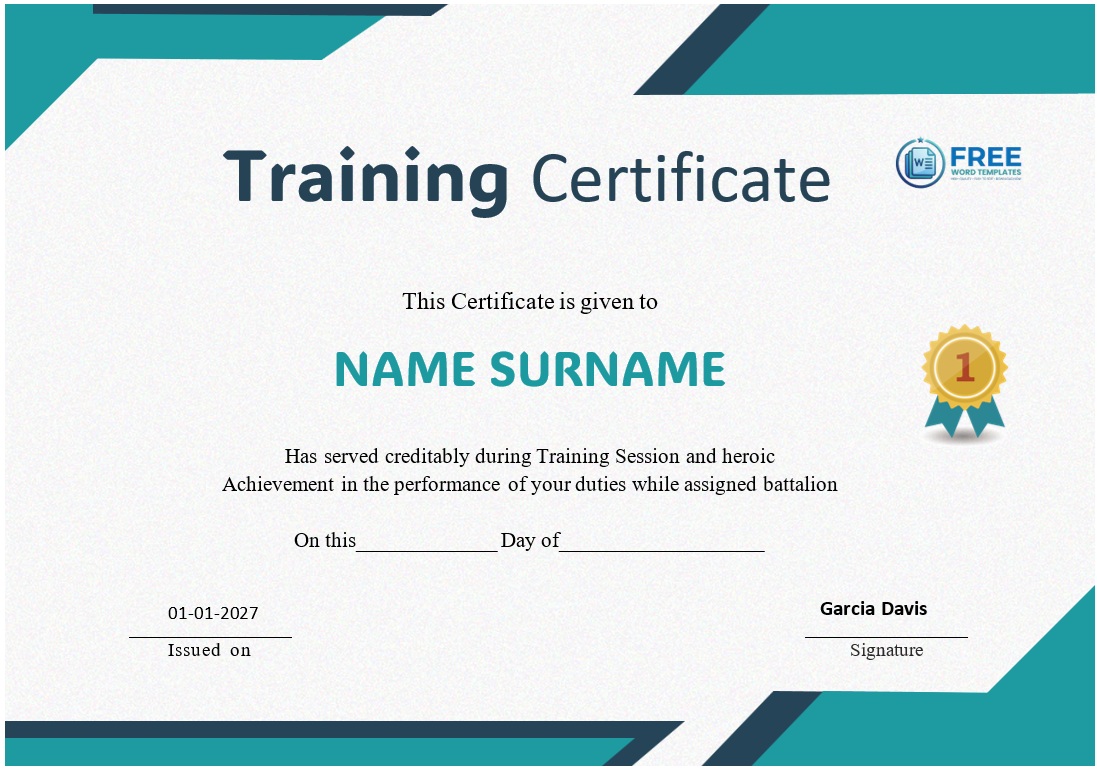
Professional Training Certificate Designs
File Size: 3.1 MB


Employee Training Certificate Templates
File Size: 3.0 MB


Training Completion Certificate Templates
File Size: 3.1 MB



Training Certificate Design Template 15
File Size: 1638 KB

Training Certificate Design Template 15
File Size: 138 KB
Training Certificate Format Guidelines
The best way to ensure that your template meets your exact requirements is to create it from scratch. Creating a document from scratch ensures that you have complete control over all of the content, which ensures that the end result is as close to perfect as possible. You will also have full control over the exact layout of your template. This will allow you to ensure that all of the relevant information is included, ensuring that the document flows seamlessly.
It is also important to ensure that you use high-quality, durable material, as these types of documents can last for a long period of time. Using documents that are poorly constructed, will not only result in you wasting time and money but could potentially damage the valuable information contained within.
When creating your own template, it is important to ensure that you use high-quality templates that have been created by qualified professionals. These professionals will often have years of experience in training and are able to provide you with invaluable advice and assistance.
If you have any questions relating to your template, it is important to ask your trainer before you begin to work on your project. In addition, if you are unable to obtain any advice or assistance from your trainer, you can always turn to the internet, where there are many websites that are dedicated to providing people with training certificate templates and other forms of professional advice.
Essential Elements of a Training Certificate Template
Recipient Name
The name of the individual who has completed the training sits at the heart of the certificate, instantly drawing attention because it personalizes the document and affirms that the achievement belongs to a specific person; by using a clear, legible typeface and positioning it prominently, the certificate conveys respect for the holder’s effort and helps prevent ambiguity should the document be examined later for verification.
Issuing Authority
Directly below the recipient, the name and logo of the organization or institution that delivered the training serve as the source of credibility, signaling that a recognized body has evaluated and endorsed the skills claimed; this element also provides a point of contact for future inquiries, reinforcing the certificate’s legitimacy in the eyes of employers or accrediting agencies.
Date of Issue
The inclusion of the exact issuance date anchors the accomplishment in time, which is crucial for tracing the relevance of the training to current industry standards and for satisfying audit requirements; presenting the date in an unambiguous format ensures that the certificate remains clear and useful across different regions and legal contexts.
Certificate Title
A concise yet descriptive title, such as “Advanced Project Management Training Certificate,” succinctly summarizes the nature of the program and sets expectations for the holder’s competencies; placed prominently, it instantly informs any reviewer of the certificate’s purpose and aligns the document with professional nomenclature, enhancing its perceived value.
Program Description
The brief narrative that follows the title elaborates on the scope, objectives, and key learning outcomes of the training, offering context that helps external parties assess the depth of knowledge acquired; by articulating specific skills and topics covered, this description adds substance to the credential, making it more than a mere formality.
Signatures and Seals
Authentic signatures of senior officials—often complemented by an embossed or digital seal—function as tamper-evident marks that substantiate the certificate’s authority; the visual weight of a handwritten endorsement combined with a distinctive seal reduces the risk of forgery and signals that the document has undergone formal approval processes.
Design Layout
The overall layout, including balanced margins, harmonious color schemes, and high-resolution graphics, unifies all elements into a polished, professional presentation; thoughtful spacing and alignment guide the reader’s eye naturally from the recipient’s name to the issuing authority, date, and verification marks, while a clean aesthetic reinforces the seriousness of the achievement and encourages the holder to display the certificate with pride.
Free Training Certificate Templates
Save time and impress participants with our free training certificate templates—ready-made, professionally designed, and instantly downloadable. Simply edit the text, add your logo, and print; no design skills required. Download now and give your courses the polished finish they deserve.
Understanding Training Certificate Templates and Their Contextual Importance
When organizations, educators, or trainers decide to acknowledge a learner’s progress, the visual and structural design of the certificate becomes more than a decorative formality—it becomes a communication tool. A well-chosen template instantly conveys the nature of the accomplishment, the credibility of the issuing body, and the expectations for future use. For instance, a sleek, minimalist layout may suggest a modern, tech-focused course, whereas a formal, ornate design often aligns with traditional academic or professional certifications. Selecting the appropriate format therefore ensures that recipients feel genuinely recognized, stakeholders perceive the credential as legitimate, and the document can be readily adapted to diverse administrative needs such as digital archiving, public display, or verification processes.
Completion Certificates: Marking the End of a Learning Journey
The most ubiquitous type of training acknowledgment is the completion certificate. Its primary purpose is to certify that a participant has fulfilled all the required components of a program—be it a weekend workshop, an online module, or a semester-long class. Typically, this template includes fields for the learner’s name, the course title, the dates of attendance, and the signature of an authorized instructor or program director. The design often balances professionalism with approachability, employing a clean header that displays the institution’s logo and a subtle border that frames the central text. Because completion certificates are frequently used for personal portfolios or résumé entries, they are crafted to be easily printable yet also compatible with digital PDF distribution, allowing learners to share their achievements across platforms without sacrificing visual integrity.
Attendance Certificates: Recognizing Participation without Assessment
When the goal of an event is to acknowledge presence rather than mastery, attendance certificates take precedence. Conferences, seminars, and industry webinars commonly rely on this format to confirm that an individual was present and engaged. Unlike completion certificates, attendance templates often downplay evaluative language; instead, they emphasize the event’s title, venue, and duration. The layout may incorporate a modest background motif reflecting the event’s theme—such as a subtle graphic of a microphone for a speaking engagement—while preserving ample whitespace to keep the focus on the attendee’s name. These certificates serve dual functions: they provide participants with a tangible reminder of networking opportunities and grant organizers a simple method for tracking engagement metrics.
Achievement Certificates: Highlighting Outstanding Performance
Beyond mere attendance, training programs sometimes wish to celebrate extraordinary results, and achievement certificates fulfill that role. Whether a trainee graduates top of the class, earns a perfect score on a final assessment, or completes a challenging project, this template is designed to spotlight excellence. Consequently, the visual hierarchy shifts, placing the accolade—such as “Award of Excellence” or “First Place”—in a prominent position, often rendered in a larger, embellished font. Color choices may become more vibrant, and additional decorative elements like ribbons or laurel wreaths are introduced to convey prestige. The narrative within the certificate typically includes a brief description of the specific accomplishment, reinforcing the distinction in a way that can be leveraged for career advancement or promotional materials.
Compliance Certificates: Validating Regulatory Adherence
In industries where legal or safety standards are non-negotiable, compliance certificates become vital. These documents attest that an individual or organization has met mandatory training requirements—examples include OSHA safety modules, data protection workshops, or HIPAA privacy courses. The template reflects the seriousness of the content through conservative typography, official seal markings, and often a unique certification number that can be cross-referenced with a governing body’s database. By embedding QR codes or secure hyperlinks, the certificate not only confirms compliance but also enables instant verification, a feature increasingly essential in audit scenarios. This format therefore balances clarity with authenticity, ensuring that stakeholders can trust the documented qualification.
Skill-Specific Certifications: Demonstrating Specialized Competence
When learners acquire a focused competency—such as project management, digital marketing analytics, or software development—a skill-specific certification is issued. These templates tend to incorporate visual cues related to the discipline: a stylized gear for engineering, a data chart motif for analytics, or a stylus for design courses. They also often list the competencies mastered, sometimes in a concise bullet-free paragraph that integrates seamlessly with the overall design. By providing a clear statement of expertise, this certificate type supports individuals in job applications, internal promotions, and professional networking, acting as a portable proof of ability that aligns with industry-recognized standards.
Corporate Recognition Certificates: Aligning Training with Organizational Goals
Finally, many companies develop internal training programs aimed at strategic objectives such as leadership development or cultural alignment. Corporate recognition certificates are tailored to reflect the organization’s branding while reinforcing its mission. These templates might juxtapose the corporate color palette with motivational language, linking the employee’s achievement directly to the company’s future aspirations. By weaving corporate identity into the certificate’s visual language, the document not only acknowledges personal growth but also cultivates a sense of belonging and shared purpose among the workforce.
Why Understanding Common Mistakes in Training Certificate Templates Matters
A training certificate is more than a simple slip of paper; it is a tangible acknowledgment of learning, a credential that can open doors, and a reflection of an organization’s professionalism. When the design, content, or distribution of a certificate is flawed, the impact ripples far beyond an embarrassed recipient. Errors can diminish the perceived value of the training, erode trust in the issuing body, and even expose the organization to legal or reputational risk. By recognizing and avoiding the most frequent pitfalls, creators can ensure that each certificate serves its purpose—celebrating achievement, reinforcing brand integrity, and providing a credible record that stands up to scrutiny.
Design Consistency and Brand Alignment
One of the first mistakes that surfaces in many templates is an inconsistent visual identity. Designers often pull together icons, color palettes, and fonts from disparate sources, assuming that a “nice looking” certificate is sufficient. In reality, an incongruent design signals a lack of attention to detail, making the certificate appear as a hastily assembled after-thought rather than an official document. This usually happens when template creators rely on free-for-all graphic resources without aligning them with the organization’s brand guidelines. The result is a certificate that not only looks unprofessional but also fails to reinforce brand recognition. To avoid this, it is essential to anchor every visual element—be it the logo, the typeface, or the border style—to the same brand bible that governs all other corporate communications. When the visual language is harmonious, recipients feel a stronger sense of belonging, and external reviewers immediately recognize the legitimacy of the credential.
Legal Accuracy and Content Precision
A second, subtler error occurs when the wording on a certificate is vague, outdated, or legally inaccurate. Many template users insert generic phrases like “Completed Training” without specifying the exact course title, duration, or competency level, assuming such details are unnecessary. In practice, this lack of specificity can create confusion for employers or accreditation bodies trying to verify the credential. Moreover, omitting critical information such as the issuing authority’s full legal name or the precise date of completion can compromise the document’s validity, especially when the certificate is later presented in formal contexts like job applications or regulatory audits. These oversights typically arise from a rush to produce a template that can be reused across multiple programs, neglecting the unique legal requirements each course might demand. By embedding placeholders that compel the user to enter exact course names, precise dates, and any required licensing numbers, the template enforces a higher standard of accuracy, thereby safeguarding both the learner’s reputation and the issuer’s credibility.
Signature Authenticity and Security Measures
Equally damaging is the tendency to substitute authentic signatures with low-resolution scans or digital fonts. Creators often assume that a simple “Signed” line or an image of a signature conveys enough authority, yet without a verifiable, high-quality signature the certificate becomes vulnerable to forgery. This mistake is especially prevalent in organizations that rely heavily on digital distribution, where the temptation to streamline the signing process leads to the use of generic, repeatable signature graphics. The adverse effect is twofold: genuine recipients may find their achievements questioned because the certificate lacks a trustworthy seal, and the organization risks being perceived as lax about document security. Integrating features such as embossed seals, QR codes linked to an online verification portal, or digitally signed PDFs not only raises the barrier against counterfeit attempts but also demonstrates a proactive stance on safeguarding the integrity of the credential.
Data Accuracy and Personalization Pitfalls
Even when the design and legal text are flawless, the certificate can still fall short if the personal data of the learner is entered incorrectly. Misspelled names, swapped dates, or omitted identification numbers often happen because the template relies on manual entry rather than an automated data merge. In a fast?paced training environment, the pressure to produce certificates quickly can cause staff to overlook a single character, which, in turn, creates an embarrassing situation for the graduate and may necessitate re-issuance. This error frequently stems from using a one-size-fits-all template that expects the user to fill in every field by hand. Implementing a system that pulls learner information directly from a centralized database not only eliminates human error but also accelerates the issuance process, allowing recipients to receive a polished, error-free certificate promptly after completion.
Distribution Methods and Record Keeping
Finally, the method of delivering certificates can inadvertently undermine their purpose. Many organizations distribute certificates as simple image files attached to an email, believing that convenience outweighs formality. Yet such files are easy to copy, alter, or lose, which diminishes their evidentiary value. Moreover, without a structured archive, the issuing body may lose track of which certificates have been sent, making it difficult to verify authenticity later on. This distribution shortcut typically arises from a desire to minimize administrative overhead, but it ends up creating more work when verification requests arise. By adopting a secure, centralized repository where each certificate is logged, timestamped, and made accessible through a unique verification link, the organization reinforces the document’s trustworthiness while simultaneously streamlining future queries.

Pete Smith is a Business Management graduate and a passionate advocate for practical, accessible resources that empower professionals and entrepreneurs to succeed. With a strong foundation in organizational strategy and operational efficiency, Pete combines academic knowledge with real-world insights to simplify complex business processes. He is the creator behind a growing online platform dedicated to offering free, high-quality documents, templates, and actionable tips designed to save time and improve productivity.