A purchase agreement is the contract between a buyer and a seller setting out the terms of a sale — what’s being sold, for how much, when ownership transfers, and what has to happen before the deal completes. It’s used where a transaction is large enough or complex enough to need negotiated terms: property, vehicles, business assets, and significant equipment. The free templates below are editable MS Word documents, and beneath them every key clause is explained in plain language, along with how a purchase agreement differs from a purchase order and a bill of sale.
Purchase Agreement vs. Purchase Order vs. Bill of Sale
Three documents, three different moments in a transaction:
- A purchase order is the buyer’s routine order document — issued for everyday goods at known prices, and binding once the seller accepts it. No negotiation, no conditions.
- A purchase agreement (also called a sales agreement or, for shares and assets, an SPA or APA) is a negotiated contract for larger transactions. Its distinguishing feature is that completion usually depends on conditions being met first — financing approved, inspection passed, title cleared.
- A bill of sale records a transfer that has already happened. It’s evidence of ownership change, typically handed over at completion — the receipt, not the promise.
Many transactions use two of them: a purchase agreement to commit both sides, then a bill of sale at closing to document the actual transfer.
Key Clauses in a Purchase Agreement
1. The parties. Full legal names and addresses of buyer and seller — company names exactly as registered, individuals as they appear on identity documents. An agreement signed by the wrong entity is difficult to enforce against the right one.
2. Description of what’s being sold. Precise enough that there is no argument later: the legal description and parcel number for property, the VIN and registration for a vehicle, serial numbers for equipment, or a schedule of assets for a business sale. “The blue van” is not a description.
3. Purchase price and payment terms. The total price, the deposit or earnest money and when it’s paid, how the balance is paid, and — importantly — what happens to the deposit if the deal falls through, which varies depending on who caused the failure.
4. Conditions precedent (contingencies). The things that must happen before either side is obliged to complete: buyer’s financing approved, satisfactory inspection or survey, clear title, landlord or regulatory consent, third-party approvals. Each condition needs a deadline and a stated consequence if it isn’t met by then. This is where most real-estate and business deals actually live, and vague contingencies are the most common source of disputes.
5. Closing (completion) date and place. When and where the transaction completes, what each side must deliver on the day, and who bears which closing costs.
6. Representations and warranties. Statements each side makes that the other relies on: that the seller owns the item free of liens and encumbrances, that they have authority to sell, that the item is in the stated condition, and — for a business — that the accounts and contracts disclosed are accurate. If a representation later proves false, the remedies clause determines what follows.
7. Transfer of title and risk of loss. When ownership passes, and separately, when the risk of damage or loss passes. These are not always the same moment, and the gap matters: if goods are destroyed between signing and delivery, this clause decides whose problem it is.
8. Delivery or possession. How and when the buyer takes the item — delivery arrangements for goods, possession date and condition for property, handover of keys, records, and access.
9. Default and remedies. What counts as a breach and what the other party can do: retain or refund the deposit, terminate, sue for damages, or compel completion. Silence here means falling back on general law, which may not give either side what they expected.
10. Dispute resolution and governing law. Which law applies, where disputes are heard, and whether mediation or arbitration comes first — particularly important when buyer and seller are in different states or countries.
11. Signatures, plus witnesses or notarization where your jurisdiction requires them. Property transactions frequently do; check before signing rather than after.
Purchase Agreement Structure at a Glance
PURCHASE AGREEMENT
Made on [date] between [Seller] and [Buyer] for the sale of [property / vehicle / assets / equipment].
1. Parties — full legal names and addresses
2. Description of Property / Goods — identifiers, schedules, condition
3. Purchase Price & Payment — deposit, balance, method, deposit forfeiture
4. Conditions Precedent — financing, inspection, title, consents — each with a deadline
5. Closing — date, place, deliverables, costs
6. Representations & Warranties — title, authority, condition, disclosures
7. Title & Risk of Loss — when ownership passes; when risk passes
8. Delivery / Possession — handover arrangements
9. Default & Remedies — breach, termination, damages
10. Dispute Resolution & Governing Law
Signed: ____________________ Signed: ____________________
[Seller] [Buyer] (witness / notary where required)
Free Purchase Agreement Templates in MS Word
Each template below is editable in Word. Before using one: name the parties in full legal form, describe the item precisely, set deadlines against every condition, and complete the governing-law clause for your jurisdiction.

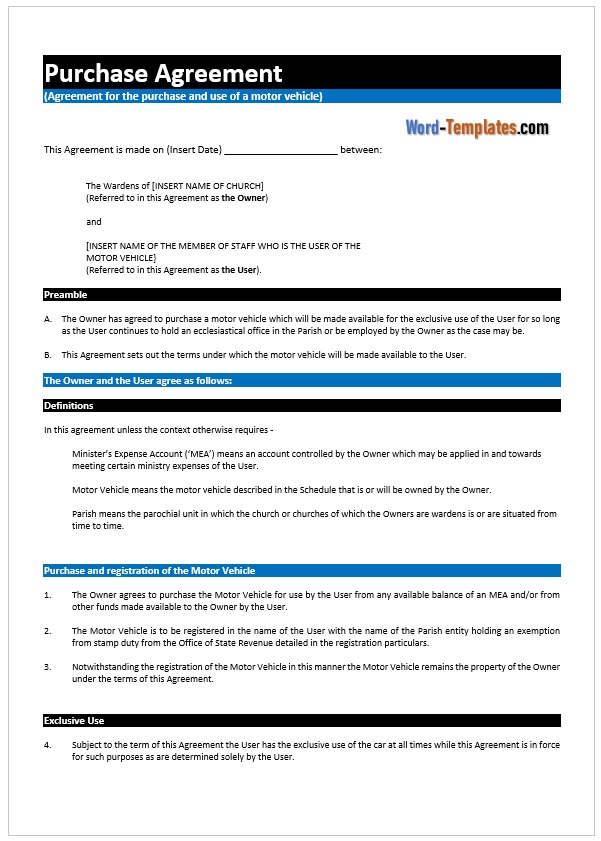


More Free Purchase Agreement Templates
Below are the hand-picked Free Purchase Agreement Templates from Public Domain to help you out.


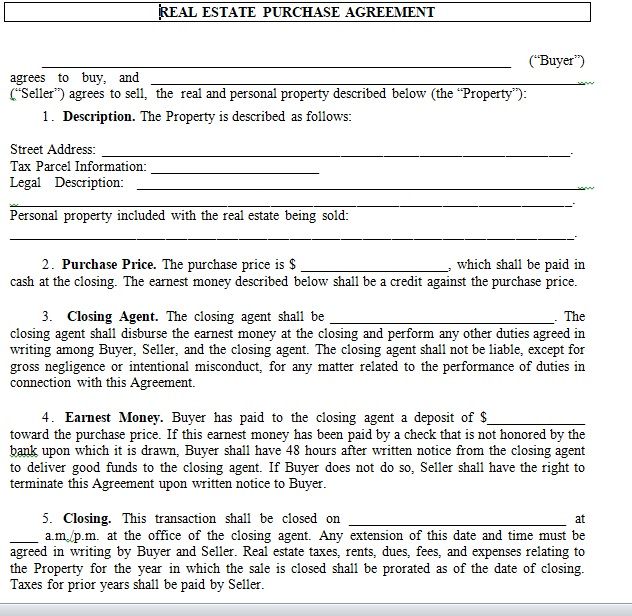


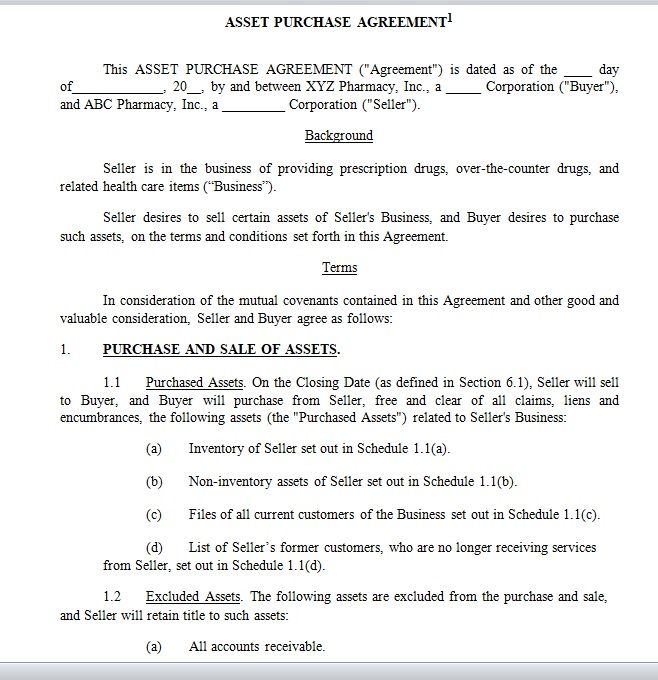

Types of Purchase Agreement
- Real estate purchase agreement — the sale of land or property. The most heavily regulated type: expect mandatory disclosures, statutory forms, financing and inspection contingencies, title work, and often escrow. Most US states have an approved standard form, and using it (or an attorney) matters more here than anywhere else.
- Vehicle purchase agreement — private car, motorcycle, or boat sales. Record the VIN or hull number, odometer reading, and whether the vehicle sells “as is.” A bill of sale usually accompanies it at handover for registration purposes.
- Business or asset purchase agreement — buying a business or a defined set of its assets. Adds schedules of assets and liabilities, treatment of employees and contracts, warranties about accounts, and often a non-compete. Related documents: NDAs during due diligence, and partnership or joint venture agreements where ownership is shared afterwards.
- Equipment and goods purchase agreement — machinery, plant, or bulk goods. Covers specification, delivery, installation, acceptance testing, and warranty period. For routine repeat buying, a purchase order is usually the right document instead.
Frequently Asked Questions
What is a purchase agreement?
A contract between buyer and seller setting out the terms of a sale — what’s being sold, the price, payment terms, the conditions that must be satisfied first, and when ownership and risk transfer. It’s used where a transaction needs negotiated terms rather than a simple order.
What is the difference between a purchase agreement and a purchase order?
A purchase order is the buyer’s routine order for goods at known prices, binding once the seller accepts. A purchase agreement is a negotiated contract for larger or more complex sales, typically with conditions that must be met before completion.
What is the difference between a purchase agreement and a bill of sale?
The purchase agreement is the promise: it commits both sides and sets the conditions. The bill of sale is the record that the transfer actually happened, usually signed at closing and used as proof of ownership afterwards.
Is a purchase agreement legally binding?
Once signed by both parties, generally yes — subject to any conditions precedent, which suspend the obligation to complete until they’re satisfied or waived. Formalities differ by jurisdiction and by what’s being sold; real estate in particular often requires specific forms, disclosures, witnessing, or notarization.
What happens to the deposit if the sale falls through?
Whatever the agreement says — which is exactly why it should say. Well-drafted agreements distinguish between failure because a condition wasn’t met (deposit usually returned) and failure because a party defaulted (deposit may be forfeited or other remedies apply).
Do I need a lawyer for a purchase agreement?
For routine equipment and goods, a carefully completed template is common practice. For real estate, business sales, and anything with significant value or complex conditions, have an attorney review the final document — and for property, start from your jurisdiction’s standard form rather than a generic template.

Pete Smith is a Business Management graduate and a passionate advocate for practical, accessible resources that empower professionals and entrepreneurs to succeed. With a strong foundation in organizational strategy and operational efficiency, Pete combines academic knowledge with real-world insights to simplify complex business processes. He is the creator behind a growing online platform dedicated to offering free, high-quality documents, templates, and actionable tips designed to save time and improve productivity.