A certificate of honor is the most formal document in the award family. It’s issued for distinguished service, sustained contribution, or standing within an institution — the recognition that carries weight rather than the one handed out weekly. The printable designs below are free to download, and beneath them you’ll find wording examples, how an honor certificate differs from the others you might be considering, and the layout and print settings that make one look like it was meant to be framed.
Honor, Merit, Achievement, or Recognition?
Five certificates, one register each. Choosing correctly matters more here than anywhere else in the family, because an honor certificate issued casually stops being an honor:
- Honor — the highest register. Distinguished service, sustained contribution, or formal standing conferred by an institution. Issued rarely, signed at the top, and worded formally.
- Achievement — something notable was accomplished, usually with a number attached.
- Merit — a defined standard was met. Non-competitive; anyone reaching the bar receives one.
- Recognition — contribution or service acknowledged, with no measured standard.
- Completion — a course or programme was finished.
The test: if you’d award it to twenty people this term, it isn’t an honor certificate. Scarcity is part of what the document means, and an organization that issues honors monthly has quietly converted them into recognition certificates with a grander name.
What Goes on a Certificate of Honor
- The issuing institution — name, crest or logo, and any formal designation.
- The title — “Certificate of Honor,” or the specific honor being conferred.
- The recipient’s full formal name, with title where appropriate. This is the one certificate where “Dr”, “Cllr” or a post-nominal belongs if the person uses one.
- The reason — what is being honoured, stated in a sentence or two rather than a phrase.
- The period where relevant — the years of service, the term, the campaign.
- The date, written out in full: “the twelfth day of December, two thousand and twenty-six” on the most formal versions, or “12 December 2026” on the rest.
- Two signatures — typically the head of the institution and one other officer, each with name and role printed beneath.
- A seal or embossed mark, which matters more on this certificate than on any other in the family.
Certificate of Honor Example
RIVERSIDE COMMUNITY TRUST
Established 1974 · Registered charity no. 0000000
CERTIFICATE OF HONOR
CONFERRED UPON
Dr Priya Nair
in recognition of twenty-two years of distinguished service
to this Trust and to the community it serves,
and of the founding and stewardship of the Mill Lane Shelter,
which has provided refuge to more than nine thousand people
since it opened in 2008.
Given this twelfth day of December, two thousand and twenty-six
| A. Farouk · Chair of Trustees | [ SEAL ] | K. Osei · Chief Executive |
Three things distinguish this from a standard award certificate. “Conferred upon” rather than “awarded to” — the language of an honor is granted, not handed over. The citation runs to several lines and includes a specific figure, because an honor is meant to record what the person did. And two signatures flank a seal, which is the visual convention that makes a certificate read as institutional rather than personal.
Free Certificate of Honor Templates
Each design below is ready to print. Add your institution’s details, the citation, and the signatures before printing on card.


Printable Certificate of Honor Design
File Size: 181 KB

Editable Certificate of Honor Template
File Size: 75 KB

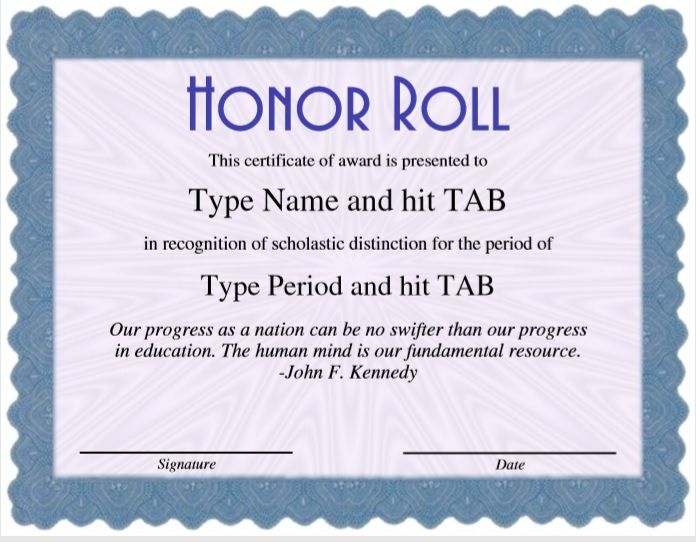
Printer-Friendly Certificate of Honor Design
File Size: 235 KB


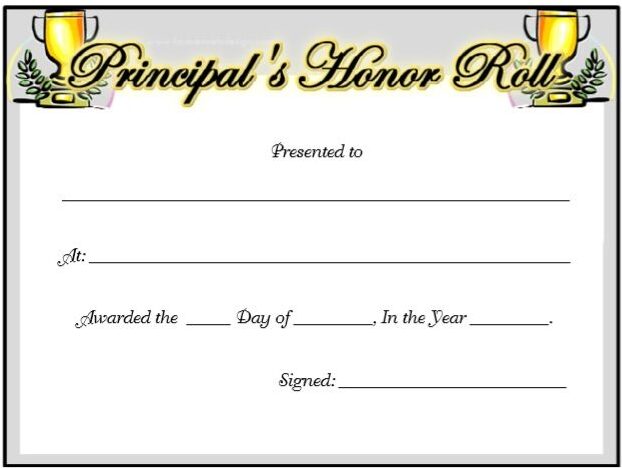
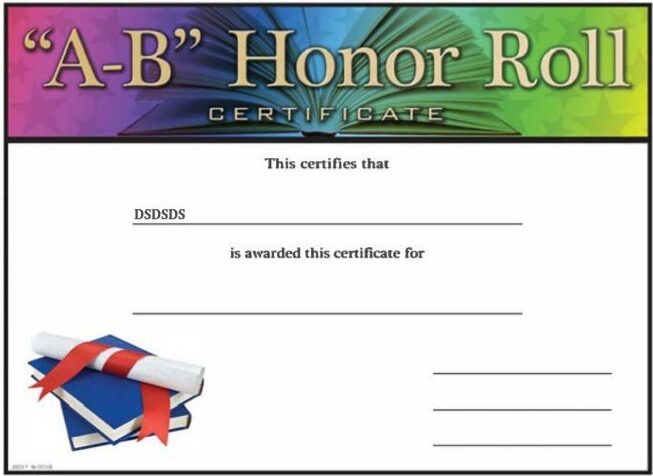
Wording Examples
Service and contribution
…in recognition of [X] years of distinguished service to [organization].
…in acknowledgement of exceptional service rendered to this community.
…for a lifetime of contribution to [field or cause].
…in grateful recognition of service as [role], [years].
Formal conferral
…is hereby honored for [specific contribution].
…upon whom this honor is conferred in recognition of [reason].
…admitted as an Honorary Member of [organization] in recognition of [reason].
…named [title] in recognition of outstanding service.
Academic
…named to the Honor Roll for the [term] semester, [year].
…in recognition of academic distinction throughout the [year] academic year.
…for placement on the Dean’s List, [term] [year].
Uniformed and emergency services
…in recognition of conspicuous service to the [service] during [event or period].
…for dedication to duty above and beyond what was required.
…in honor of [X] years of service to this [department / brigade / corps].
Whichever you use, write the citation rather than filling a blank. An honor certificate reading “in recognition of your service” and nothing more is a form; one naming what the person actually did is a document their family keeps.
Honor Roll Certificates
The most common use of the term in schools, and it works a little differently from the formal version above.
An honor roll certificate recognises academic standing over a term or semester — typically a grade point average above a stated threshold, sometimes split into tiers such as Honor Roll and High Honor Roll. Unlike a conferred honor, it’s earned against published criteria, so any number of students can receive one.
What makes them work:
- State the criteria on the certificate — “for achieving a grade point average of 3.5 or above”. It tells the student and their family exactly what the recognition represents.
- Name the term and year. These accumulate, and a student with four of them wants to see which four.
- Distinguish the tiers visually if you use more than one, so High Honor Roll doesn’t look identical to Honor Roll.
- Issue them promptly, within a couple of weeks of results. A certificate arriving the following term has stopped meaning much.
- Present them publicly where you can — assembly or an awards evening rather than a pile handed to a form tutor.
Layout and Typography
An honor certificate should read as formal without becoming fussy. The reliable choices:
- Centre the main text blocks — title, name, citation — and leave generous margins. Symmetry and space are what read as formality.
- Establish a clear hierarchy: the award title largest, the recipient’s name second, the citation smaller, and the signature block smaller still.
- Use a serif typeface for the title and name — Garamond, Times New Roman, Georgia. Serifs carry the tradition that this document is trading on.
- Two font families maximum, with a clean sans-serif such as Calibri for any supporting text. A third font is what makes a formal certificate look home-made.
- Line spacing around 120% of the font size, so the citation doesn’t feel cramped.
- Add a little letter-spacing to uppercase headings — a small amount of tracking on a line like CERTIFICATE OF HONOR noticeably improves it.
- Keep borders restrained. A double rule or a simple frame supports the text; a heavy decorative border competes with it. Whatever you choose, the border should be the last thing the eye notices, not the first.
- Colour sparingly — navy, maroon, deep green, black or gold for formal awards, used on the title and border rather than across the whole design.
Printing Specifications
- Page size: A4 (210 × 297 mm) or US Letter (8.5 × 11 in), depending on where it will be printed.
- Bleed: 3 mm (0.125 in) around all edges if any element runs to the edge, so trimming doesn’t cut into the design. Increase to 6 mm on heavier card, which is harder to trim precisely.
- Resolution: export at 300 dpi or higher. Anything lower shows on a seal or a crest, which is exactly where people look.
- Embed your fonts when exporting to PDF, or a print shop’s system will substitute them and the layout will shift.
- Card weight: 250 gsm or heavier. An honor certificate on ordinary paper undercuts everything the design is trying to do.
- Finish: matt rather than gloss — it photographs better, and recipients photograph these.
- Sign by hand, in ink, and add a seal or embossed mark if you have one. On this certificate above all others, a printed signature is noticed.
- Consider framing for the most significant awards. It roughly doubles the chance the certificate ends up on a wall.
Other certificates in this family: blank certificate templates to build a design from scratch, and membership certificates where the recognition is of standing rather than service.
Frequently Asked Questions
What is a certificate of honor?
A formal document recognising distinguished service, sustained contribution, or standing conferred by an institution. It’s the highest register of the award family, issued rarely, worded formally, and usually signed by two senior officers with a seal.
What is the difference between a certificate of honor and a certificate of achievement?
Achievement records something specific that was accomplished, usually measurable. Honor recognises service, contribution or standing over time, and carries a more formal tone. If you’d award it to twenty people this term, it isn’t an honor certificate.
What should be written on a certificate of honor?
A citation of a sentence or two naming what the person actually did — not a single phrase. “In recognition of twenty-two years of distinguished service and the founding of the Mill Lane Shelter” is a citation; “in recognition of your service” is a blank someone forgot to fill in.
What is an honor roll certificate?
Academic recognition for a term or semester, awarded against published criteria such as a minimum grade point average. Unlike a conferred honor, any number of students can earn one. State the criteria and the term on the certificate itself.
Should a certificate of honor have a seal?
Where you have one, yes. A seal or embossed mark is the visual convention that makes a certificate read as institutional rather than personal, and it matters more on an honor certificate than on any other kind.
What font should a certificate of honor use?
A serif typeface — Garamond, Times New Roman or Georgia — for the title and the recipient’s name, paired with one clean sans-serif for supporting text. Two font families at most, with generous line spacing and a little tracking on uppercase headings.
What paper should it be printed on?
Card of 250 gsm or heavier, matt rather than gloss, at 300 dpi or above with fonts embedded. Sign it by hand in ink, and consider framing the most significant awards.

Pete Smith is a Business Management graduate and a passionate advocate for practical, accessible resources that empower professionals and entrepreneurs to succeed. With a strong foundation in organizational strategy and operational efficiency, Pete combines academic knowledge with real-world insights to simplify complex business processes. He is the creator behind a growing online platform dedicated to offering free, high-quality documents, templates, and actionable tips designed to save time and improve productivity.