An Employee of the Year certificate marks the single biggest contribution of the year, and it’s the most visible recognition most workplaces give. It’s also the award most easily got wrong — a name announced with no explanation, or a winner everyone assumes was chosen for the wrong reasons, does more harm than giving nothing at all. The free templates below are editable MS Word designs, and beneath them you’ll find wording, how to present it, and how to choose the recipient so that the award means something to the people who didn’t win.
Choosing the Winner
This decides whether the award works, and it happens long before anyone opens a template.
- Publish the criteria before the year starts. If people don’t know what’s being measured, they can’t aim at it — and when the winner is announced, everyone constructs their own theory about why. Two or three stated criteria are enough: sustained performance, contribution beyond the role, living the values you actually care about.
- Let anyone nominate, with a short written reason. Nominations from colleagues surface people managers don’t see — the person who quietly fixes things, the one who trains every new starter, the one in a back-office role nobody notices until they’re on leave.
- Decide by panel, not by one person. A single decision-maker, however fair, produces an award that looks like a personal preference. Three or four people across different departments removes most of that.
- Don’t run it as a popularity vote. An all-staff ballot reliably selects the most sociable person rather than the most deserving, and the people doing quiet, essential work never win one.
- Watch the pattern over years. If the same department wins three times running, the award has stopped being about individuals and everyone has noticed. Check the history before finalising.
- Write down why. The panel’s reasoning becomes the citation on the certificate, and if you can’t write two specific sentences, the decision probably isn’t right yet.
The Problem With One Annual Winner
Worth being honest about, because it’s why so many recognition programmes fade after a couple of years.
If two hundred people are eligible and one wins, then a hundred and ninety-nine didn’t — and unless they can see exactly why the winner was chosen, some of them conclude the award isn’t available to people like them. An annual prize with no visible reasoning can demotivate more people than it motivates.
Three things prevent that:
Use several categories. Employee of the Year alongside awards for newcomer of the year, team of the year, customer champion, and a behind-the-scenes award recognises different kinds of contribution and gives more people a genuine chance. It also stops the same high-profile roles winning every time.
Recognise more often. A monthly or quarterly award, or simply a habit of writing to someone when they’ve done something well, does more for morale across a year than one evening in December. The annual award then sits on top of a culture of recognition rather than substituting for one.
Read the citation out loud. The single most effective thing you can do. When people hear what the winner did, the award becomes a statement about what the organization values rather than a mystery about who management likes.
What Goes on the Certificate
- Company name and logo, at the top.
- The award title — “Employee of the Year” — and the year itself.
- The recipient’s full name, set large and spelled correctly.
- The citation — one or two sentences naming what they actually did. This is the part that matters.
- The date of presentation.
- Signatures — ideally two: the managing director or chief executive, and the recipient’s own manager.
- A seal or embossed mark, if you use one.
Employee of the Year Certificate Example
HARBOUR LOGISTICS LTD.
EMPLOYEE OF THE YEAR
2026
PRESENTED TO
Rosa Silva
for rebuilding the despatch process after the warehouse move,
cutting picking errors by 62% in three months,
and for training four new starters while doing it —
without once being asked to.
| K. Osei · Managing Director | 12 December 2026 |
The citation is doing everything here. It names a project, a measurable result, and something the person did beyond what was asked — and the last line is what makes it personal rather than procedural. A certificate reading “Employee of the Year 2026” above a name would be correct, forgettable, and would leave the rest of the room guessing.
Free Employee of the Year Certificate Templates
Each template below is editable in Word. Add your logo and signature block once, then change only the name, year and citation.

Employee of the Year Certificate Template – 01
File Size: 267 KB

Employee of the Year Certificate Template – 02
File Size: 102 KB
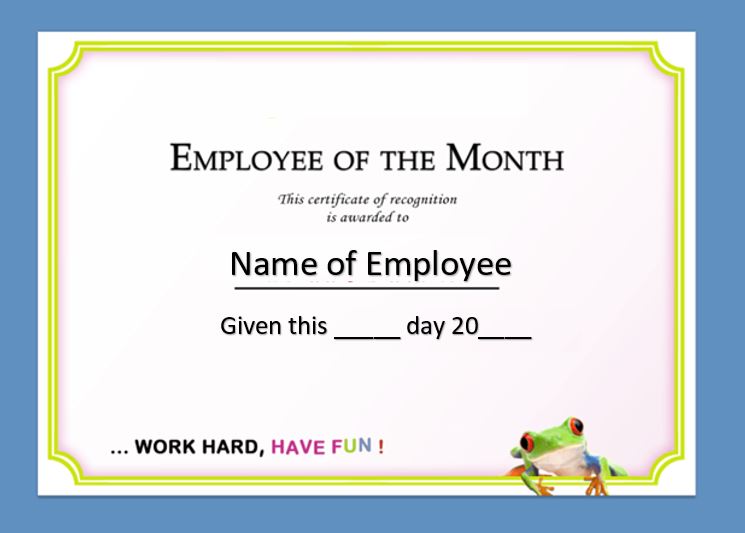
Employee of the Year Certificate Template – 03
File Size: 76 KB
Wording
Performance
…for consistently outstanding performance throughout [year].
…for exceeding every target set in [year], and raising the standard for the team.
…for [specific achievement], and for the sustained quality of their work all year.
Going beyond the role
…for taking on [specific responsibility] without being asked, and making it work.
…for stepping in during [situation] and holding things together when it mattered.
…for [achievement] — none of which was in the job description.
Supporting others
…for training [number] new colleagues while carrying a full workload.
…for being the person everyone asks, and never once making anyone feel foolish for asking.
…for making this a better place to work for the people around them.
Long contribution
…for [number] years of reliability, good humour, and work that never needed checking.
…in recognition of a year in which [name] did more than anyone realised at the time.
Whichever you use, add the specifics. A number, a project, a situation. The named detail is what turns a citation from a compliment into a record — and it’s what the recipient’s family reads twice.
Presenting It
- In public, with the citation read aloud. Not just the name. Thirty seconds of explanation is the difference between an award and a raffle.
- Check the name pronunciation beforehand. Ask, don’t guess. Getting it wrong in front of the company is what the recipient will remember about the evening.
- Sign it by hand, and have the managing director present it personally where possible. A certificate left on a desk, or handed over by someone who wasn’t involved in the decision, loses most of its value.
- Pair it with something tangible — a voucher, extra leave, a good pen, a donation to a charity they choose. The certificate is the record; the gift is the thank-you.
- Take a photograph and ask permission before sharing it internally or externally. Some people want it on the intranet; some very much don’t.
- Tell the wider organization why — an email or newsletter item with the citation. It reaches the people who weren’t in the room, which is most of them.
- Copy it to the personnel file. It’s evidence at appraisal time, and it matters if the person ever needs a reference.
Design and Printing
- Two fonts at most — a decorative or serif face for the award title and recipient’s name, and a plain readable one for the citation and date. A third font is what makes a formal certificate look home-made.
- Classic colours. Navy, deep maroon, forest green, black, or gold accents. Use them on the title and border rather than across the whole design.
- Restrained borders. A double rule or simple frame gives structure; a heavy decorative border competes with the text. The border should be the last thing noticed, not the first.
- Keep margins generous and the hierarchy clear: award title largest, name second, citation smaller, signatures smallest.
- Export at 300 DPI with fonts embedded, so logos and seals stay sharp and a print shop doesn’t substitute your typeface.
- Print on 250 gsm card or heavier, matt rather than gloss — matt photographs better, and people photograph these.
- Consider framing it. For the top annual award it roughly doubles the chance the certificate ends up on a wall rather than in a drawer, and the cost is trivial against what the award is meant to signal.
Other workplace certificates: achievement certificates for measurable accomplishments, certificates of recognition for contribution and service, certificates of honor for long or distinguished service, and blank certificates if you’d rather build your own design.
Frequently Asked Questions
What should an Employee of the Year certificate include?
The company name and logo, the award title and year, the recipient’s full name, a one or two sentence citation naming what they did, the date, and signatures from a senior leader and ideally their own manager.
How do you choose Employee of the Year?
Publish the criteria before the year begins, open nominations to everyone with a short written reason, and decide by a panel drawn from different departments rather than a single manager. Avoid an all-staff popularity vote, which tends to select the most visible person rather than the most deserving.
What do you write on an employee award certificate?
Name the specific contribution — a project, a number, a situation they handled. “For rebuilding the despatch process and cutting picking errors by 62%” is a record; “for outstanding performance” is a phrase.
Does an annual award actually motivate people?
Only if the reasoning is visible. With two hundred eligible people and one winner, the other hundred and ninety-nine need to see why — otherwise some conclude the award isn’t available to them. Several categories, more frequent recognition, and reading the citation aloud all help.
Should the award be a staff vote?
Generally not. Open ballots reward visibility and sociability rather than contribution, and people in quiet or back-office roles rarely win one. Open nominations with a panel decision gets the benefit of staff input without the popularity effect.
What should be given alongside the certificate?
Something tangible — a voucher, additional leave, or a donation to a charity the recipient chooses. The certificate is the permanent record; the gift is the thank-you. Present both publicly, with the citation read out.
What paper should an award certificate be printed on?
250 gsm card or heavier, matt rather than gloss, exported at 300 DPI with fonts embedded. Sign by hand, and consider framing the top annual award.

Pete Smith is a Business Management graduate and a passionate advocate for practical, accessible resources that empower professionals and entrepreneurs to succeed. With a strong foundation in organizational strategy and operational efficiency, Pete combines academic knowledge with real-world insights to simplify complex business processes. He is the creator behind a growing online platform dedicated to offering free, high-quality documents, templates, and actionable tips designed to save time and improve productivity.