A share certificate (called a stock certificate in the US) is the document a company issues to a shareholder as evidence that they own a stated number of shares. Private companies and startups issue them to founders, investors, and employees when shares are allotted or transferred. The free templates below are editable MS Word documents for companies issuing their own certificates, and this page explains what each certificate must contain, how it relates to the company’s share register, and the sequence to follow when issuing shares.
The Certificate Is Evidence — the Register Is the Record
This is the point most template pages skip, and it matters more than any design choice. A company’s register of members (its share register) is the legal record of who owns what. The share certificate is the shareholder’s evidence of that entry — useful, expected, and often required by banks, investors, and auditors, but secondary to the register. Two consequences follow: entering the shareholder in the register is the step that must not be skipped, and a certificate issued without a matching register entry proves nothing. Keep the register current first, then issue the certificate to match it exactly — same name, same number of shares, same class, same date.
What a Share Certificate Must Include
- Certificate number — sequential, so certificates can be tracked and cancelled certificates accounted for.
- Company name, registration number, and jurisdiction — the full legal name as registered, with the company number and place of incorporation.
- Shareholder’s name and address — exactly as recorded in the register of members.
- Number of shares — in figures and, on many certificates, in words as well.
- Class of shares — ordinary/common, preference/preferred, or a lettered class (A, B). Where classes carry different rights, the class must be stated; “100 shares” alone is ambiguous in a company with more than one class.
- Nominal or par value, where your jurisdiction uses one — and whether the shares are fully paid or partly paid. Partly paid shares carry a future obligation, so the status belongs on the face of the certificate.
- Date of issue — matching the allotment or transfer date in the register.
- Signatures — typically two directors, or a director and the company secretary, according to your articles. Add the company seal if your company uses one.
- Transfer restriction legend — private company shares usually can’t be transferred freely. A short note that transfers are subject to the company’s articles and any shareholders’ agreement puts holders and future buyers on notice.
Share Certificate Structure at a Glance
[COMPANY NAME] LIMITED
Incorporated in [jurisdiction] | Company No. [registration number]
SHARE CERTIFICATE
Certificate No: ________ Date of Issue: ______________
This is to certify that [Shareholder Name], of [address], is the registered holder of [number] ([number in words]) [class] shares of [nominal value] each, fully paid, in the capital of the above-named company, subject to the company’s articles of association.
Transfer of these shares is restricted by the company’s articles of association and any shareholders’ agreement in force.
Director
Director / Secretary (Seal)
How Shares Are Issued: The Sequence
- Board approval — the directors resolve to allot the shares (or approve a transfer), within whatever authority the articles and shareholders give them.
- Consideration received — payment or other agreed consideration for the shares.
- Register of members updated — the shareholder’s name, address, share count, class, and date are entered. This is the step that creates the ownership record.
- Certificate issued — prepared from the register entry, signed, and given to the shareholder. Many jurisdictions require certificates to be issued within a set period after allotment or transfer, so check your local company law rather than leaving it open-ended.
- Statutory filings — where required, notify the companies registry of the allotment and any change in share capital, within the applicable deadline.
For transfers, the old certificate is surrendered and cancelled before a new one is issued — never leave two live certificates covering the same shares.
Free Share Certificate Templates in MS Word
Each template below is editable in Word. Fill in your company details, the shareholder’s details from the register, the number and class of shares, and the signature blocks required by your articles.
Traditional Share Certificate Template (Bordered)

A classic ornate design with fields for certificate number, share class, nominal value, and two signature blocks.

Plain Corporate Stock Certificate Template

A simpler layout without heavy ornament — suited to startups and small companies issuing founder or investor shares.
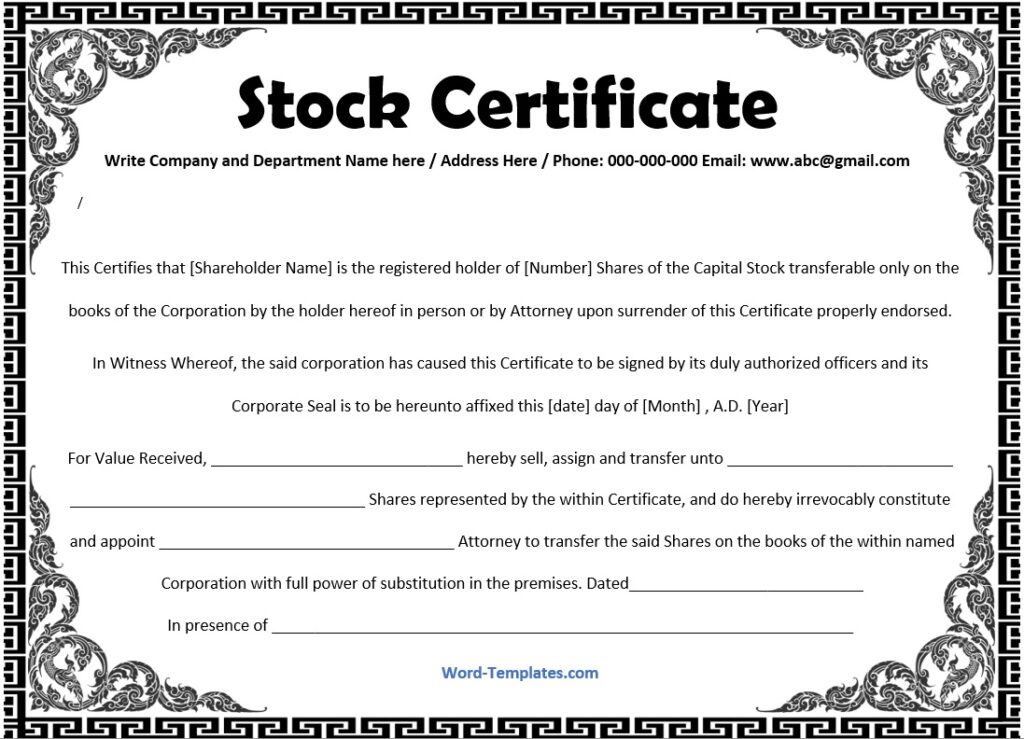
Here is the download button for this stock shares certificate template.

Here is the download button for this stock shares certificate template.
For LLCs, the equivalent document is a membership certificate covering units or percentage interest — see our membership certificate templates. Related agreements: partnership agreements and joint venture agreements.
Certificated vs. Uncertificated Shares
Paper certificates are now mainly a private-company practice. Shares in listed public companies are largely held in electronic (dematerialized) form through brokers and central depositories, where ownership is recorded digitally and no paper is issued. Some jurisdictions also allow private companies to operate entirely uncertificated if their articles permit it. So the honest answer to “do we still need share certificates?” is: usually yes for a private company — shareholders, banks, and investors expect them, and they’re cheap to produce — but check your articles and local rules rather than assuming they’re mandatory.
Frequently Asked Questions
What is a share certificate?
A document issued by a company confirming that a named person holds a stated number of shares of a stated class. It’s the shareholder’s evidence of ownership; the company’s register of members is the legal record it evidences.
What information must a share certificate contain?
Certificate number, the company’s full name and registration details, the shareholder’s name, the number and class of shares, nominal value and paid status where applicable, date of issue, and authorized signatures — plus a transfer restriction note for private companies.
Who signs a share certificate?
Whoever your articles of association specify — commonly two directors, or one director and the company secretary. If the company keeps a seal, it’s usually applied as well. Follow the articles rather than the template’s default.
What happens if a share certificate is lost?
The company issues a replacement, normally after the shareholder provides a written indemnity (and in some cases a statutory declaration) confirming the original is lost and accepting responsibility if it resurfaces. The replacement gets a new certificate number, and the loss is recorded.
Is a share certificate proof of ownership?
It’s strong evidence, but the register of members is the definitive record. If the two disagree, the register generally governs — which is why the certificate should always be prepared from the register entry, not the other way round.
Do private companies still issue paper share certificates?
Most do. Listed company shares are largely electronic, but private companies typically still issue paper certificates because shareholders, banks, and investors expect them — subject to what the company’s articles and local rules require.

Pete Smith is a Business Management graduate and a passionate advocate for practical, accessible resources that empower professionals and entrepreneurs to succeed. With a strong foundation in organizational strategy and operational efficiency, Pete combines academic knowledge with real-world insights to simplify complex business processes. He is the creator behind a growing online platform dedicated to offering free, high-quality documents, templates, and actionable tips designed to save time and improve productivity.