A certificate of completion confirms that someone finished something — a course, a training programme, a workshop, an internship, a set of required hours. Training providers, employers, schools, and clubs all issue them, and a good one is specific enough that an employer reading it two years later knows exactly what it covers. The free templates below are editable MS Word designs, and beneath them you’ll find wording examples, what to include, and two situations where a certificate of completion means something quite different from what most people assume.
Completion, Achievement, Attendance, or Participation?
Four certificates that sound similar and say different things. Choosing the wrong one either overstates what happened or undersells it:
- Completion — the person finished the whole thing. It says nothing about how well they did, only that they got to the end.
- Achievement — they met a standard or accomplished something measurable. Stronger than completion, and it should only be used where there was something to achieve.
- Attendance — they were present. Common for conferences and single-session events, where there’s nothing to complete.
- Participation — they took part. The gentlest of the four, and appropriate where involvement rather than outcome is the point.
Related certificates on this site: training certificates for courses and CPD, merit certificates where a standard was met, and certificates of recognition for contribution rather than completion.
Completion Is Not Competence
Worth stating plainly, because it affects how you word the certificate.
A completion certificate confirms attendance and finishing — it does not certify that the person can now do the thing. Those are different claims, and employers, regulators, and insurers treat them very differently. A certificate saying someone “has completed a course in electrical safety” is a factual record. One saying they are “qualified to work on electrical installations” is a competence claim, and unless you’re an accredited awarding body with an assessment behind it, you shouldn’t be making it.
The practical rule: describe what happened, not what the person can now do. “Has successfully completed the 12-hour Food Hygiene Level 2 course” is accurate and useful. “Is now qualified in food hygiene” is a claim you may not be entitled to make.
Where an assessment was part of the course, say so — “completed the course and passed the end-of-course assessment” is both stronger and still accurate.
What Goes on a Certificate of Completion
- The issuing organization — name, logo, and any accreditation or registration reference.
- The title — “Certificate of Completion,” clearly.
- The recipient’s full name, spelled as it appears on their official documents. This is the field that matters most and the one most often got wrong.
- What was completed — the exact course or programme title, not a category.
- Dates — the date of completion, and the period covered where the programme ran over time.
- Duration or contact hours — essential where learners will claim CPD credit. “12 contact hours” is the figure their professional body will ask for.
- Assessment, if there was one, and whether it was passed.
- Certificate number — sequential, so an employer can verify it with you.
- Signature of the trainer, course director, or head of the organization, with name and role printed beneath.
- Seal or stamp, where you use one.
Certificate of Completion Example
NORTHGATE TRAINING ACADEMY
Accredited provider no. 000000
CERTIFICATE OF COMPLETION
THIS CERTIFIES THAT
Tunde Okafor
has successfully completed the
Level 2 Award in Food Safety and Hygiene
comprising 12 contact hours of instruction,
and has passed the end-of-course assessment.
Completed 18 September 2026
| S. Malik · Course Director | Certificate no. NTA-2026-0841 |
Three details make this certificate useful rather than decorative. The course title is exact, so an employer knows precisely what was covered. The contact hours are stated, which is what a professional body needs for CPD. And the certificate number means the claim can be checked with the issuer — which is what separates a credential from a printout.
Free Certificate of Completion Templates in MS Word
Each template below is editable in Word. Set up your organization’s details, logo, and signature block once, then change only the name, course, and date for each certificate.
Formal Certificate of Completion

A traditional double-bordered design with space for a logo, the course title, contact hours, a certificate number, and two signatures.

Modern Certificate of Completion
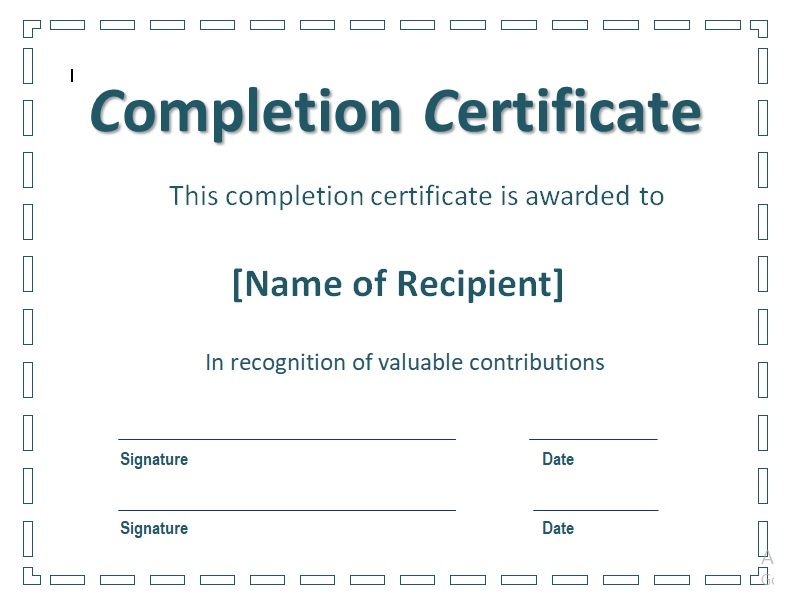
A cleaner contemporary layout suited to corporate training and online courses, with a wide name area and a simple accent border.




Wording Examples
Courses and training
…has successfully completed the [course title], comprising [X] contact hours of instruction.
…has completed the [programme] delivered between [date] and [date].
…has completed the [course] and passed the end-of-course assessment.
…has completed all modules of the [programme] to the required standard.
Workshops and short sessions
…attended and completed the [workshop] on [date], a session of [X] hours.
…has completed the [title] workshop, covering [brief scope].
Internships and placements
…has satisfactorily completed [X] hours of on-the-job training with [organization] from [date] to [date].
…has completed a [duration] internship in the [department] department.
Programmes and projects
…has completed the [programme] and fulfilled all requirements.
…has completed all stages of the [project] to the satisfaction of [organization].
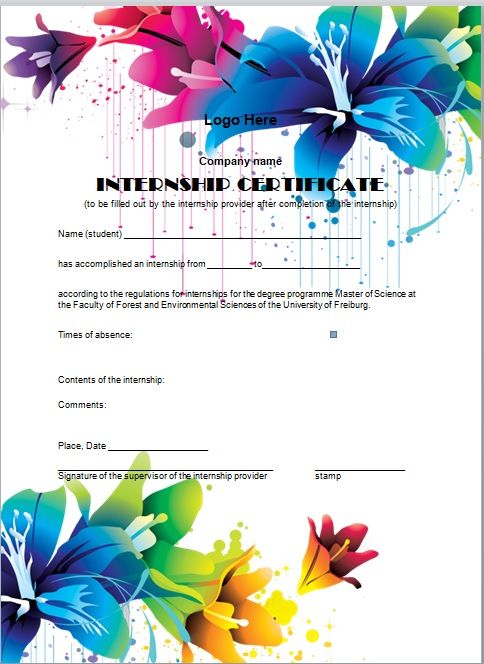
OJT and Internship Certificates
On-the-job training certificates carry more weight than most completion certificates, because students frequently need them to satisfy an academic requirement — the certificate is the proof their institution accepts.
That means they need more than a name and a date. Include:
- The exact number of hours completed, since course requirements are usually expressed in hours. This is the single most important field.
- The start and end dates of the placement.
- The department or area they worked in, and the nature of the work.
- The supervisor’s name and position, and a contact where the institution may verify it.
- The company’s full name, address, and registration details.
- A signature and company stamp — many institutions won’t accept an unstamped certificate.
If your organization takes interns regularly, ask the sending institution once what their certificate must contain. Requirements differ, and a certificate rejected for a missing field means a student chasing you weeks after they’ve left. Where a student also needs a fuller reference, an experience certificate covers the work performed in more detail.
Construction: A Different Document Entirely
If you arrived looking for a certificate of completion for a building project, the template you need probably isn’t on this page — and it’s worth knowing why.
In construction, a certificate of practical completion (or substantial completion) is a contract administration document, usually issued by an architect, contract administrator, or engineer under the terms of the building contract. Issuing it has legal and financial consequences: it commonly triggers a payment stage, releases part of any retention, starts the defects liability or rectification period, ends the contractor’s liability for liquidated damages, and shifts responsibility for insuring the works to the employer.
Because of that, the form and wording usually come from the contract itself — JCT, NEC, AIA, FIDIC and other standard forms each have their own certificates and procedures. A decorative certificate template is not a substitute, and issuing something that looks like a completion certificate without the contractual basis can create real disputes about when those consequences took effect.
If you need one, use the certificate prescribed by your contract, and take advice from the contract administrator. What the templates on this page are suitable for in a construction setting is training and induction records — site safety inductions, equipment training, toolbox talks — where a completion certificate is exactly the right document.
Issuing and Verifying
- Number every certificate and keep a register: number, name, course, date, hours. It takes seconds and it’s what lets you confirm a certificate when an employer calls.
- Check the spelling of the name against the enrolment record, not from memory. A misspelled name on a credential is a certificate someone has to ask you to reissue.
- Sign by hand where you can. A printed signature on a credential suggests nobody checked it.
- Send it promptly — within a week of completion. Certificates that arrive months later have usually stopped being useful to the person who earned them.
- Send a PDF as well as any printed copy. Most recipients need to attach it to a job application or a CPD record, and a scan of a posted certificate is always worse than the original file.
- Keep the register for as long as the certificate might be relied on. For regulated training, that could be years, and the register is the only way to verify a certificate someone produces later.
- Print on card, 200 gsm or heavier, for anything handed over in person.
Frequently Asked Questions
What is a certificate of completion?
A document confirming that someone finished a course, programme, placement, or set of requirements. It records what was completed and when, and it doesn’t by itself imply that an assessment was passed.
What is the difference between a certificate of completion and a certificate of achievement?
Completion confirms that someone finished; achievement confirms they met a standard or accomplished something measurable. Use achievement only where there was a standard to meet, and completion where finishing is the fact being recorded.
What should a certificate of completion include?
The issuing organization, the recipient’s full name, the exact title of what was completed, the completion date, the contact hours, whether an assessment was passed, a certificate number, and an authorised signature.
Does a certificate of completion mean someone is qualified?
No. It records that they completed the training, not that they’re competent or qualified to perform the work. Unless you’re an accredited awarding body with an assessment behind the course, word the certificate to describe what was completed rather than what the person can now do.
What should an OJT completion certificate include?
The exact number of hours completed, the start and end dates, the department and nature of the work, the supervisor’s name and position, the company’s full details, and a signature with company stamp. Check the student’s institution for any additional requirements.
Is a certificate of completion valid for construction projects?
Not for contractual practical completion. That certificate is issued under the building contract by the contract administrator or architect, and it triggers payment, retention release, and the defects liability period. Use the form prescribed by your contract. These templates suit construction training and site inductions instead.
Why should certificates have a number?
So they can be verified. An employer or institution checking a credential needs to be able to contact the issuer and confirm it, and a numbered certificate matched to a register makes that a two-minute task rather than an impossible one.

Pete Smith is a Business Management graduate and a passionate advocate for practical, accessible resources that empower professionals and entrepreneurs to succeed. With a strong foundation in organizational strategy and operational efficiency, Pete combines academic knowledge with real-world insights to simplify complex business processes. He is the creator behind a growing online platform dedicated to offering free, high-quality documents, templates, and actionable tips designed to save time and improve productivity.